
A Name That Lasts
The Days of Noah, Babylon and the End of Days
Why did Hashem choose Avram? The answer runs through this week’s parashah: the flood, the rainbow, the seventy nations and the Tower of Babel. Along the way we ask the questions people ask about the end: Can we know the day? Who is taken and who is left? Who are Gog and Magog? Who is Babylon the great?





Go for yourself
At Minchah we just read the first verses of next week’s parashah:
“Hashem said to Avram, ‘Go from your land, from your birthplace, and from your father’s house, to the land that I will show you. I will make you a great nation, and I will bless you, and I will make your name great, and you will be a blessing… and in you all the families of the earth will be blessed’” (Genesis 12:1–3).
Why Avram? Why did Hashem choose this one man, out of the whole world, and tell him to leave everything behind? To answer that, we have to go back through this week’s parashah: the flood, the nations and the Tower of Babel. Our sages see a pattern:
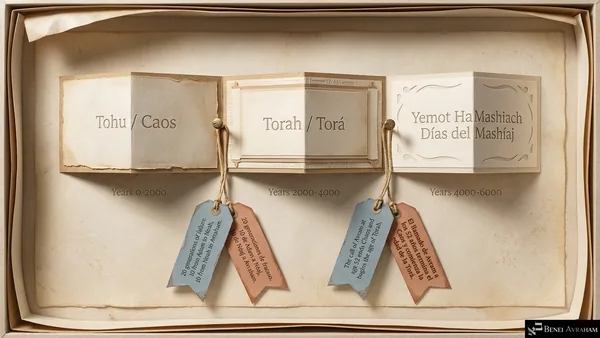
There were ten generations from Adam to Noach, to show how patient Hashem is, for all those generations kept angering Him until He brought the flood upon them. There were ten generations from Noach to Avraham, to show how patient Hashem is, for all those generations kept angering Him, until Avraham our father came and received the reward of them all. (Pirkei Avot 5:2)
Twenty generations of people who failed. Then one man who said yes.

Our sages divide history into three great ages: “The world will last six thousand years: two thousand years of tohu [chaos], two thousand years of Torah, and two thousand years of the days of Messiah” (Sanhedrin 97a). The age of Torah began in the year 2000 from creation, when Avraham was 52 and began to teach the world about the one true God (Avodah Zarah 9a). So the call of Avram ends the age of chaos and begins the age of Torah. And both of this week’s judgments, the flood (in the year 1656) and the Tower of Babel (in 1996), came in the world’s second thousand years. Rabbi Efraim Palvanov points out that this matches the second day of creation, the only day the Torah never calls “good” (Bereshit Rabbah 4:6). We’re not here to set dates. But the pattern is clear: each age ends in judgment and begins in hope.
This parashah isn’t only about the past. Yeshua said, “As it was in the days of Noah, so it will be at the coming of the Son of Man” (Matthew 24:37). And Peter says the flood is the pattern for the end of this age:
“In the last days scoffers will come… saying, ‘Where is the promise of His coming?’… But they deliberately forget that… the world of that time was flooded with water and destroyed. By the same word, the present heavens and earth are being kept for fire, reserved for the day of judgment” (2 Peter 3:3–7).
So as we walk through Noach’s story, we’ll ask the questions people ask about the end, and let the Torah answer them.
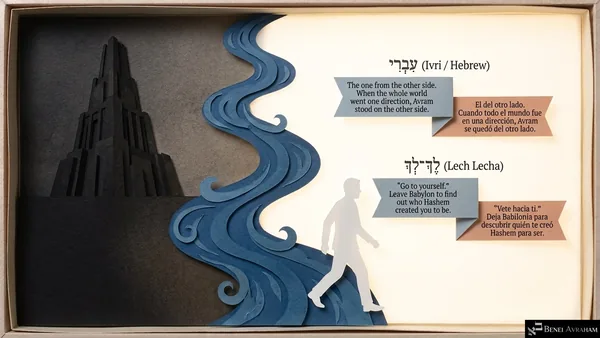
Hebrew lesson: לֶךְ־לְךָ (lech lecha), “go for yourself”
Hashem could have just said lech, “go.” Instead He said lech lecha, literally “go for yourself” or “go to yourself.” Rashi explains: “Go for your own benefit and for your own good” (Rashi on Genesis 12:1). The Chassidic teachers add: go to yourself, to the person Hashem created you to be. Sometimes we have to leave something behind to find out who we really are.
Can we know the day and the hour?

Hashem had set a limit: “his days will be one hundred and twenty years” (Genesis 6:3). Our sages read this as a countdown. Mankind had 120 years to repent. Peter calls Noach “a preacher of righteousness” (2 Peter 2:5), and he tells us why Hashem waited so long: “God waited patiently in the days of Noah while the ark was being built” (1 Peter 3:20).
People love to calculate the end. Some take those 120 years and turn them into 120 jubilees of fifty years, which adds up to 6,000 years, and then try to work out the date. But look at what actually happened. The world got 120 years of warning, but Noach was told the exact day only one week ahead: “In seven more days I will send rain on the earth” (Genesis 7:4). And right before Yeshua compared His coming to the days of Noah, He said: “About that day and hour no one knows, not even the angels of heaven” (Matthew 24:36). The 120 years aren’t a date to circle on the calendar.
Why seven more days? Rashi says those were the seven days of mourning for righteous Methuselah, Noach’s grandfather (Rashi on Genesis 7:4; Sanhedrin 108b). Even at the very end, Hashem gave the world one more week. “He is patient with you, not wanting anyone to perish, but everyone to come to repentance” (2 Peter 3:9).

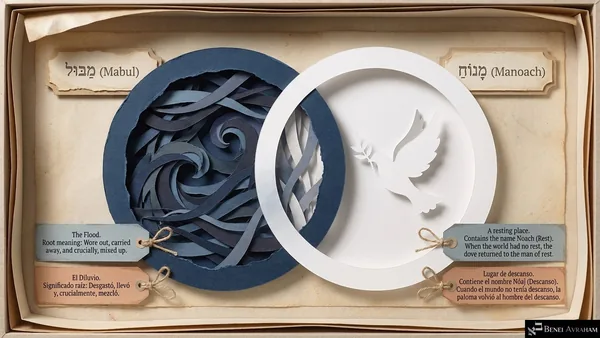
Hebrew lesson: מַבּוּל (mabul), “flood”
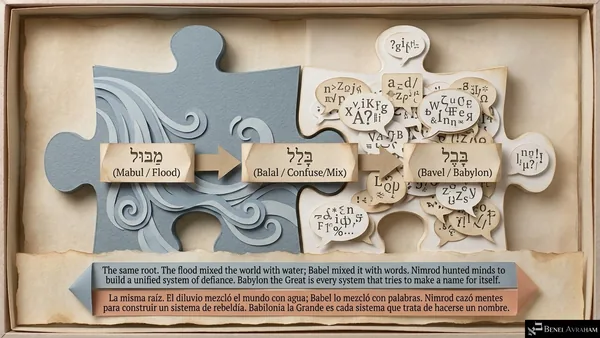
The Torah has a special word for Noach’s flood: mabul. It’s never used for any other flood. Rashi gives three explanations of the name. It wore out everything (bilah), it mixed up everything (bilbel), and it carried everything from high places down to low places (hovil) (Rashi on Genesis 6:17). Remember that middle meaning, “to mix up.” It comes back at the Tower of Babel.
An ark built from language

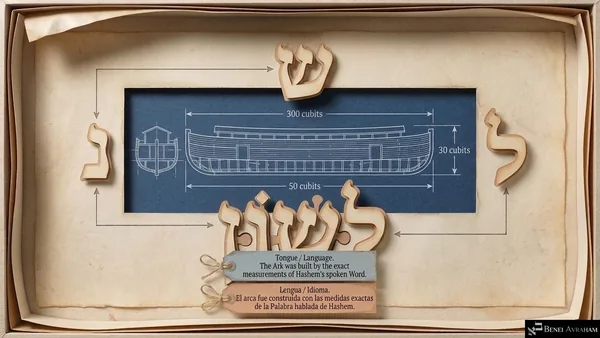
Hashem gave Noach exact measurements: “The length of the ark shall be three hundred cubits, its width fifty cubits, and its height thirty cubits” (Genesis 6:15). That’s about 450 feet long, 75 feet wide and 45 feet tall.
Rabbi Efraim Palvanov points out something beautiful. In Hebrew, every letter is also a number. The ark’s three measurements, 300, 50 and 30, are the letters shin, nun and lamed. Put them together and you get lashon, “tongue” or “language.” The ark was built by the power of Hashem’s word. Keep that in mind, because the last story in our parashah is all about language.
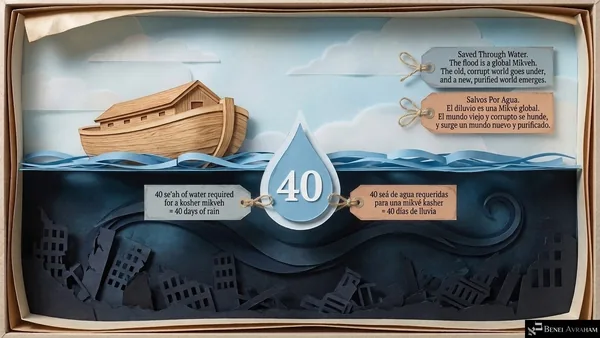
Saved through the water

Peter compares the flood to immersion: “In the ark a few people, eight in all, were saved through water. And this water is a picture of the immersion that now saves you, not by removing dirt from the body, but as the pledge of a good conscience toward God, through the resurrection of Yeshua the Messiah” (1 Peter 3:20–21).
The old world went under the water, and a new world came out. That’s what happens in a mikveh. Some teachers note that a kosher mikveh must hold forty se’ah of water, and the rain of the flood fell for forty days. The whole earth went into the mikveh.
Taken or left?

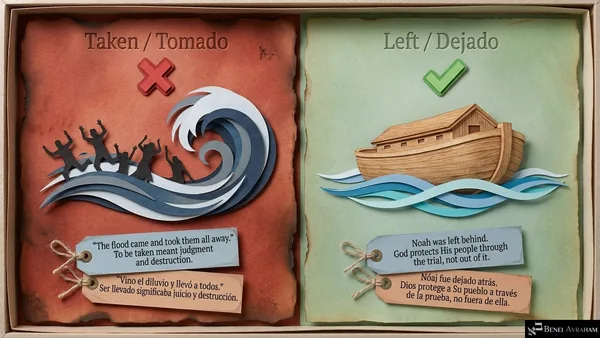
Yeshua said: “They knew nothing until the flood came and took them all away. That is how it will be at the coming of the Son of Man. Then two men will be in the field; one will be taken and the other left” (Matthew 24:39–40).
Notice who was “taken” in the days of Noah. “The flood came and took them all away.” The ones taken were swept away in judgment. Noach was the one “left,” safe in the ark. As we learned at Sukkot, you don’t want to be taken. You want to be left.
Will believers be taken out before the judgment? Many people teach that believers will be removed from the earth before the hard times begin. But Hashem didn’t take Noach off the earth. He kept him safe through the waters. The ark didn’t fly above the flood. It rode on top of it. Yeshua prayed the same way for His disciples: “I do not ask You to take them out of the world, but to keep them from the evil one” (John 17:15). Hashem’s pattern is protection in the middle of judgment.
Are we living in the days of Noah? The Torah tells us what those days looked like. “The earth was filled with violence” (Genesis 6:11). “All flesh had corrupted its way on the earth” (6:12). As we learned this morning, heavenly beings crossed the boundaries Hashem had set, and men learned secrets they were never meant to have. Violence, corruption, and people tampering with what Hashem made “according to its kind”: that sounds a lot like today.
Hebrew lesson: מָנוֹחַ (manoach), “resting place”
“But the dove found no resting place [manoach] for the sole of her foot, and she returned to him into the ark” (Genesis 8:9). Do you hear Noach’s name in manoach? Noach means “rest.” When there was no rest anywhere in the world, the dove came back to the man of rest. The second time, Noach’s dove came back with a fresh olive leaf. There was hope.
The bow in the clouds

“I have set My bow in the cloud, and it will be the sign of the covenant between Me and the earth… the waters will never again become a flood to destroy all flesh” (Genesis 9:13, 15).
Hebrew lesson: קֶשֶׁת (keshet), “bow”
In Hebrew, a rainbow is simply a keshet, a bow, the same word as a bow for shooting arrows. The Ramban explains: when warriors want to show they come in peace, they turn their bow away from the enemy. A rainbow’s curve points up toward heaven, and its ends point down. The bow is aimed away from the earth (Ramban on Genesis 9:12). Hashem is saying, “I have put down My weapon.”
But read the promise carefully: “the waters will never again become a flood.” Why say water? The Talmud tells that when the Torah was given at Sinai, the whole world shook, and the kings of the nations ran to Bilam in a panic: “Is Hashem bringing another flood?” Bilam answered: “He swore He would never bring a flood of water. But a flood of fire He may bring” (Zevachim 116a). That’s exactly what Peter says: the present world is “being kept for fire” (2 Peter 3:7). The rainbow promises no more floods of water. It doesn’t promise there will be no day of judgment.
This morning’s haftarah carried the rainbow’s promise into the end of days: “This is like the waters of Noah to Me: as I swore that the waters of Noah would never again cover the earth, so I have sworn that I will not be angry with you or rebuke you… My kindness will never depart from you, and My covenant of peace will not be shaken” (Isaiah 54:9–10). The rainbow is Hashem’s oath that He will never give up on His people.
Gog and Magog are in this week’s parashah

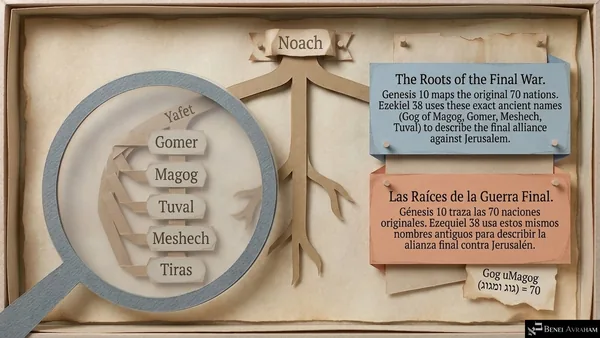
Between the rainbow and the tower, the Torah lists seventy nations that came from Noach’s sons (Genesis 10). Most people skip right over this list. But look at the sons of Yafet: “Gomer, Magog, Madai, Yavan, Tuval, Meshech and Tiras” (Genesis 10:2).
Now open Ezekiel’s vision of the great war at the end of days: “Gog, of the land of Magog, the chief prince of Meshech and Tuval… Persia, Cush and Put with them… Gomer and all his troops, Beit Togarmah from the far north” (Ezekiel 38:2–6). Almost every nation in the final war against Israel comes straight out of Noach’s family tree. The families that scattered from Babel will gather once more, this time against Jerusalem, and Hashem Himself will defeat them.
Who are they today? Josephus said Magog were the Scythians, north of the Black Sea, in today’s southern Russia and Ukraine (Antiquities 1.123). The Talmud says Gomer is Germania, and one sage says Tiras is Persia, today’s Iran (Yoma 10a). And in gematria, Gog uMagog adds up to 70, the number of the nations in Genesis 10. Next week, in Lech Lecha, we’ll see the Torah’s first picture of that war, when four kings from the north and east invade the Land and Avram goes out to fight them.
Let us make a name
Now we come to the story that leads straight to Avram.
“Now the whole earth had one language and the same words… They said to one another, ‘Come, let us build ourselves a city, and a tower with its top in the heavens, and let us make a name for ourselves, so that we will not be scattered over the face of the whole earth’” (Genesis 11:1, 4).

Hebrew lesson: שָׂפָה (safah), “lip” and “language”
The Hebrew word for “language” here is safah, literally “lip.” The whole world spoke with one lip. Rashi says it was lashon hakodesh, the holy tongue, Hebrew (Rashi on Genesis 11:1). Remember the ark’s measurements that spelled lashon? The world still had the language of creation.
Why did they build the tower? Rashi says they claimed the sky collapses every 1,656 years, as it did in the flood, so they would build supports for it (Rashi on Genesis 11:1). They weren’t building a tower to reach Hashem. They were building it to protect themselves from Hashem.
And Hashem says: “Look, they are one people, and they all have one language, and this is only the beginning of what they will do. Nothing they plan will be impossible for them” (11:6). One people, one language, unlimited power. Today the whole world is connected again, and artificial intelligence is built on “large language models.” Once again mankind is building something amazing out of language. The question is the same as at Babel: are we building it for Hashem’s name, or for our own?

Hebrew lesson: בָּבֶל (Bavel), “confusion”
“That is why it was called Bavel, because there Hashem confused [balal] the language of the whole earth” (Genesis 11:9). Remember mabul: it mixed up everything. The flood mixed up the world with water, and Babel mixed it up with words. Same root, two judgments.
Who led the building at Babel? Nimrod, “the first mighty one on the earth… a mighty hunter before Hashem. The beginning of his kingdom was Bavel” (Genesis 10:8–10). Rashi says “before Hashem” means “in defiance of Hashem.” Nimrod hunted people’s minds and led the world to rebel (Rashi on Genesis 10:9). He is the Torah’s first picture of the ruler who will appear again at the end: one man, one world system, one language, all united against Hashem.
Who is Babylon the great? Babel becomes Babylon, the empire that destroyed the first Temple. And at the end of the Bible it returns as a woman riding a beast: “Babylon the great,” “the great city that rules over the kings of the earth” (Revelation 17:5, 18). In the first century, “Babylon” was a code name for Rome (1 Peter 5:13). But the Torah shows her real nature. She is every Babel: every city and system that tries to make a name for itself. And she always falls.
When she falls, a voice from heaven calls: “Come out of her, My people, so that you will not share in her sins or receive her plagues” (Revelation 18:4; see Jeremiah 51:45). Do you hear it? That’s lech lecha. The Midrash says Nimrod threw Avram into a fire in Ur of the Chaldeans, in the land of Babylon, because he wouldn’t bow to idols, and Avram came out unharmed (Bereshit Rabbah 38:13). Then Hashem said to him: Go. Get out of Babylon.
Shem, Ever and Avram
The world was scattered, and the holy tongue was lost to the nations. But not everyone was lost.
Hebrew lesson: שֵׁם (Shem), “name”
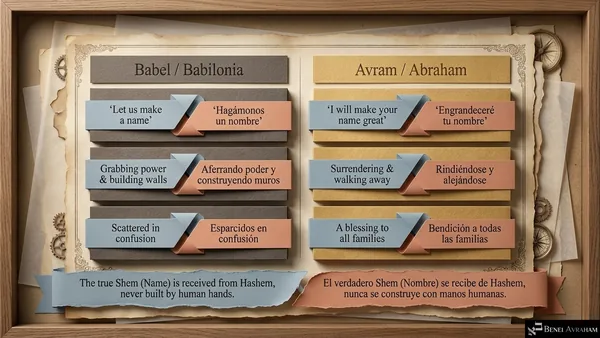
Noach’s oldest son was named Shem, which means “name.” The builders of Babel wanted to make a shem for themselves. The real Shem didn’t need a tower. And Hashem Himself is called HaShem, “The Name.” The Torah counts the generations from Shem, through Ever, down to Avram (Genesis 11:10–26).
If you add up the years in the Torah, Noach lived until Avram was 58, and Shem lived even longer. Our sages say Shem is Melchizedek, the priest-king of Shalem who blessed Avram with bread and wine (Nedarim 32b; Rashi on Genesis 14:18).

Hebrew lesson: עִבְרִי (Ivri), “Hebrew”
The first person in the Torah called a Hebrew is Avram: “Avram the Ivri” (Genesis 14:13). Rashi says he came from the other side (ever) of the river. The Midrash says: “The whole world was on one side, and he was on the other side” (Bereshit Rabbah 42:8). After Babel, the whole world went one direction, and one man stood on the other side, with Hashem. That’s why our holy language is called Ivrit: the language of the ones who crossed over.
A name that lasts

Now go back to the verse we read at Minchah. Do you hear it differently?
The builders of Babel said: “Let us make a name for ourselves.” Hashem said to Avram: “I will make your name great.”
At Babel, men tried to grab a name for themselves, and they were scattered. In Lech Lecha, one man gave up his land, his birthplace and his father’s house, and Hashem gave him a name that has lasted four thousand years. At Babel, the nations were scattered over the earth. Through Avram, “all the families of the earth will be blessed.”

And the story isn’t over. Zephaniah promised that Hashem will undo Babel: “Then I will give the peoples a pure language, so that all of them may call on the name of Hashem and serve Him shoulder to shoulder” (Zephaniah 3:9). On Shavuot in Jerusalem, the disciples of Yeshua began to speak, and people from every nation heard them “each in his own language” (Acts 2:6). At Babel, one language became many, and no one understood. At Shavuot, many languages heard one message, and everyone understood.

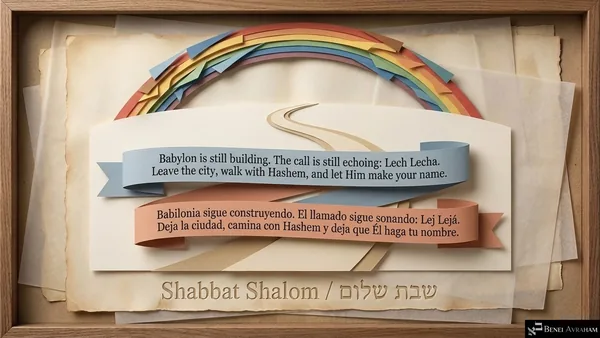
Babylon is still building its towers. But the call still goes out: Lech lecha. Leave behind the city that wants to make a name for itself. Walk with Hashem, and let Him make your name.
“We are waiting for new heavens and a new earth, where righteousness dwells. So, beloved, since you are waiting for these things, be eager to be found by Him without spot or blemish, and at peace” (2 Peter 3:13–14).
Shabbat shalom.
Bible verses are in modern English, with Hashem for the Divine Name (LORD). Jewish sources are given in short translation or paraphrase. A shiur for after Minchah, Shabbat Noach 5787 (October 17, 2026).