
Between the Pieces
Can We Know the End, and Can We Hasten It?
Avram is the only person in the Torah given a dated prophecy of exile and redemption: “four hundred years.” The numbers still did not add up, and the sages found that Hashem brought Israel out early. A shiur on Genesis 15: the stars, the covenant between the pieces, the 400 and 430 years, the Ephraimites who calculated the end, Rabbi Eliezer and Rabbi Yehoshua, and “I will hasten it in its time.” A short quiz follows.



At the appointed time
At Minchah we just read the first aliyah of next week’s parashah. Avraham is ninety-nine years old, three days after his circumcision, sitting at the door of his tent in the heat of the day, when three visitors arrive. One of them says: “I will surely return to you at this time next year, and behold, Sarah your wife will have a son” (Genesis 18:10). Sarah, listening at the tent door, laughs. And Hashem answers: “Is anything too wonderful for Hashem? At the appointed time I will return to you, at this season, and Sarah will have a son” (Genesis 18:14).

Hebrew lesson: לַמּוֹעֵד (la-moed), “at the appointed time”
Moed is the Torah’s word for Hashem’s festivals: “These are the appointed times of Hashem (moadei Hashem), holy convocations, which you shall proclaim at their appointed time” (Leviticus 23:4). A moed is a time Hashem has fixed. Twenty-five years after lech lecha, the promise of a son finally gets a date. But notice when Avraham hears it: one year before, not twenty-five years before. Hashem had an appointed time all along. He did not announce it until it was almost here.
That is the question for this afternoon. Does the end have an appointed time? Can we know it? And can we do anything to bring it closer?
To answer, we go back to where we left Avram this morning: the night after the war, lying awake, and Hashem speaking to him in a vision:
“Fear not, Avram. I am your shield. Your reward is very great” (Genesis 15:1).
We stay in that one chapter, Genesis 15, because it is the chapter where Avram asks the question everyone asks about the end: how long? And it is the only place in the Torah where Hashem answers that question with a number.
Our haftarah this morning came from the chapter right after Isaiah 40, and Isaiah 40 ends with the same promise Hashem made to Avram: “Behold, Hashem God comes with might… Behold, His reward is with Him” (Isaiah 40:10). When Hashem comes, He brings the reward with Him. Avram did not have to go and collect it. Neither do we.
Go out of your astrology

Avram answers Hashem’s promise with a complaint. “Hashem God, what will You give me, since I go childless?” (15:2). What good is a great reward with no one to inherit it?
“He took him outside and said, ‘Look now toward the heavens and count the stars, if you are able to count them.’ And He said to him, ‘So shall your seed be’” (Genesis 15:5).
Hebrew lesson: הַחוּצָה (ha-chutzah), “outside”
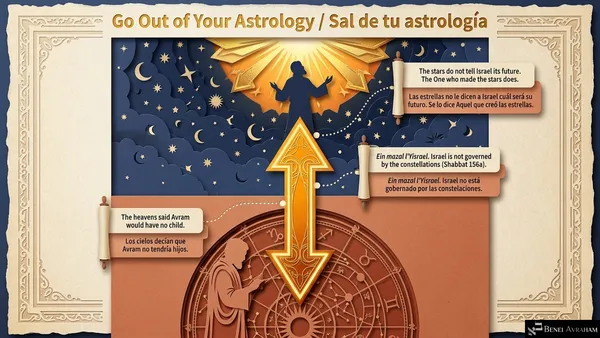
The Torah says Hashem took Avram “outside.” Outside of what? He was already standing under the open sky in a vision. Rashi, following the Talmud, gives a deeper reading: “Go out of your astrology. You have seen in the stars that you will not have a son. Avram will have no son, but Avraham will have a son” (Rashi on Genesis 15:5; Shabbat 156a). Avram came from Ur of the Chaldeans, the land of the star-gazers. He had read his own fate in the heavens, and the heavens said: no child. Hashem took him above the stars and said: you are not ruled by them. From this verse Rabbi Yochanan derives the principle ein mazal l’Yisrael, Israel is not governed by the constellations (Shabbat 156a).
This is worth saying clearly, because in every generation, including ours, people read the end of days in the stars, in comets, in eclipses, in the signs of the zodiac. Hashem showed Avram the stars to make a promise, not to read a forecast. The stars do not tell Israel its future. The One who made the stars does.
Count the stars. Can you? Isaiah, in the verse just before this morning’s haftarah, says Hashem can: “Lift up your eyes on high and see who created these. He brings out their host by number; He calls them all by name. By the greatness of His might and the strength of His power, not one is missing” (Isaiah 40:26). So shall your seed be: counted, every one called by name, not one missing.
But there is a second meaning, and it is the one that matters most. Today the Jewish people are about fifteen million, two tenths of one percent of the world. Hardly uncountable. Where are all of Avraham’s children? Daniel tells us: “Many of those who sleep in the dust of the earth will awake, some to everlasting life… and those who lead many to righteousness will shine like the stars forever and ever” (Daniel 12:2–3). The promise of the stars is kept in the resurrection, when every sleeping child of Avraham wakes and shines. Yeshua said it this way: “Then the righteous will shine like the sun in the kingdom of their Father” (Matthew 13:43).
He believed
“He believed in Hashem, and He counted it to him as righteousness” (Genesis 15:6).
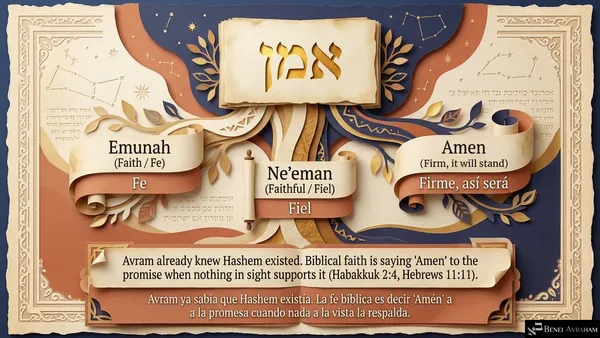
This is one of the most important verses in the Torah, and we should be careful about what it says. Avram already knew that Hashem existed. He had left Ur for Him, built altars to Him, and just fought a war in His name. What did he believe now? He believed that Hashem would do what He had just promised: give a childless old man a son and make him into the stars of heaven. He believed the promise when nothing he could see supported it.

Hebrew lesson: וְהֶאֱמִן (ve-he’emin), “and he believed”
The root is aleph-mem-nun, the same root as emunah, faith, ne’eman, faithful, and amen. To say amen is to say, “that is firm, that will stand.” Avram said amen to Hashem’s promise. That is what biblical faith is: not an opinion that God exists, but trust that the One who promised will keep His word. The letter to the Hebrews describes it exactly: “He considered Him faithful who had promised” (Hebrews 11:11).
The Talmud says that the prophet Habakkuk took all six hundred and thirteen commandments and stood them on this one principle: “the righteous shall live by his faith” (Habakkuk 2:4; Makkot 24a). Paul built his whole teaching on our verse (Romans 4:3; Galatians 3:6). Jew and Gentile alike are counted righteous the way Avram was: by trusting the promise of the God of Israel.
Between the pieces
Now Avram asks a second question. Hashem has promised him the land, and Avram says, “How shall I know that I will possess it?” (15:8). The answer is a covenant ceremony unlike any other in the Bible.
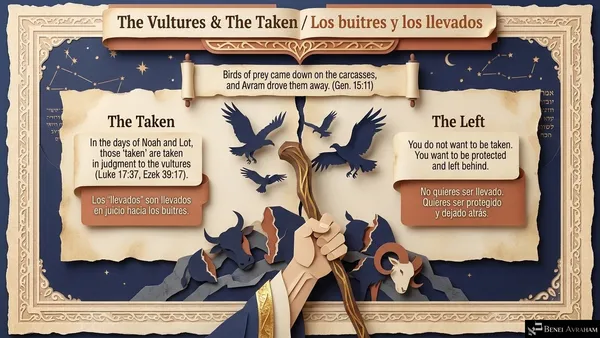
“Bring Me a three-year-old heifer, a three-year-old she-goat, a three-year-old ram, a turtledove and a young pigeon.” He brought all these, cut them in half, and laid each half opposite the other, but he did not cut the birds. Birds of prey came down on the carcasses, and Avram drove them away (Genesis 15:9–11).
In the ancient world, two parties made a covenant by walking together between the pieces of a slaughtered animal. The meaning was: may this happen to me if I break my word. But look who walks here:
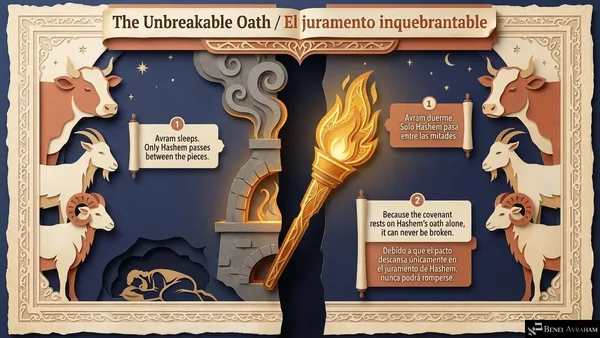
“As the sun was going down, a deep sleep fell on Avram, and behold, a dread, a great darkness, fell on him… When the sun had set and it was dark, behold, a smoking furnace and a flaming torch passed between these pieces. On that day Hashem made a covenant with Avram” (Genesis 15:12, 17–18).

Avram is asleep. Only Hashem passes between the pieces. This covenant rests on Hashem’s oath alone, not on Avram’s performance. That is why it can never be broken. Everything we said this morning about the land as “an everlasting possession” rests on this: Hashem bound Himself.
The sages read the whole scene as a vision of the exile that was coming. The heifer, the goat and the ram are the kingdoms that would rule over Israel: Babylon, Media and Greece (Bereshit Rabbah 44:15). And why did Avram not cut the birds? Rashi explains: the nations are compared to bulls, rams and goats, but Israel is compared to a dove. He divided the animals to show that the kingdoms would pass away, and he left the bird whole to show that Israel will endure forever (Rashi on Genesis 15:10). And the four words that describe what fell on Avram, eimah (dread), chashechah (darkness), gedolah (great) and nofelet (falling), are the four kingdoms: dread is Babylon, darkness is Media, great is Greece, and falling is Edom, the fourth kingdom, which falls on Israel and will itself fall (Bereshit Rabbah 44:17). The same four kingdoms Avram fought this morning as four kings, he now sees as a darkness falling on his children.

And the birds of prey. “Birds of prey came down on the carcasses, and Avram drove them away.” Where else do we meet vultures over carcasses? When Yeshua described the coming of the Son of Man, He said, “One will be taken and the other left,” and the disciples asked, “Where, Master?” He answered: “Where the body is, there the vultures will gather” (Luke 17:34–37). The ones taken are taken to the vultures. Ezekiel saw it at the end of the war of Gog: “Speak to the birds of every kind… gather for the great sacrifice… you shall eat the flesh of the mighty and drink the blood of the princes of the earth” (Ezekiel 39:17–18). As we said at Sukkot: you do not want to be taken. You want to be left. Avram, standing over the pieces of the covenant, drove the vultures away from his children.
Four hundred years
Now comes the number. Hashem tells Avram what the darkness means:
“Know for certain that your seed will be strangers in a land that is not theirs, and they will serve them, and they will afflict them four hundred years. But I will also judge the nation they serve, and afterward they will come out with great possessions… And in the fourth generation they will return here, for the iniquity of the Amorite is not yet complete” (Genesis 15:13–14, 16).
Avram is told the end. Four hundred years. He is the only person in the Torah given a date. So let’s see what happened to it, because it teaches us everything about dates.
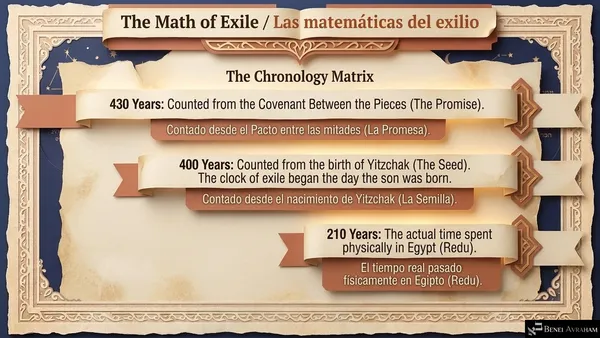
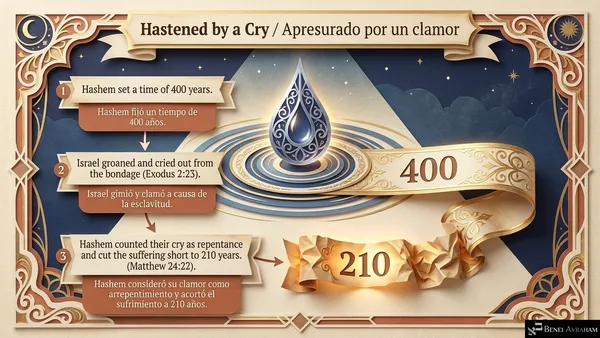
When Israel finally left Egypt, the Torah says: “The dwelling of the children of Israel, who dwelt in Egypt, was four hundred and thirty years. And at the end of four hundred and thirty years, on that very day, all the hosts of Hashem went out from the land of Egypt” (Exodus 12:40–41). Four hundred years promised; four hundred and thirty counted. And then the Torah gives us the family tree, and it does not fit either number. Kehat, Levi’s son, went down to Egypt with Yaakov (Genesis 46:11). Kehat lived 133 years. His son Amram lived 137. Amram’s son Moshe was 80 at the Exodus (Exodus 6:18, 20; 7:7). Even if none of their lives overlapped, that is at most 350 years. Allowing for the fact that fathers are alive when sons are born, our sages concluded that Israel was in Egypt for 210 years. Yaakov hinted at it when he sent his sons down: redu, “go down” (Genesis 42:2), and the letters of redu add up to 210 (Rashi on Genesis 42:2).

So which is it: 400, 430 or 210? Rashi lays it out (Rashi on Genesis 15:13 and Exodus 12:40):
- 430 years from the covenant between the pieces, when Avraham was 70, to the Exodus.
- 400 years from the birth of Yitzchak, “your seed,” to the Exodus. The moment the promised son was born, the clock of exile began. He was a stranger in a land not his own from his first day.
- 210 years actually spent in Egypt.
The 430 years in Exodus 12:40 count not the years in Egypt but the years of “sojourning,” of being strangers, from the day Hashem made the promise. The ancient Greek translation of the Torah even reads the verse that way, “in the land of Egypt and in the land of Canaan,” and the Talmud lists this among the changes the sages made for King Ptolemy so that he would not misread it (Megillah 9a). And Paul counts the same way: “The Torah, which came four hundred and thirty years after the promise, does not annul a covenant previously ratified by God” (Galatians 3:17). Paul counts from the promise to Sinai, exactly as the sages do. When the Brit Hadashah does chronology, it does it the Jewish way.
Now look at the end of Hashem’s answer. “In the fourth generation they will return here, for the iniquity of the Amorite is not yet complete.” Why wait? Because Hashem does not judge a nation until its measure is full. The Canaanites were given four hundred more years to repent. The delay was not Hashem forgetting His promise. The delay was mercy toward the Amorites. Peter says the same about the end of this age: “The Lord is not slow about His promise, as some count slowness, but is patient toward you, not wanting any to perish” (2 Peter 3:9).

The men who calculated the end
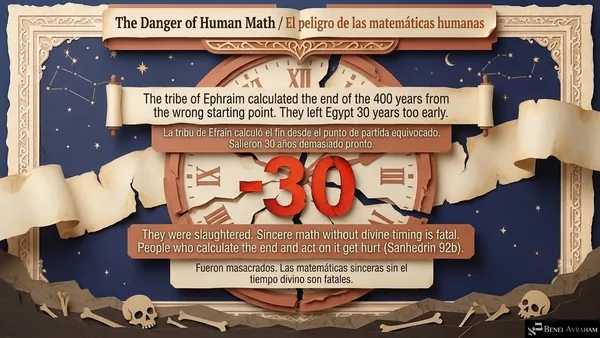
What happens when people take a number like this and act on it? The Talmud tells us. Rav says that the tribe of Ephraim calculated the time of the end and got it wrong. They left Egypt before the appointed time and were slaughtered by the men of Gath (Sanhedrin 92b; 1 Chronicles 7:20–22). The Targum tells us how early: thirty years before the appointed end (Targum Yonatan on Exodus 13:17). Thirty years is exactly the gap between the two ways of counting we just saw. They counted the four hundred years from the covenant between the pieces instead of from the birth of Yitzchak. And Rav says their bones lay in the valley for centuries, until Ezekiel was shown the valley of dry bones and they lived again (Ezekiel 37).
Think about that. They had a real prophecy, with a real number, from the mouth of Hashem Himself. They did the math sincerely. They were thirty years off, and it killed them. And only Hashem could bring them back. People who calculate the end and act on their calculations get hurt. It has happened in every generation since, and the pattern never changes: the date passes, the explanation shifts, a new date appears.
Repentance or an appointed time?

So if even Avram’s number could not simply be counted, what can we know about the end? After the destruction of the Temple, two of the greatest sages argued about exactly this. Both were students of Rabban Yochanan ben Zakkai, the two who carried him out of the besieged city in a coffin so that he could speak to the Romans.
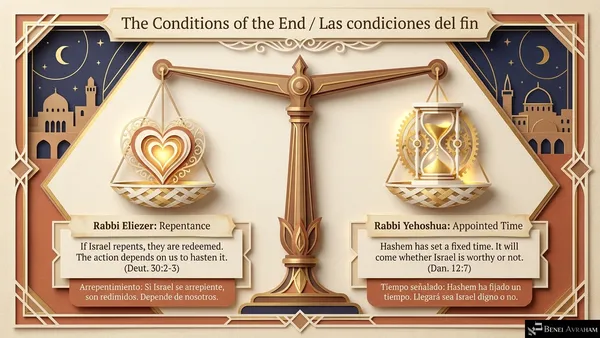
Rabbi Eliezer says: If Israel repents, they are redeemed, and if not, they are not redeemed. Rabbi Yehoshua said to him: If they do not repent, they are not redeemed? Rather, the Holy One, blessed be He, will raise up over them a king whose decrees are as harsh as Haman’s, and Israel will repent, and He will return them to the good. (Sanhedrin 97b)
Rabbi Eliezer says the redemption depends on us. He has the Torah on his side: “You will return to Hashem your God and obey His voice… then Hashem your God will restore your captivity and have compassion on you, and will gather you again from all the peoples” (Deuteronomy 30:2–3). Rabbi Yehoshua says Hashem has set a time, and it will come whether Israel is worthy or not. He has the prophets on his side: “You were sold for nothing, and you will be redeemed without money” (Isaiah 52:3), and Daniel’s oath that the end will come after “a time, times and half a time” (Daniel 12:7). The Talmud says that at this last proof, Rabbi Eliezer fell silent (Sanhedrin 98a).

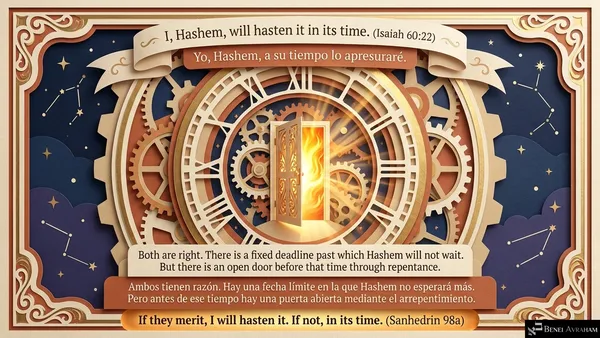
Which one is right? The Talmud answers with a verse that seems to contradict itself. Isaiah says of the redemption: “I, Hashem, will hasten it in its time” (Isaiah 60:22). If it has a set time, how can it be hastened? And if it can be hastened, what is the set time for?
Rabbi Alexandri said: Rabbi Yehoshua ben Levi pointed out a contradiction. It is written “in its time,” and it is written “I will hasten it.” If they merit, I will hasten it. If they do not merit, in its time. (Sanhedrin 98a)
Both rabbis are right. There is an appointed time, the deadline past which Hashem will not wait, whether or not we deserve it. And there is a door open before that time, through repentance. Hashem would rather come early.
Yeshua taught both sides too. On the one hand, His whole message was “Repent, for the kingdom of heaven is at hand” (Matthew 4:17), a call to bring the redemption near. On the other hand, when His disciples asked, “Master, is it at this time that You are restoring the kingdom to Israel?”, He answered: “It is not for you to know times or seasons which the Father has fixed by His own authority” (Acts 1:6–7). There is a fixed time. The Father has set it. And it is not ours to know: “Of that day and hour no one knows, not even the angels of heaven, nor the Son, but the Father alone” (Matthew 24:36).
The sages said the same about the hiddenness of the day. Isaiah says: “The day of vengeance is in My heart, and the year of My redemption has come” (Isaiah 63:4). The Talmud comments: “To My heart I have revealed it; to My limbs I have not revealed it” (Sanhedrin 99a). Not even the angels, Hashem’s “limbs,” know the day. It is in His heart alone. That is why, a page earlier, the Talmud says: “May the bones of those who calculate the end rot” (Sanhedrin 97b). Not because the end is not coming, but because the calculators, when their date passes, say the end is not coming at all.

How the Exodus was hastened
Go back to Avram’s four hundred years one more time. Hashem had set a time. And yet when the moment came, He did not wait for the four hundred years in Egypt. “The children of Israel groaned because of the bondage and cried out, and their cry for help went up to God. God heard their groaning, and God remembered His covenant with Avraham, with Yitzchak and with Yaakov” (Exodus 2:23–24). They cried out, and Hashem counted their cry as the beginning of repentance, and He hastened the day. The number was kept, counted from the promise. The suffering was cut short. Yeshua said the same will happen at the end: “Unless those days had been cut short, no flesh would be saved. But for the sake of the elect those days will be cut short” (Matthew 24:22).
So how do we hasten the day? Not with a calendar. Peter tells us: “What sort of people ought you to be in holy conduct and godliness, looking for and hastening the coming of the day of God” (2 Peter 3:11–12). Repentance, good deeds, Torah, kindness: every one of them tips the scale. Rabbi Yehoshua ben Levi once asked the Messiah himself when he would come, and the Messiah answered, “Today.” When the day passed, Eliyahu explained: “Today, if you will hear His voice” (Sanhedrin 98a; Psalm 95:7). The door is open every day.
And if the day tarries? Habakkuk answers: “The vision is yet for the appointed time… though it tarries, wait for it, for it will surely come, it will not delay” (Habakkuk 2:3). From this verse the Rambam wrote the words we sing: Ani ma’amin, I believe with complete faith in the coming of the Messiah, and though he may tarry, I wait for him every day.
The end is a birth

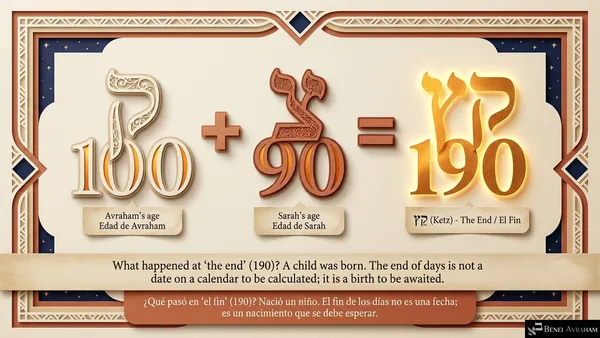
Before we close, one small thing from the end of the parashah. When Hashem finally tells Avraham that Sarah will have a son, Avraham laughs: “Shall a child be born to a man a hundred years old? Shall Sarah, who is ninety, give birth?” (Genesis 17:17). And at Minchah we heard Sarah laugh at the same news (Genesis 18:12). One hundred and ninety. In Hebrew letters, one hundred is kuf and ninety is tzadi. Put them together and they spell קֵץ, ketz, “the end.”
What happened at “the end”? A child was born. In the Torah, the end is not a date on a calendar. It is a birth: the birth of the promised son, against every calculation, long after the stars had said it was impossible. The sages call the birth pangs before the Messiah chevlei Mashiach, and the prophets call the final redemption a birth (Isaiah 66:7–8). The end is not something that happens to us. It is something that is born.
One more. Lech lecha, the two words that open our parashah, add up to one hundred. Avraham was seventy-five when he was told to go. He was one hundred when the son was born. The whole journey of the parashah, from “go” to “a son,” is inside those two words.
Those who wait

This morning’s haftarah opened with Israel’s complaint in exile: “Why do you say, O Yaakov, and speak, O Israel, ‘My way is hidden from Hashem, and my judgment is passed over by my God’?” (Isaiah 40:27). That is the question under all the other questions. Not “when?”, but “has He forgotten?”
Isaiah answers: “Have you not known? Have you not heard? The everlasting God, Hashem, the Creator of the ends of the earth, does not grow faint or weary; His understanding is unsearchable… Those who wait for Hashem will renew their strength. They will mount up with wings like eagles. They will run and not grow weary. They will walk and not faint” (Isaiah 40:28, 31).
Avraham waited twenty-five years from lech lecha to the birth of Yitzchak. He waited the rest of his life for the land, and “died in faith, not having received the promises, but having seen them and greeted them from afar” (Hebrews 11:13). He did not calculate. He did not give up. He walked. “Walk before Me and be whole” (Genesis 17:1). And when the appointed time came, it came exactly as promised: “Hashem visited Sarah as He had said… at the appointed time (la-moed) of which God had spoken” (Genesis 21:1–2).
That is what Hashem asks of us. Not to know the day. Not to count it. To wait for Him the way Avraham waited: trusting the promise, hastening the day with holiness, and walking before Him until He comes, with His reward with Him.
Shabbat shalom.
A short quiz follows.
Quiz: test yourself
Sixteen questions on what we just learned. Every one can be answered from memory; the choices are there to help, and one of them in each question is a joke. Tap a choice to check your answer.
Question 1 of 16
After the war of the kings, Hashem tells Avram, “Fear not.” What does He say He is to Avram?
Show the answer
Answer: B. “Fear not, Avram, I am your shield; your reward is very great” (Genesis 15:1). The haftarah’s own chapter answers: “Behold, his reward is with him” (Isaiah 40:10).
Question 2 of 16
“He took him outside” (Genesis 15:5). According to Rashi, what did Hashem really mean?
Show the answer
Answer: A. The stars said Avram would never have a son. Hashem lifted him above the stars: ein mazal l’Yisrael, Israel is not ruled by the stars (Rashi; Shabbat 156a–b). He showed Avram the stars to make a promise, not to read a forecast.
Question 3 of 16
Isaiah 40:26, the verse just before the haftarah, says Hashem counts the stars and does what?
Show the answer
Answer: B. “He brings out their host by number; He calls them all by name… not one is missing.” So shall your seed be: counted, named, and not one lost.
Question 4 of 16
Daniel says those who lead many to righteousness will shine like what?
Show the answer
Answer: C. “Many of those who sleep in the dust of the earth will awake… and those who lead many to righteousness will shine like the stars forever and ever” (Daniel 12:2–3). The promise of the stars is finally kept in the resurrection.
Question 5 of 16
“He believed in Hashem, and He counted it to him as righteousness” (Genesis 15:6). Avram already knew Hashem existed. So what did he believe?
Show the answer
Answer: B. Avram already knew Hashem existed. He trusted that Hashem would do what He promised, when nothing in sight said He could (Hebrews 11:8–12; Romans 4). The sages condense the whole Torah into one verse: “the righteous shall live by his faith” (Habakkuk 2:4; Makkot 24a).
Question 6 of 16
“Dread, darkness, great, falling on him” (Genesis 15:12). In the midrash, what do these four words stand for?
Show the answer
Answer: C. Dread is Babylon, darkness is Media, great is Greece, and falling is Edom (Bereshit Rabbah 44:17). The same four kingdoms invaded in the war of the kings this morning, and Daniel sees them as four beasts.
Question 7 of 16
“Birds of prey came down on the carcasses, and Avram drove them away” (Genesis 15:11). When Yeshua’s disciples ask where those “taken” will go, what does he answer?
Show the answer
Answer: D. “Where the body is, there the vultures will gather” (Luke 17:37). The ones “taken” in the days of Noah and Lot are taken in judgment (Ezekiel 39:17–20; Revelation 19:17–21). You want to be left.
Question 8 of 16
Who passed between the pieces of the covenant?
Show the answer
Answer: B. “A deep sleep fell on Avram… a smoking furnace and a torch of fire passed between these pieces” (Genesis 15:12, 17). The covenant rests on Hashem’s oath alone.
Question 9 of 16
Hashem told Avram “400 years,” and Exodus says “430 years.” How long were the children of Israel actually in Egypt, according to the sages?
Show the answer
Answer: B. Kehat came down with Jacob (Genesis 46:11). Kehat lived 133 years, Amram 137, and Moshe was 80 at the Exodus, so 430 years in Egypt is impossible. Redu (“go down,” Genesis 42:2) = 210.
Question 10 of 16
According to Rashi, from when are the 400 years counted?
Show the answer
Answer: A. The 400 years run from the birth of Isaac, “your seed,” and the 430 years from the covenant between the pieces (Rashi on Genesis 15:13 and Exodus 12:40). So the exile began with the birth of the promised son.
Question 11 of 16
Which apostle counts the 430 years from the promise to Avraham, and not from the descent to Egypt?
Show the answer
Answer: C. “The Law, which came 430 years after, does not annul a covenant previously ratified by God” (Galatians 3:17). The Septuagint and the Talmud (Megillah 9a, “in Egypt and in other lands”) read the verse the same way.
Question 12 of 16
Some Ephraimites counted the 400 years from the wrong starting point. What happened to them?
Show the answer
Answer: D. Their bones were the dry bones that Ezekiel saw come to life (Sanhedrin 92b; 1 Chronicles 7:20–22; Targum Yonatan on Exodus 13:17). When we calculate the end and act on it, people get hurt, and only Hashem can bring them back.
Question 13 of 16
Rabbi Eliezer and Rabbi Yehoshua argued about the redemption. What did Rabbi Eliezer say it depends on?
Show the answer
Answer: A. “If Israel repents, they are redeemed; if not, they are not redeemed” (Sanhedrin 97b). Rabbi Yehoshua answered that Hashem has set a time, and the redemption will come whether or not Israel is worthy.
Question 14 of 16
“I, Hashem, will hasten it in its time” (Isaiah 60:22). How does the Talmud make both halves true?
Show the answer
Answer: B. “If they merit, I will hasten it. If not, in its time” (Sanhedrin 98a). Peter says we hasten the day of God by “holy conduct and godliness” (2 Peter 3:11–12): repentance and good deeds, not arithmetic.
Question 15 of 16
At Minchah we read: “At the appointed time (la-moed) I will return to you, and Sarah will have a son.” What else does the Torah call a moed?
Show the answer
Answer: A. “These are the appointed times of Hashem (moadei Hashem)” (Leviticus 23:4). A moed is a time Hashem has fixed. Avraham waited twenty-five years for the promise, and Hashem told him the date only one year before it came.
Question 16 of 16
Avraham was 100 and Sarah was 90 when Isaac was promised. In Hebrew letters, 100 + 90 spells what word?
Show the answer
Answer: B. Kuf (100) and tzadi (90) spell קץ, ketz. And what happened at “the end”? A child was born. In the Torah, the end is a birth, not a date. “The day of vengeance is in My heart” (Isaiah 63:4): “to My heart I revealed it; to My limbs I did not” (Sanhedrin 99a).
Bible verses are in modern English, with Hashem for the Divine Name (LORD). Jewish sources are given in short translation or paraphrase. A shiur for after Minchah, Shabbat Lech Lecha 5787 (October 24, 2026).