
A Time to Weep, a Time to Dance
Kohelet, Eicha and the End of Days
Moshe has died, the scroll is rolling back to Bereshit, and today we open Kohelet, the book that calls everything under the sun a passing breath. So what lasts? This shiur walks through Kohelet and Eicha: tears with no comforter, nothing new under the sun, dust and spirit, and the coming judgment. It ends in the heart, lev, hidden between the Torah's last letter and its first.






Between the end and the beginning
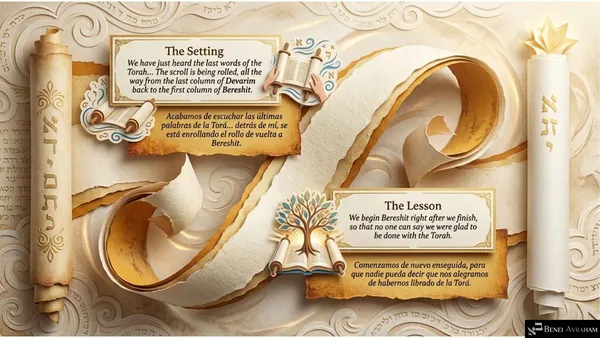
We have just heard the last words of the Torah. Moshe has gone up the mountain, Hashem has shown him the land, and he has died. The five books are finished.
And right now, behind me, the scroll is being rolled back to Bereshit. We begin again right away, so that no one can say we were glad to be done with the Torah. We are not done.
There is no better book for this moment than Kohelet.
The book of this Shabbat
Kohelet, Ecclesiastes, is read on the Shabbat of Sukkot, and this year that Shabbat is today. We will not read it aloud, so let us study it instead. This little book asks almost every question we have asked about the end of days.
“The words of the Preacher, the son of David, king in Jerusalem. Vanity of vanities, saith the Preacher, vanity of vanities; all is vanity” (Ecclesiastes 1:1–2).

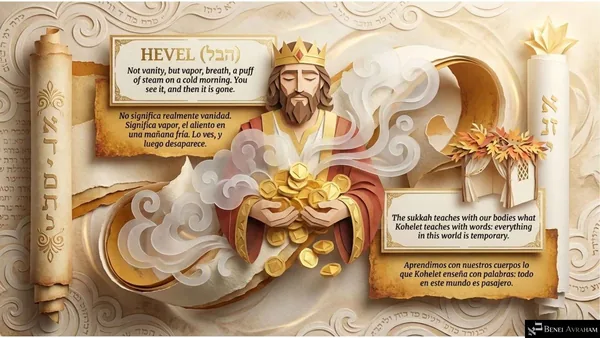
Tradition says these are the words of King Shlomo, the king who received “six hundred threescore and six talents of gold” in one year (1 Kings 10:14). He had everything, and at the end he wrote one word over all of it: hevel.
Hevel does not really mean “vanity.” It means vapor, a breath on a cold morning. You see it, and then it is gone. That is why Kohelet belongs to Sukkot. For seven days we lived in a hut with leaves for a roof, and learned with our bodies what Kohelet teaches with words: everything in this world is temporary.
So today, on the eighth day, we ask: what lasts?

A time to weep, a time to dance
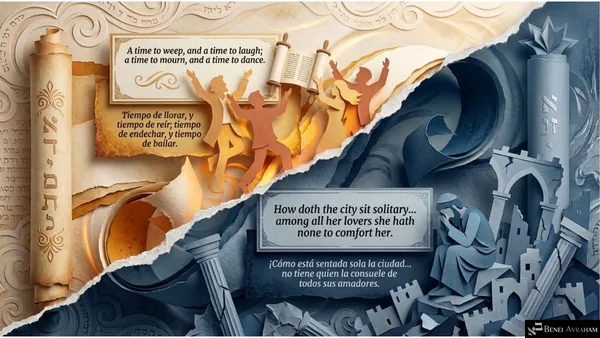
“To every thing there is a season, and a time to every purpose under the heaven… A time to weep, and a time to laugh; a time to mourn, and a time to dance” (Ecclesiastes 3:1, 4).
This morning we danced with the Torah. But Kohelet also says, “It is better to go to the house of mourning, than to go to the house of feasting” (Ecclesiastes 7:2). So even on our happiest day, let us visit the house of mourning for a moment. Let us open Eicha.
“How doth the city sit solitary, that was full of people!… among all her lovers she hath none to comfort her” (Lamentations 1:1–2). And Jeremiah tells us what was lost: “He hath violently taken away his tabernacle [sukko]… Hashem hath caused the solemn feasts and sabbaths to be forgotten in Zion” (Lamentations 2:6).
Hashem’s sukkah torn down. The festivals and Sabbaths forgotten. Today is a sukkah day, a festival and a Shabbat all at once. Everything Eicha mourns, we are holding in our hands. And Rashi tells us what the King says on this eighth day: “My sons, please, stay with me one more day. Your parting is hard for me” (Rashi on Leviticus 23:36). Eicha is the sound of the parting. Shemini Atzeret is the Father saying, “Stay.”
Now listen to Kohelet: “Behold the tears of such as were oppressed, and they had no comforter” (Ecclesiastes 4:1). Ein lahem menachem, “they had no comforter.” It is the same cry as Eicha: ein lah menachem, “none to comfort her.” The sages heard a name in that word:
What is the name of the Messiah?… Some say: Menachem is his name, as it is said: “Because the comforter [menachem] that should relieve my soul is far from me.” (Sanhedrin 98b, on Lamentations 1:16)
Kohelet saw tears with no comforter. Eicha cried for a comforter who was far away. Revelation shows us the end of the story: “And God shall wipe away all tears from their eyes; and there shall be no more death, neither sorrow, nor crying” (Revelation 21:4).

Under the sun
Twenty-nine times Kohelet says “under the sun.” It is his name for this world, where everything rises and sets and passes away: “What profit hath a man of all his labour which he taketh under the sun?” (Ecclesiastes 1:3).
The sages answered:
Under the sun he has no profit. But before the sun, he has. (Shabbat 30b)
What came before the sun? The Torah. Labor under the sun passes like vapor. Torah lasts forever.
Now look at how the Bible ends. The new Jerusalem “had no need of the sun… for the glory of God did lighten it” (Revelation 21:23). Isaiah saw it too: “Hashem shall be unto thee an everlasting light… and the days of thy mourning shall be ended” (Isaiah 60:19–20). Kohelet describes life under the sun. The World to Come is the world beyond the sun, and there the days of mourning end. That is the answer to Eicha.

Nothing new under the sun?
“The thing that hath been, it is that which shall be… and there is no new thing under the sun” (Ecclesiastes 1:9).
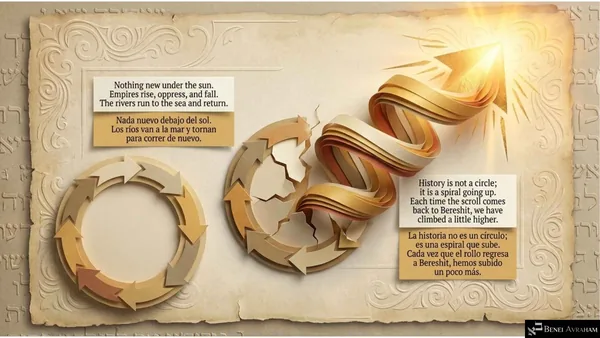
This is a key to prophecy: it comes true once, then echoes again, from Antiochus to Rome to the end. Kohelet paints the circle with the sun and the rivers: “All the rivers run into the sea; yet the sea is not full; unto the place from whence the rivers come, thither they return again” (Ecclesiastes 1:7).
Look at the scroll. It, too, is returning to where it began. But this is not an empty circle. We are not the same people we were last year. Each time the scroll comes back to Bereshit, we have climbed a little higher. History is not a circle; it is a spiral going up.
And the circle does not go on forever. Daniel saw a stone cut without hands shatter the kingdoms of this world, and “the God of heaven set up a kingdom, which shall never be destroyed” (Daniel 2:44). At the end of Revelation, the One on the throne says what Kohelet never could: “Behold, I make all things new” (Revelation 21:5).

Many Christians picture the earth burned up and thrown away. But Kohelet says, “the earth abideth for ever” (1:4). Hashem renews His creation (Isaiah 65:17), and the new Jerusalem comes down: “the tabernacle of God is with men” (Revelation 21:3). The sukkah torn down in Eicha stands again.
There is nothing new under the sun. But Hashem is not under the sun.

Who knows the time?
“He hath made every thing beautiful in his time: also he hath set the world in their heart, so that no man can find out the work that God maketh from the beginning to the end” (Ecclesiastes 3:11).
Daniel was told, “the words are closed up and sealed till the time of the end” (Daniel 12:9), and Yeshua said, “It is not for you to know the times or the seasons” (Acts 1:7). That is why we never set dates.
But the Hebrew word for “the world” in that verse is ha’olam, which also means “eternity.” Hashem has set eternity in our hearts. We cannot see the end, but we were made to long for it.

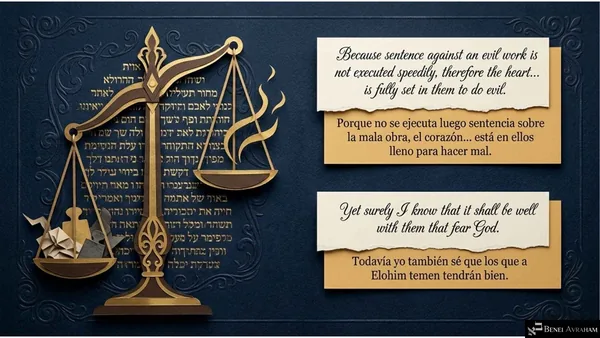
And while we wait, we ask what every generation asks: how long? “Because sentence against an evil work is not executed speedily, therefore the heart of the sons of men is fully set in them to do evil” (Ecclesiastes 8:11). The martyrs in Revelation cry, “How long, O Lord?” (Revelation 6:10). Kohelet answers with faith: “yet surely I know that it shall be well with them that fear God” (Ecclesiastes 8:12).

Dust and spirit
“Who knoweth the spirit of man that goeth upward?” (Ecclesiastes 3:21).
Many Christians say the soul goes straight to heaven; Adventists teach “soul sleep” from “the dead know not any thing” (9:5). Our sages also differ: the Rambam sees the World to Come as a world of souls, the Ramban as body and soul together after the resurrection.
Kohelet points the way: “Then shall the dust return to the earth as it was: and the spirit shall return unto God who gave it” (Ecclesiastes 12:7). And Daniel adds that the dust will not keep them: “many of them that sleep in the dust of the earth shall awake, some to everlasting life” (Daniel 12:2). So each view holds part of the truth. The body sleeps, the spirit returns to its Maker, and in the resurrection the two are joined again for the World to Come.

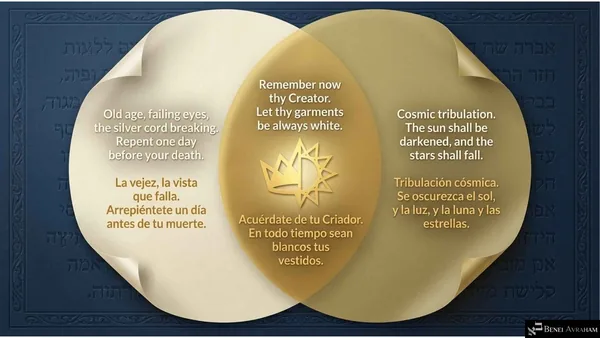
Kohelet’s last poem warns us not to wait: “Remember now thy Creator… while the sun, or the light, or the moon, or the stars, be not darkened” (Ecclesiastes 12:1–2). The sages read it as old age; Yeshua used the same picture for the end of days (Matthew 24:29). Both are true. So the sages taught, “Repent one day before your death,” which means every day, and they quoted Kohelet: “Let thy garments be always white” (Shabbat 153a, on Ecclesiastes 9:8). In Revelation, the faithful stand before the throne “clothed with white robes” (Revelation 7:9).

The end of the matter
The sages once wanted to hide Kohelet away. Why didn’t they?
Because its beginning is words of Torah, and its end is words of Torah. (Shabbat 30b)
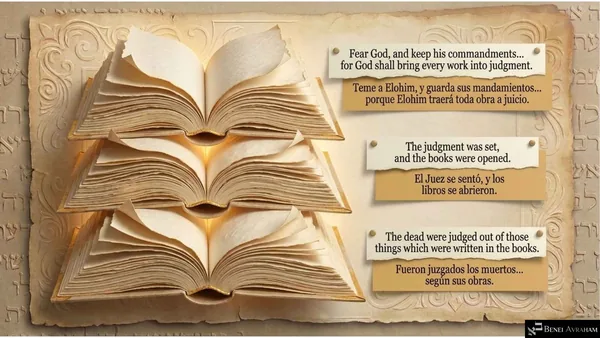
Here is its end: “Fear God, and keep his commandments: for this is the whole duty of man. For God shall bring every work into judgment” (Ecclesiastes 12:13–14).
This is also the end of Daniel and Revelation. Daniel saw “the judgment was set, and the books were opened” (Daniel 7:10). Revelation saw the dead “judged… according to their works” (Revelation 20:12), and its last blessing sounds just like Kohelet: “Blessed are they that do his commandments, that they may have right to the tree of life” (Revelation 22:14).

Better is the end than the beginning
“Better is the end of a thing than the beginning thereof” (Ecclesiastes 7:8).
The Torah’s last word is Yisrael (ישראל), and its last letter is lamed (ל). In a few moments we will read Bereshit (בראשית), and its first letter is bet (ב). Together, the end and the beginning spell לב, lev: heart.
Right now, while the scroll is being rolled, the lamed has been read and the bet is coming. We are standing in the space between them, in the middle of the heart. That is where Hashem set eternity, and where He promised to write His Torah: “I will put my law in their inward parts, and write it in their hearts” (Jeremiah 31:33).
Go thy way with joy
Everything under the sun is vapor. But the end is better than the beginning. The Comforter is coming. The dust will awake. Hashem will make all things new, the days of mourning will end, and His sukkah will stand among us forever. On that eighth day, the King will say, “Stay with me,” and no one will ever have to leave.

Until then, Kohelet gives us one more verse for Simchat Torah: “Go thy way, eat thy bread with joy, and drink thy wine with a merry heart; for God now accepteth thy works” (Ecclesiastes 9:7).
A time to weep, and a time to dance. We danced with the Torah this morning, and in the World to Come we will dance and never stop.
The scroll is ready. Let us go back to Bereshit.
Chag sameach, and Shabbat shalom.
Bible verses are in modern English, with Hashem for the Divine Name (LORD). Jewish sources are given in short translation or paraphrase. Part of our Sukkot 5787 series on the end of days.