SMS/Text 469-608-9944
Parashat Miketz · Genesis 41:1–44:17 · Haftarah 1 Kings 3:15–4:1

Miketz: A Visual Journey

Illustrated teaching slides from Benei Avraham, in English and Spanish, walking through Parashat Miketz portion by portion: Par’oh dreams of seven fat cows swallowed by seven lean ones, and of seven full ears swallowed by seven thin ones; the chief butler remembers Yosef, who is brought from the dungeon and declares that Elohim will give Par’oh an answer of peace; Yosef is set over all the land of Mitzrayim, gathers grain in the years of plenty and names his sons Menasheh and Efrayim; when the famine comes his brothers go down to buy grain and bow before him, and he speaks roughly to them, holds Shimon and sends them home with their silver in their sacks; Yaakov at last lets Binyamin go, the brothers eat in Yosef’s house, and Yosef’s silver goblet is found in Binyamin’s sack. The haftarah follows: Shlomo wakes from his dream and comes to Yerushalayim, and judges between two women who both claim the living child, and all Yisrael sees that the wisdom of Elohim is in him. Tap any image to open the slideshow; use the arrows (or swipe) to move through every slide.

Rishon · Genesis 41:1–14

First Portion

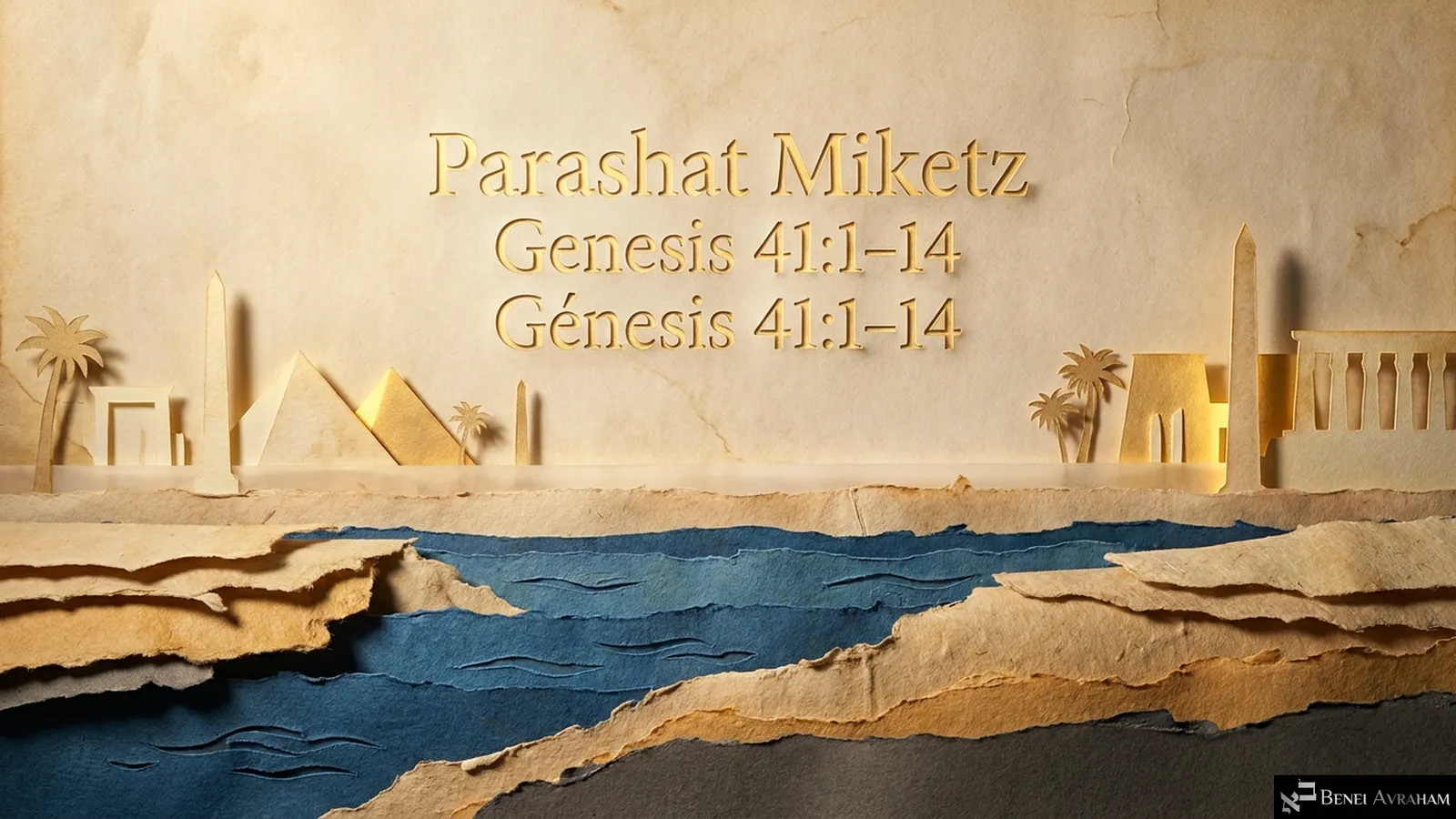
Title card for the first portion: paper pyramids, obelisks and palms above a blue river, “Parashat Miketz, Genesis 41:1–14”.
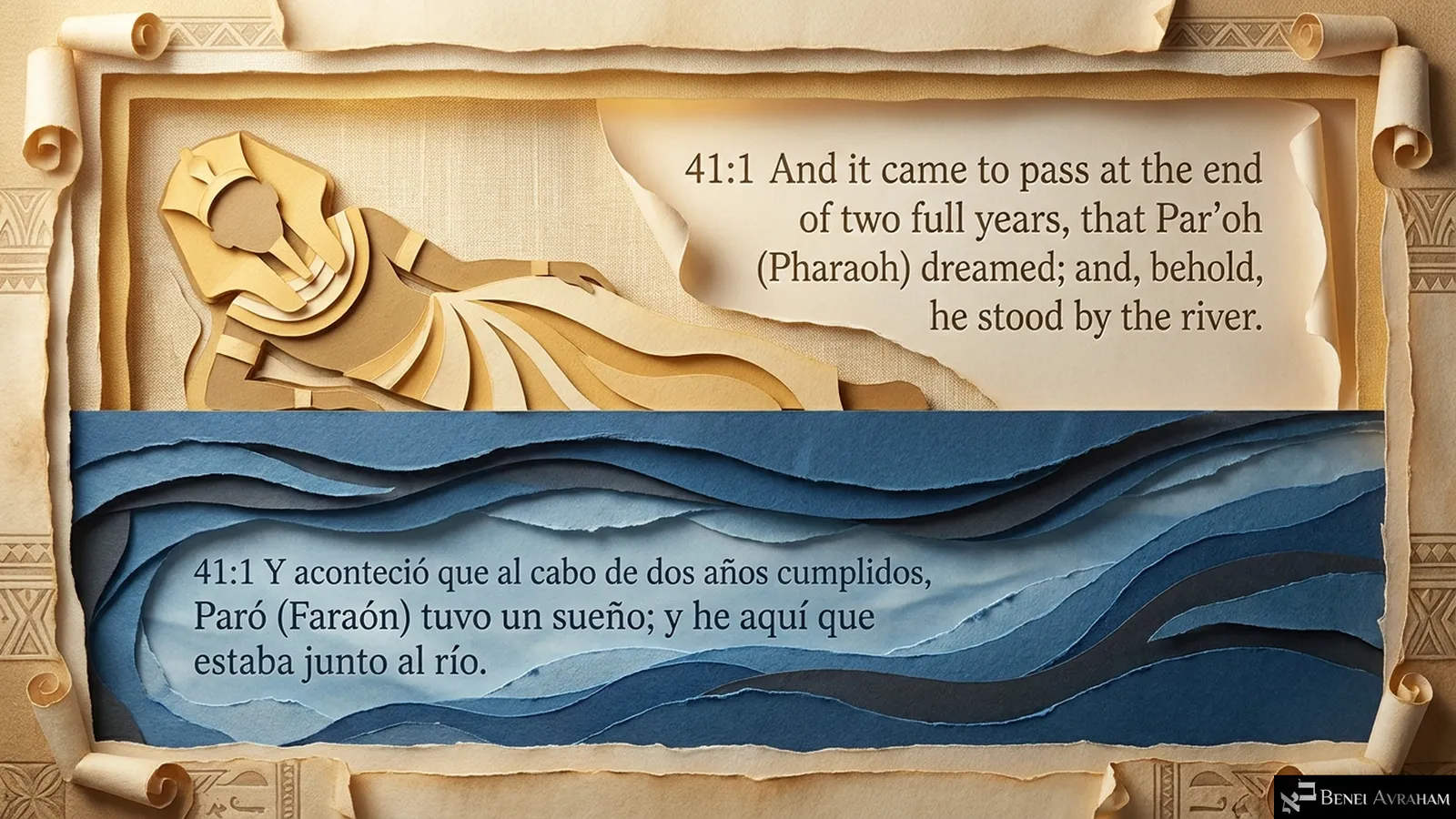
Par’oh lies asleep in paper robes above the blue waves of the river: at the end of two full years Par’oh dreamed, and behold, he stood by the river (Genesis 41:1).
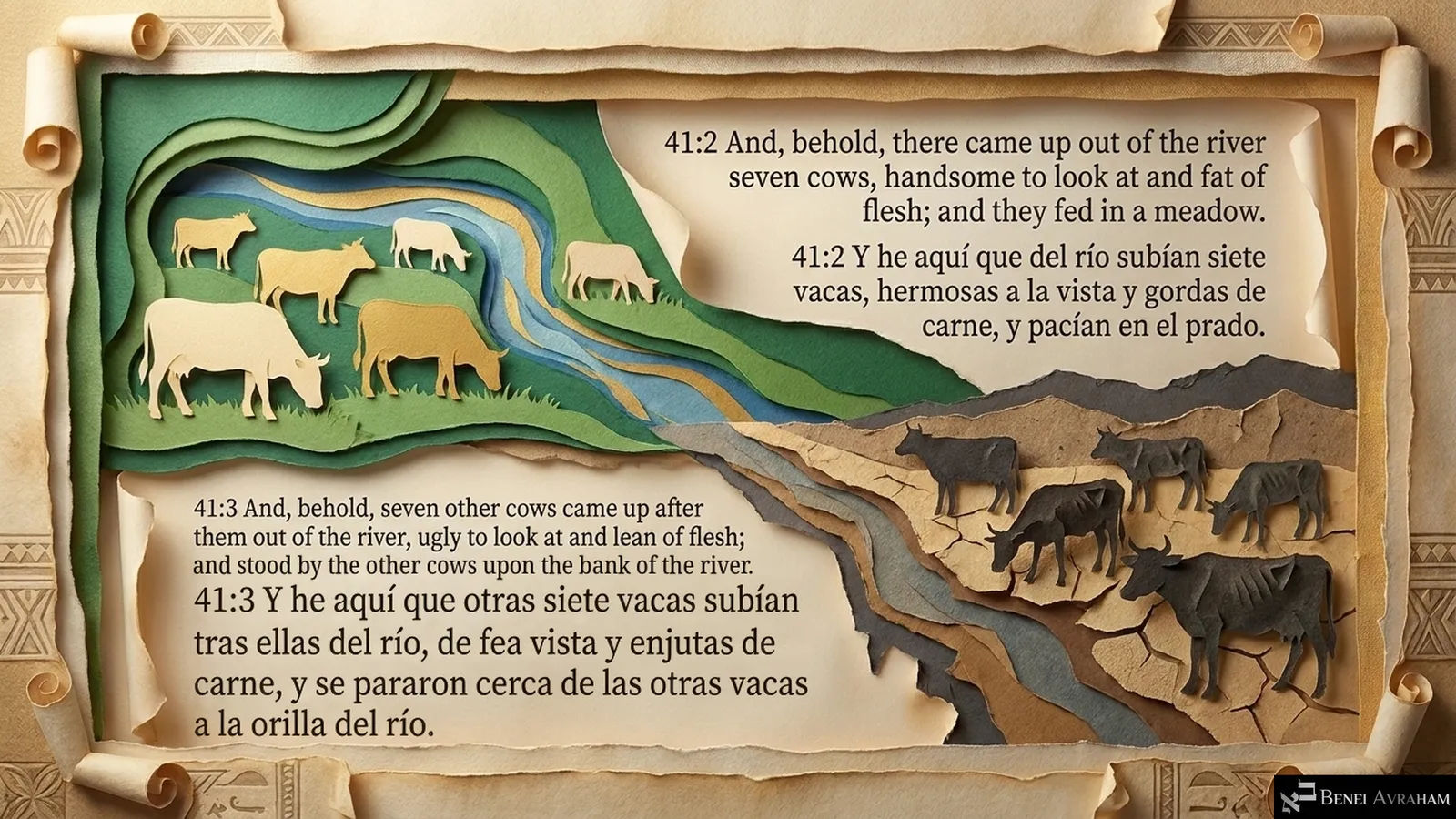
Seven sleek cows graze in a green meadow by the river while seven gaunt dark cows come up onto cracked ground: seven cows handsome and fat, and seven other cows ugly and lean (Genesis 41:2–3).
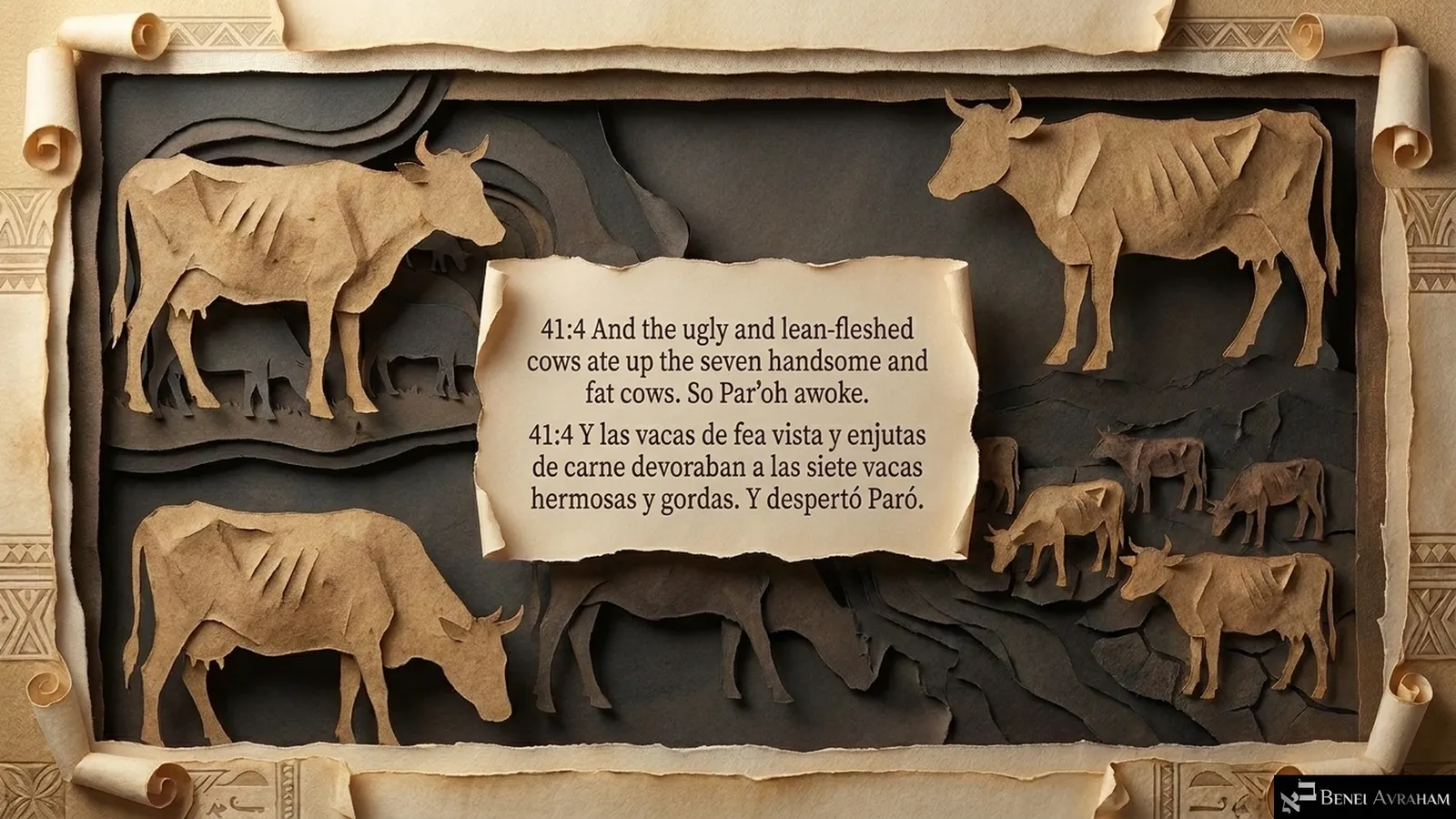
Gaunt paper cows fill a dark landscape: the ugly and lean-fleshed cows ate up the seven handsome and fat cows; so Par’oh awoke (Genesis 41:4).
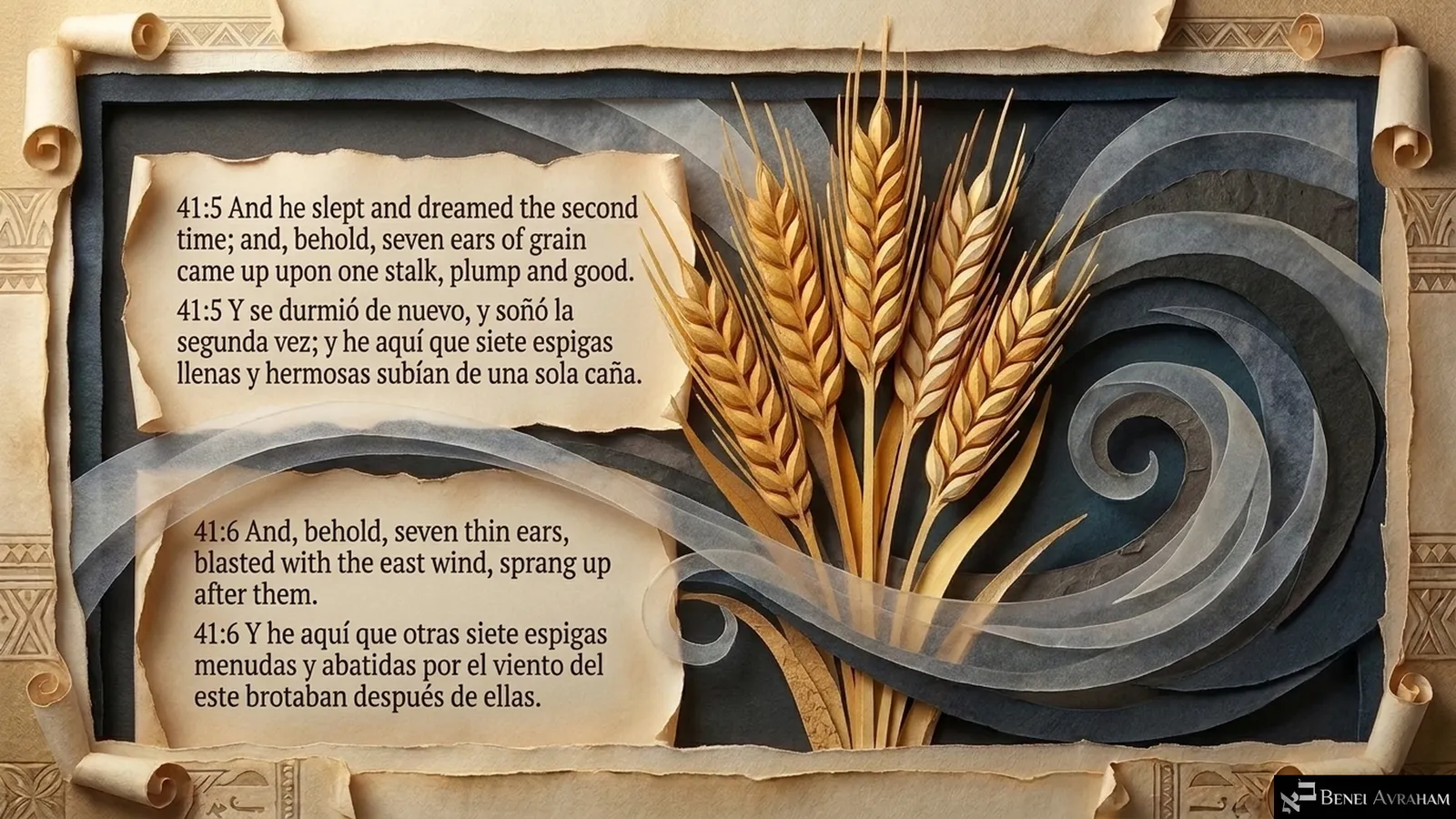
Seven golden ears of grain on one stalk, with a grey east wind swirling behind: seven ears plump and good, and seven thin ears blasted with the east wind (Genesis 41:5–6).
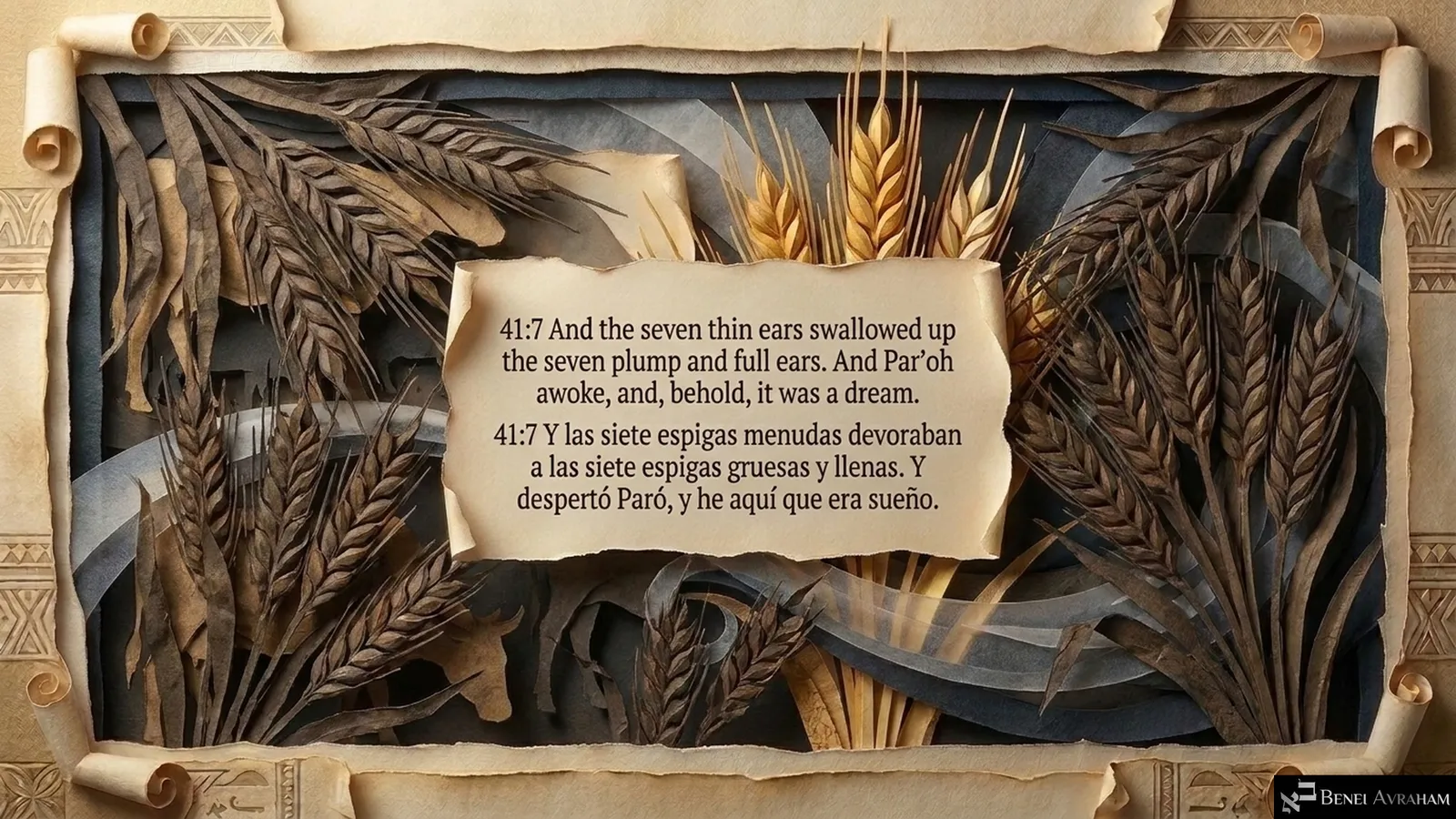
Withered brown ears close in around the golden stalk: the seven thin ears swallowed up the seven plump and full ears; Par’oh awoke, and behold, it was a dream (Genesis 41:7).
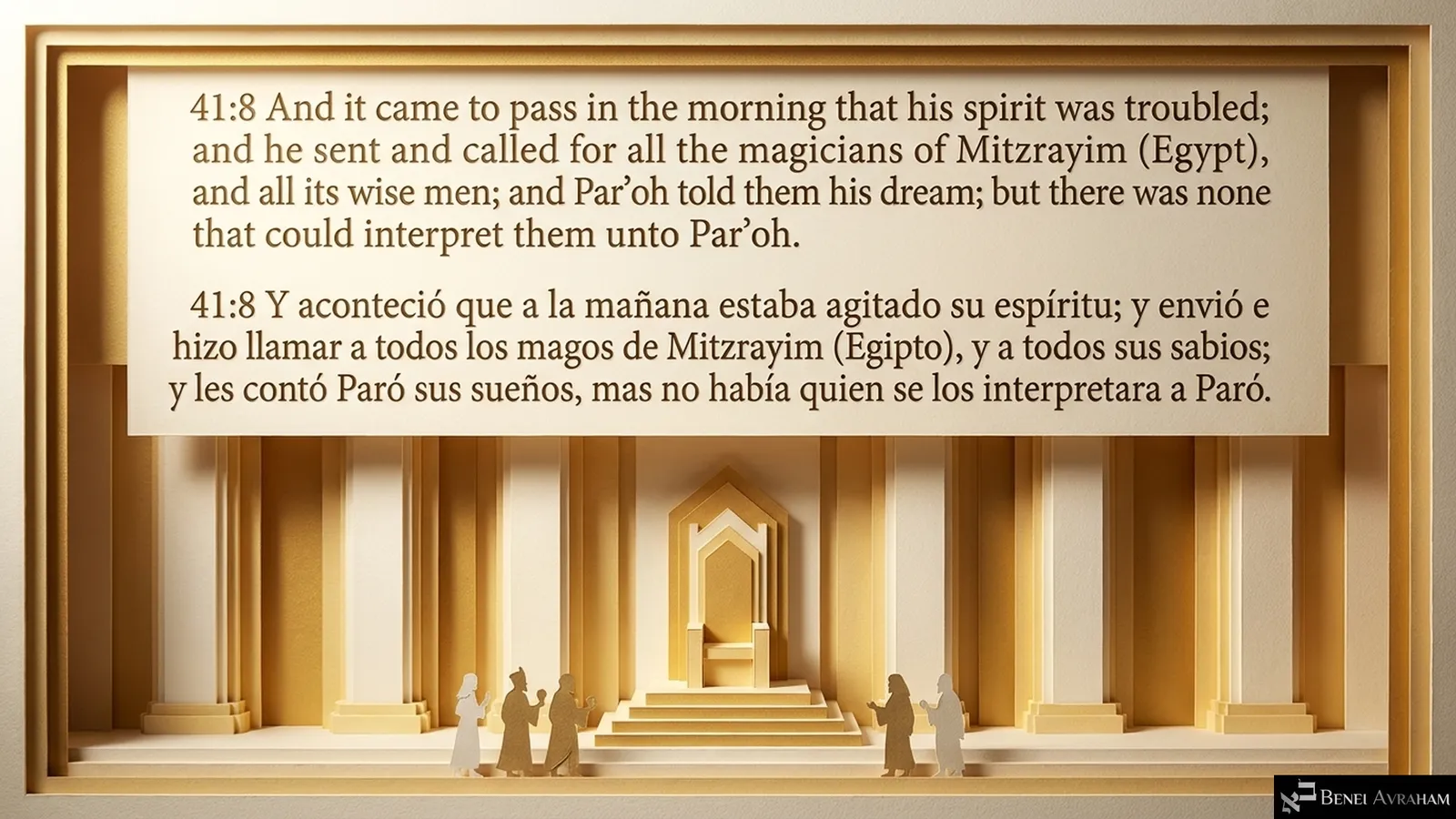
Paper magicians and wise men stand before an empty golden throne between tall columns: Par’oh’s spirit was troubled, and none could interpret his dreams (Genesis 41:8).
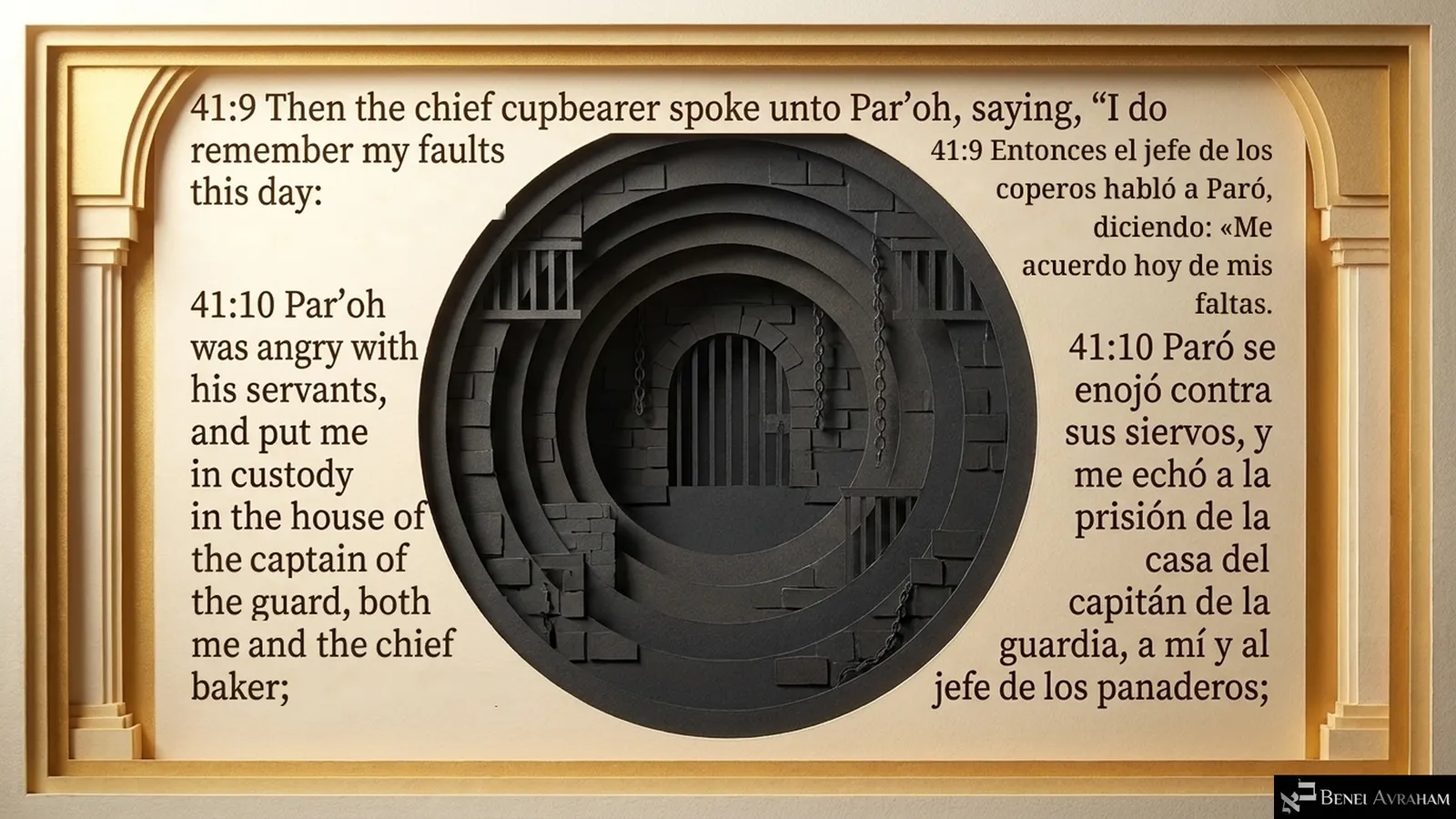
A round paper dungeon of stone, bars and chains opens in the middle of the page: the chief cupbearer remembers his faults, and how Par’oh put him and the chief baker in custody (Genesis 41:9–10).
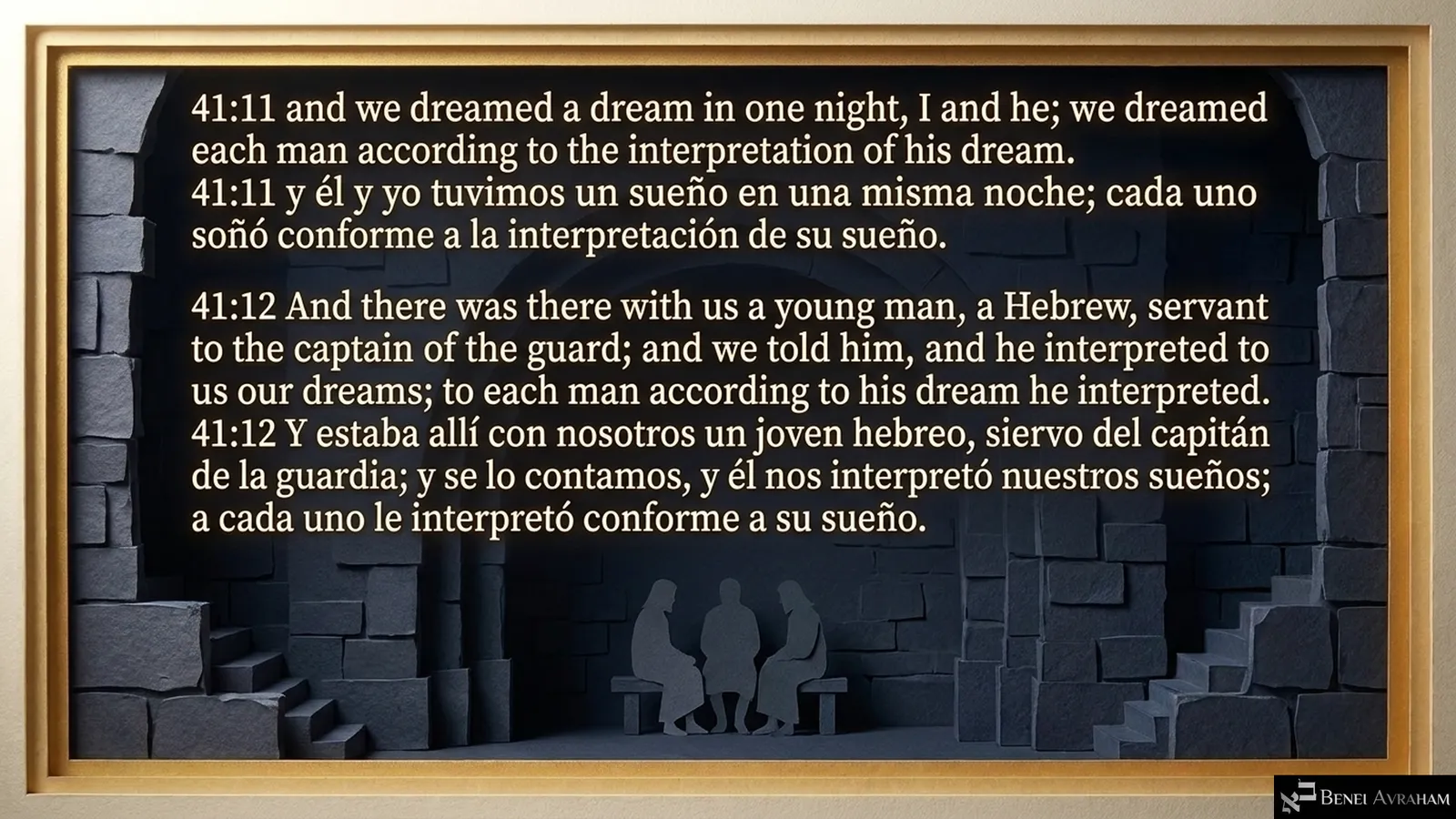
Three paper figures sit together on a bench in a stone dungeon: the cupbearer and the baker each dreamed a dream, and a young Hebrew servant interpreted them (Genesis 41:11–12).
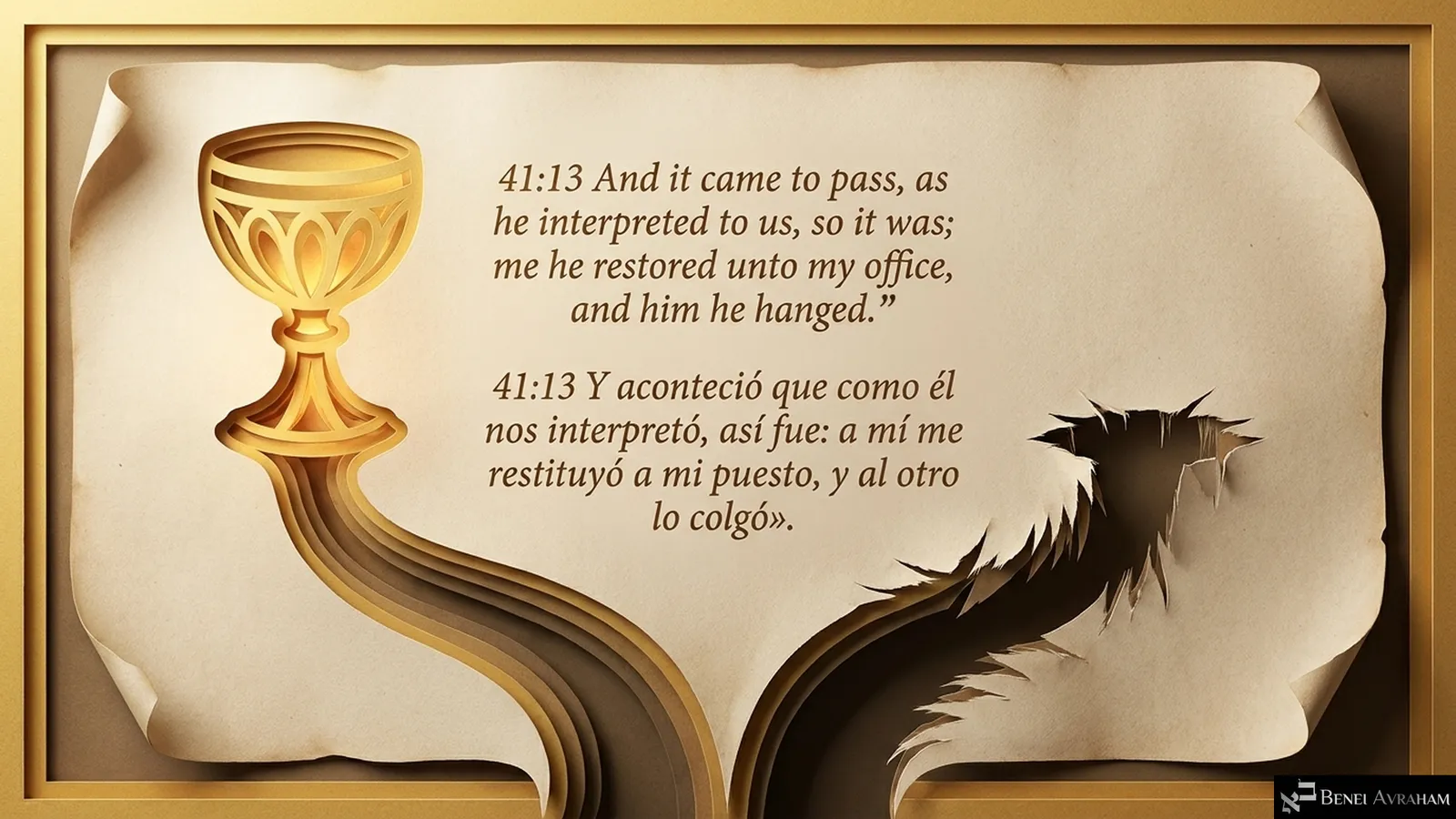
A golden cup on one side and a torn black tear in the page on the other: as he interpreted to us, so it was; me he restored unto my office, and him he hanged (Genesis 41:13).
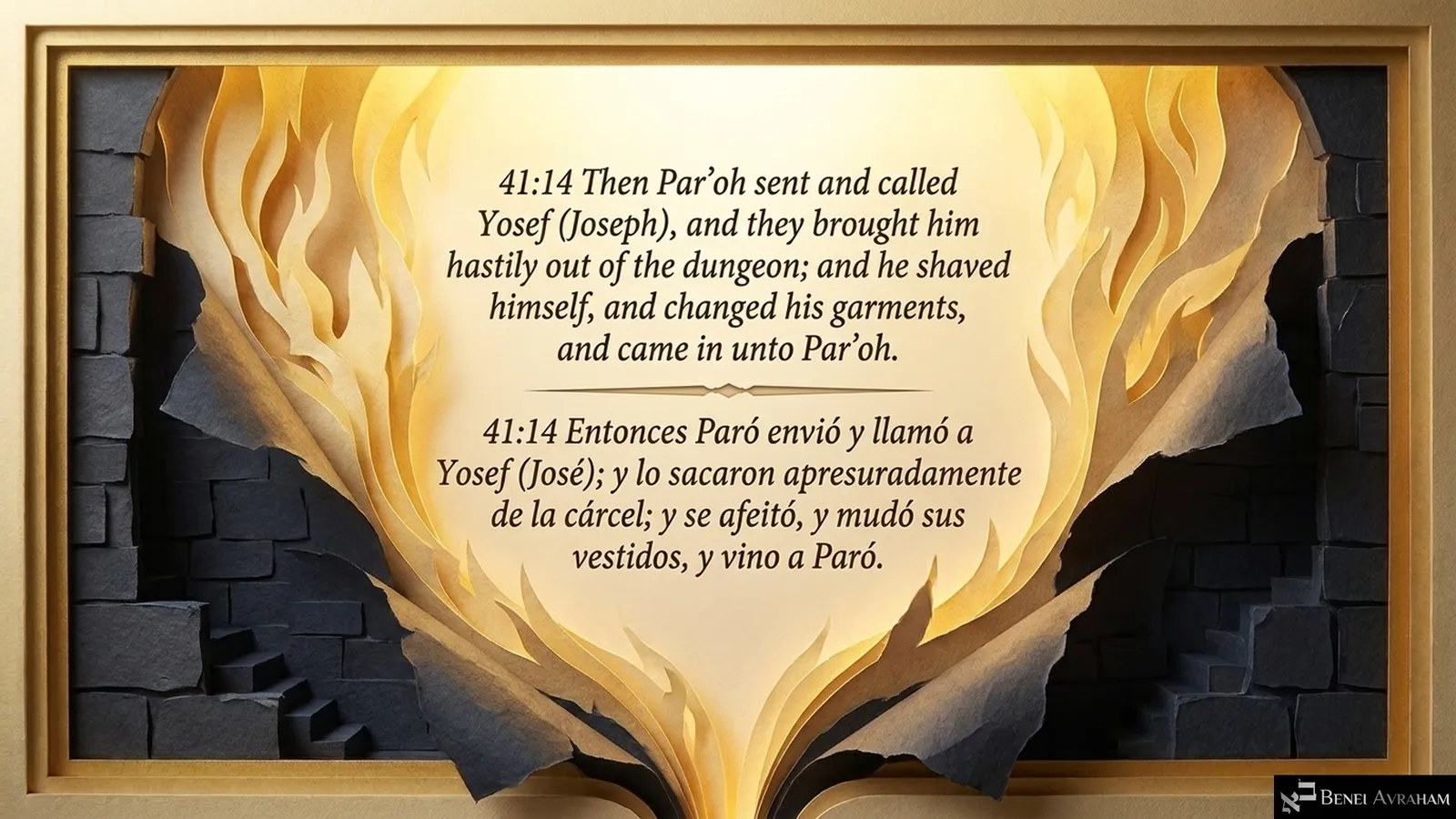
Golden paper flames burst open the dark stone walls of the dungeon: Par’oh sent and called Yosef, and they brought him hastily out of the dungeon; he shaved and changed his garments (Genesis 41:14).
Sheni · Genesis 41:15–38

Second Portion

Title card for the second portion over a desert of pyramids, palms and sailboats on the river: “Parashat Miketz, 2nd portion, Genesis 41:15–38”.
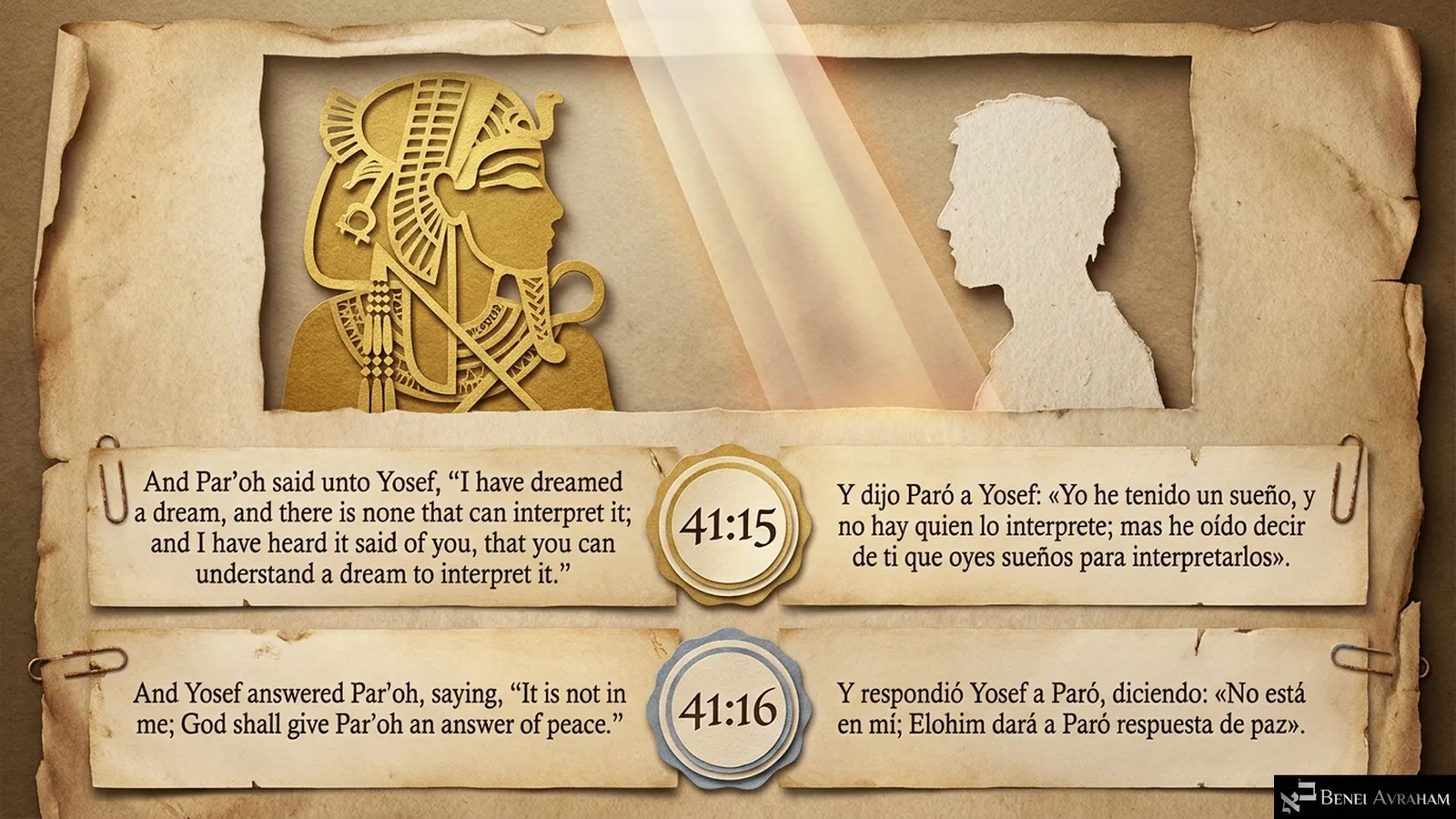
A golden paper Par’oh faces the white silhouette of Yosef in a beam of light: “I have dreamed a dream, and there is none that can interpret it”; “It is not in me; God shall give Par’oh an answer of peace” (Genesis 41:15–16).
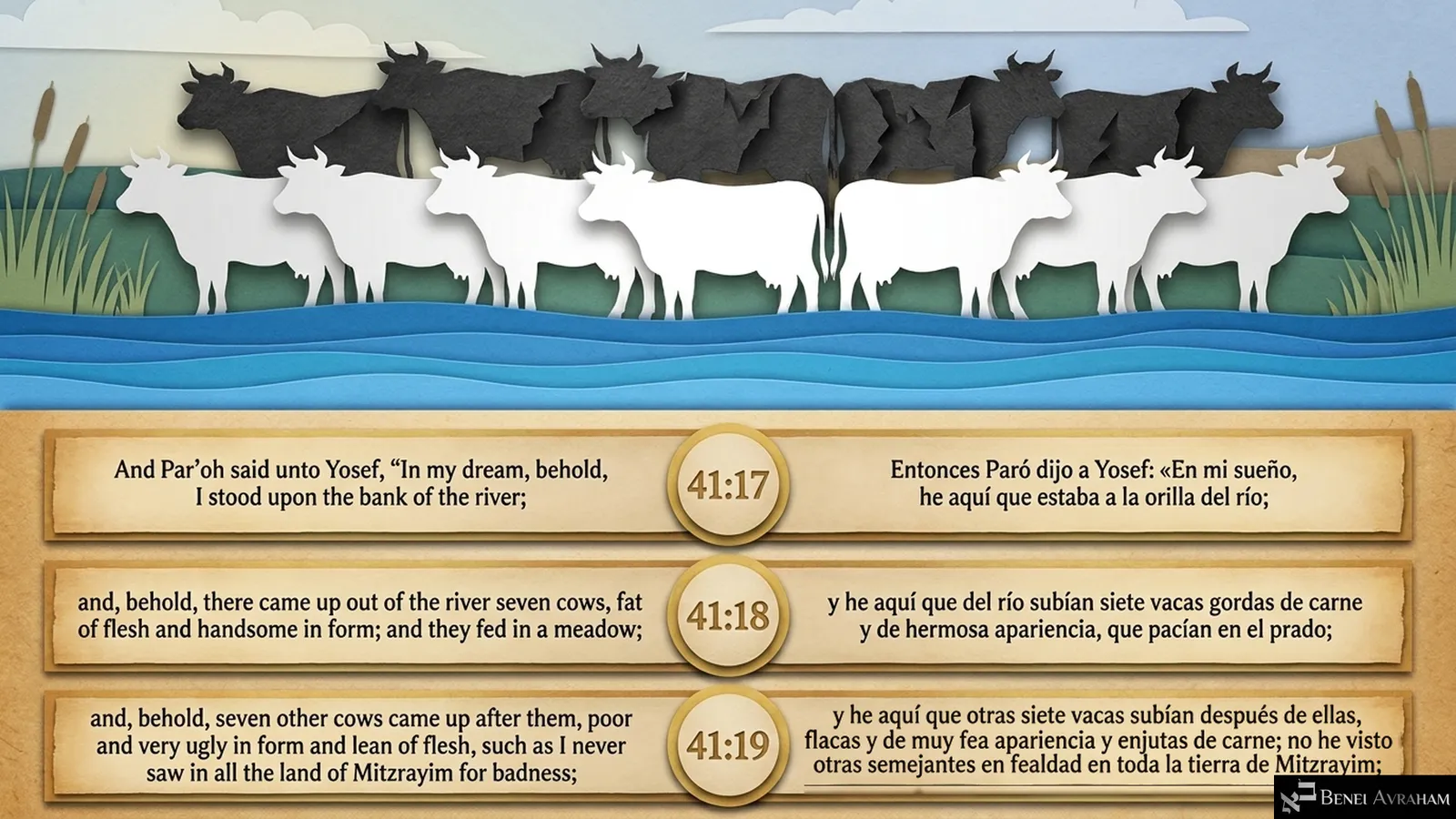
Seven white cows and seven dark gaunt cows stand above the river: Par’oh retells his dream of the fat cows and the poor, ugly cows such as he never saw in all Mitzrayim (Genesis 41:17–19).
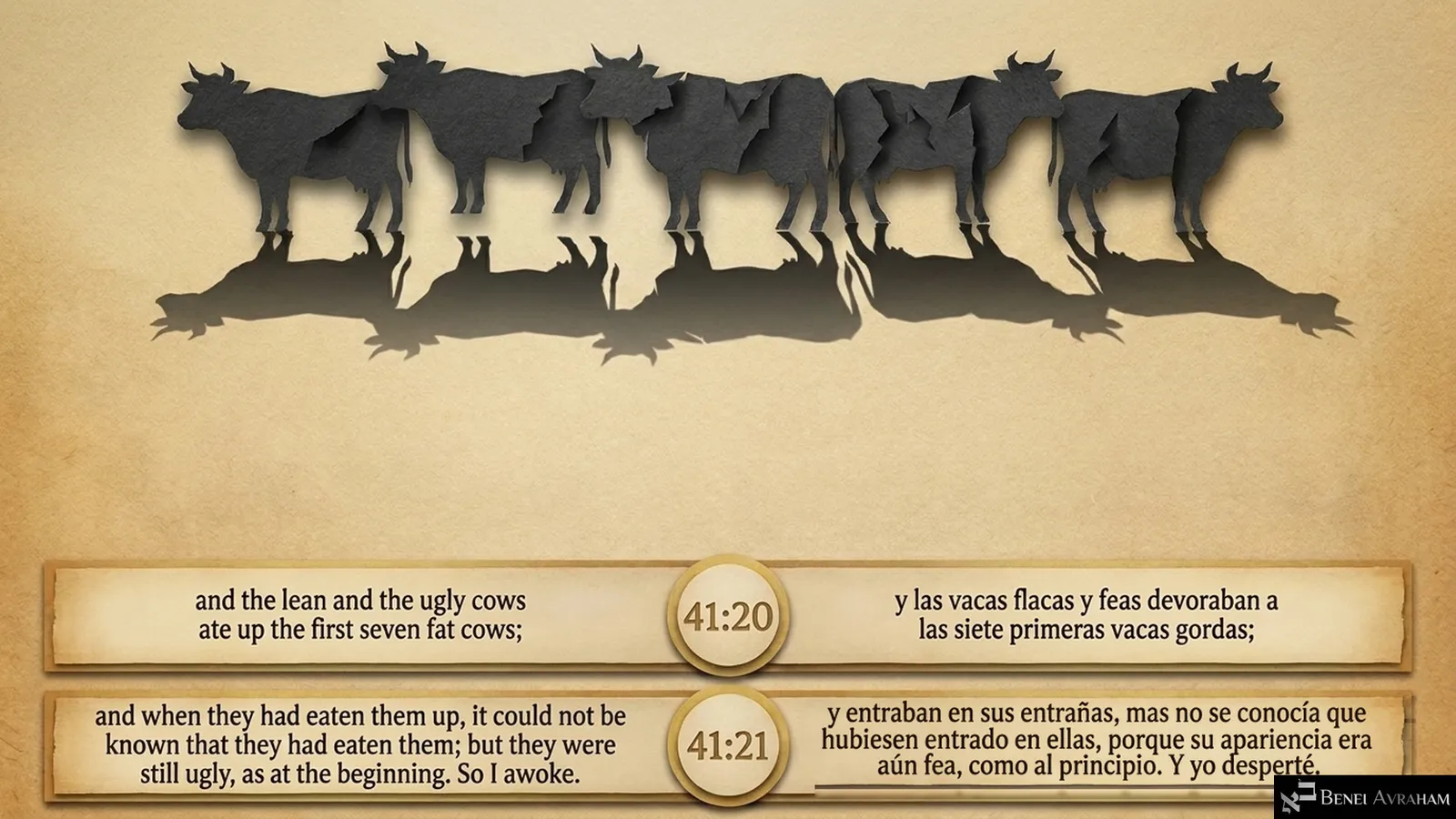
Seven dark, gaunt paper cows cast long shadows on bare parchment: the lean and ugly cows ate up the first seven fat cows, and they were still ugly, as at the beginning (Genesis 41:20–21).
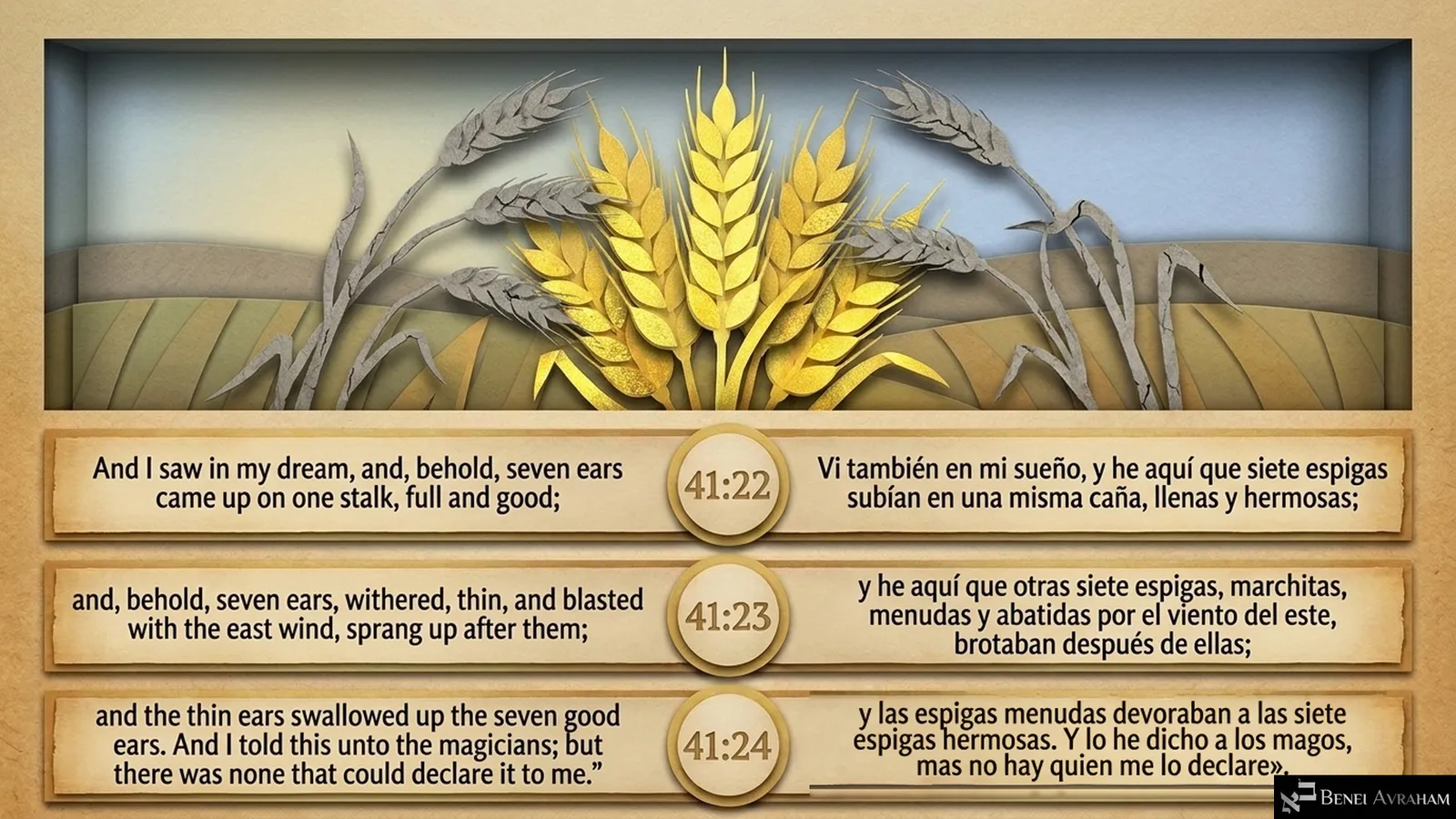
Seven golden ears stand among withered grey stalks over the fields: the seven thin ears swallowed up the seven good ears, and none could declare it to me (Genesis 41:22–24).
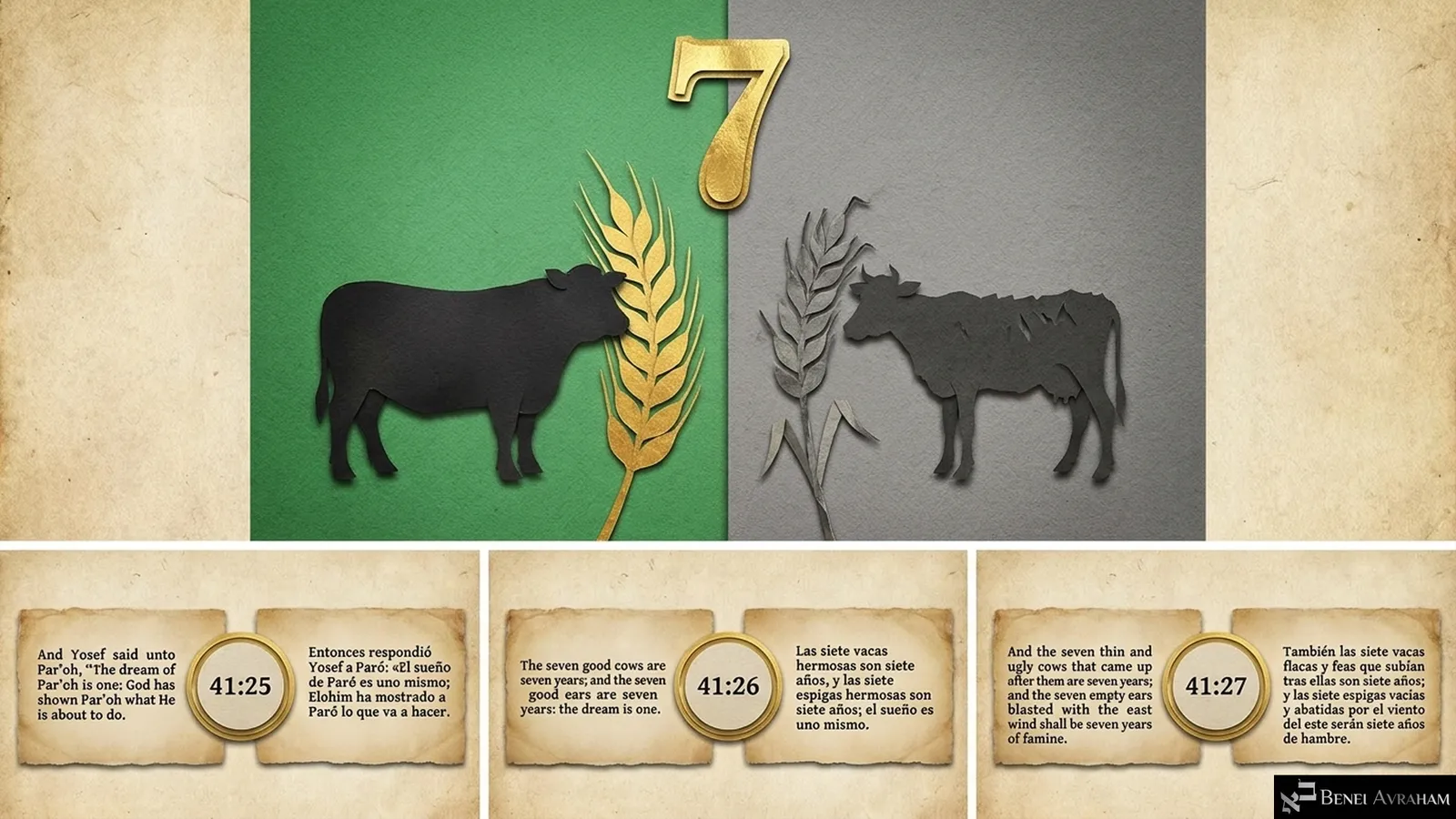
A golden 7 above a strong cow and a golden ear on green, and a gaunt cow and a withered ear on grey: “The dream of Par’oh is one … the seven good cows are seven years, and the seven thin cows are seven years of famine” (Genesis 41:25–27).
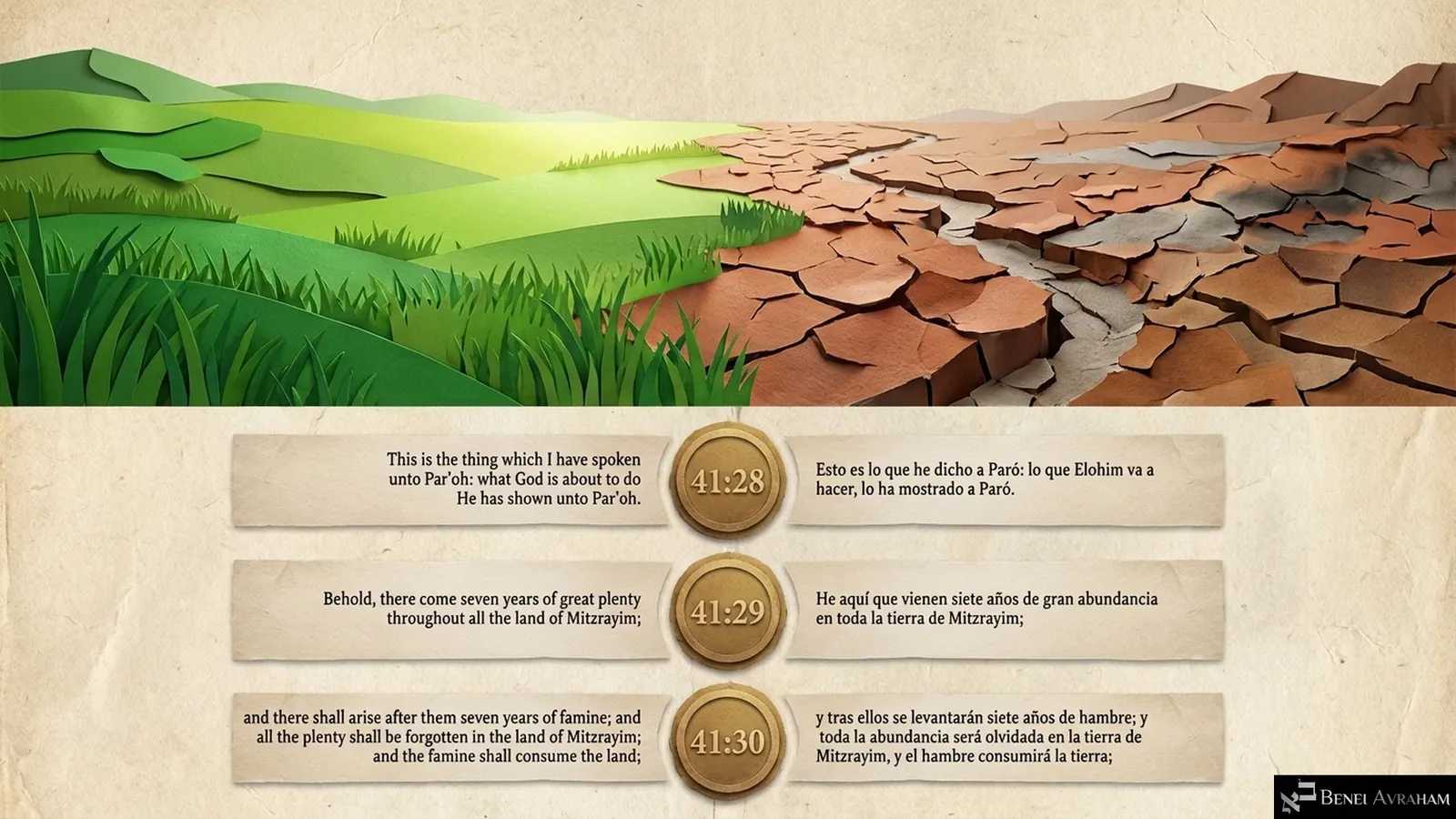
Green paper hills turn to cracked red earth: seven years of great plenty throughout Mitzrayim, then seven years of famine, and all the plenty shall be forgotten (Genesis 41:28–30).
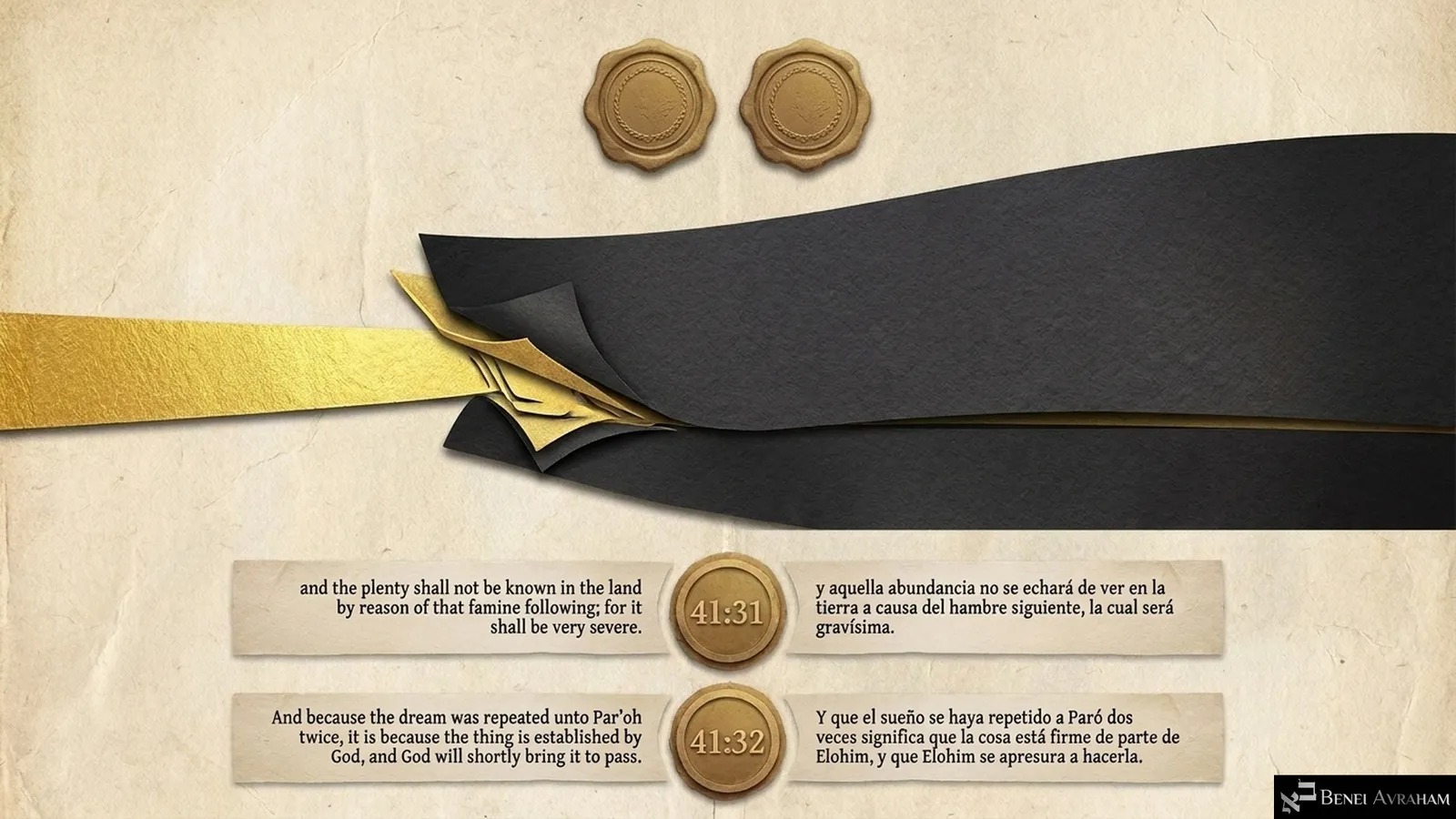
A golden band of plenty disappears into a wide black band of famine, under two wax seals: the plenty shall not be known by reason of that famine, and the dream was repeated twice because the thing is established by God (Genesis 41:31–32).
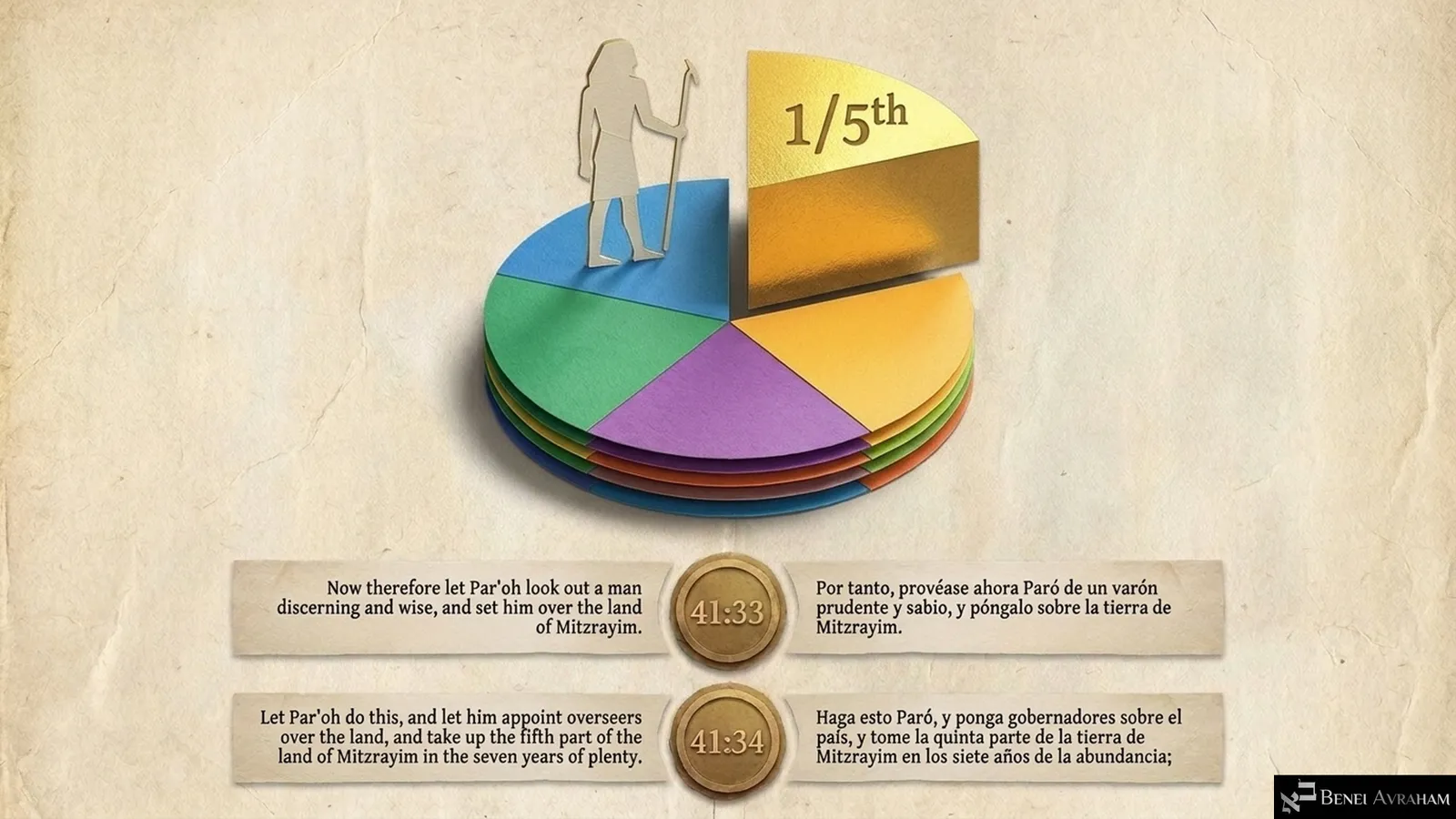
A paper overseer stands on a layered disc with one golden fifth lifted out: let Par’oh set a man discerning and wise over the land, and take up the fifth part in the seven years of plenty (Genesis 41:33–34).
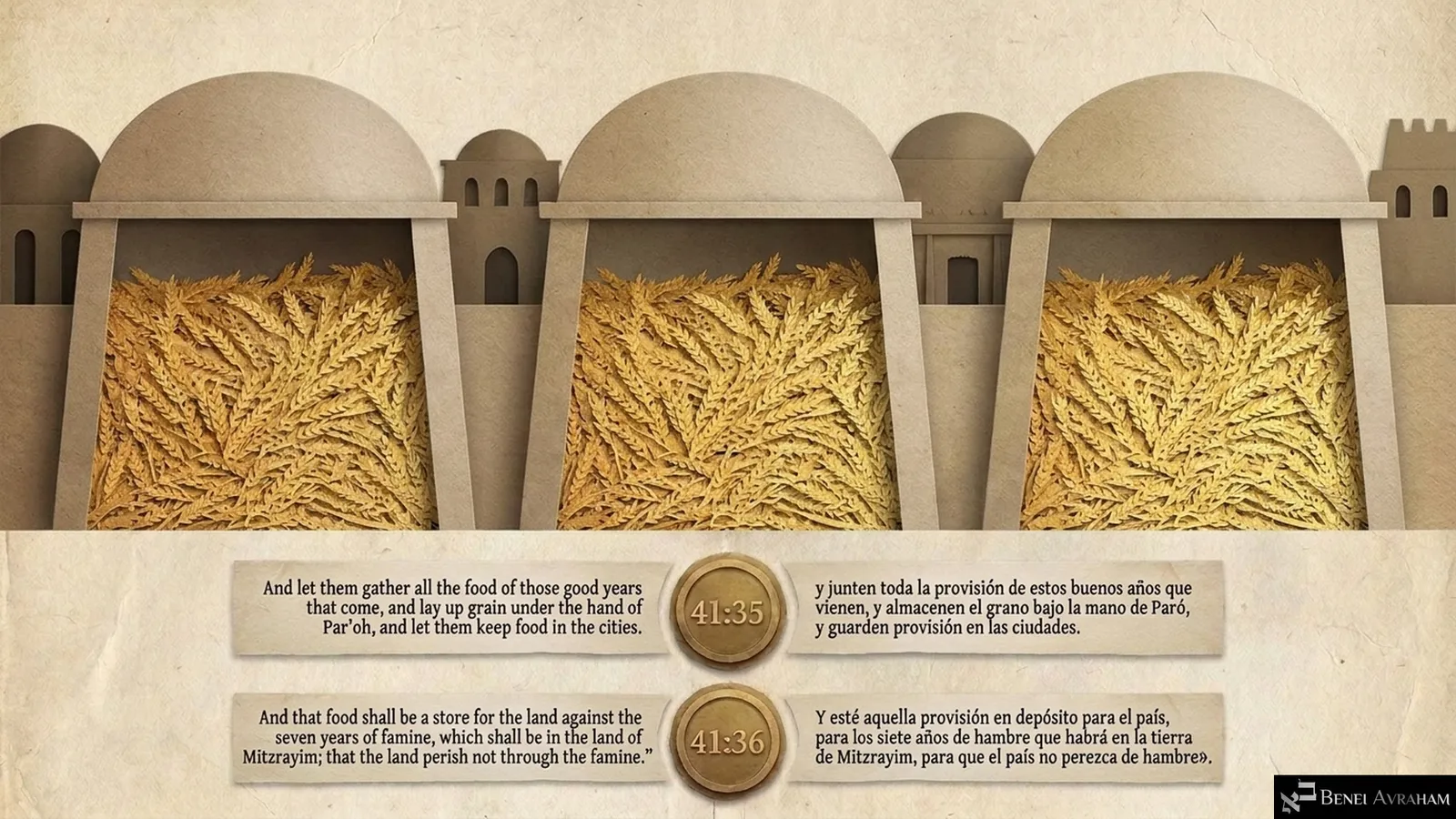
Three domed paper storehouses heaped with golden grain: let them gather all the food of those good years and keep it in the cities, a store against the seven years of famine (Genesis 41:35–36).
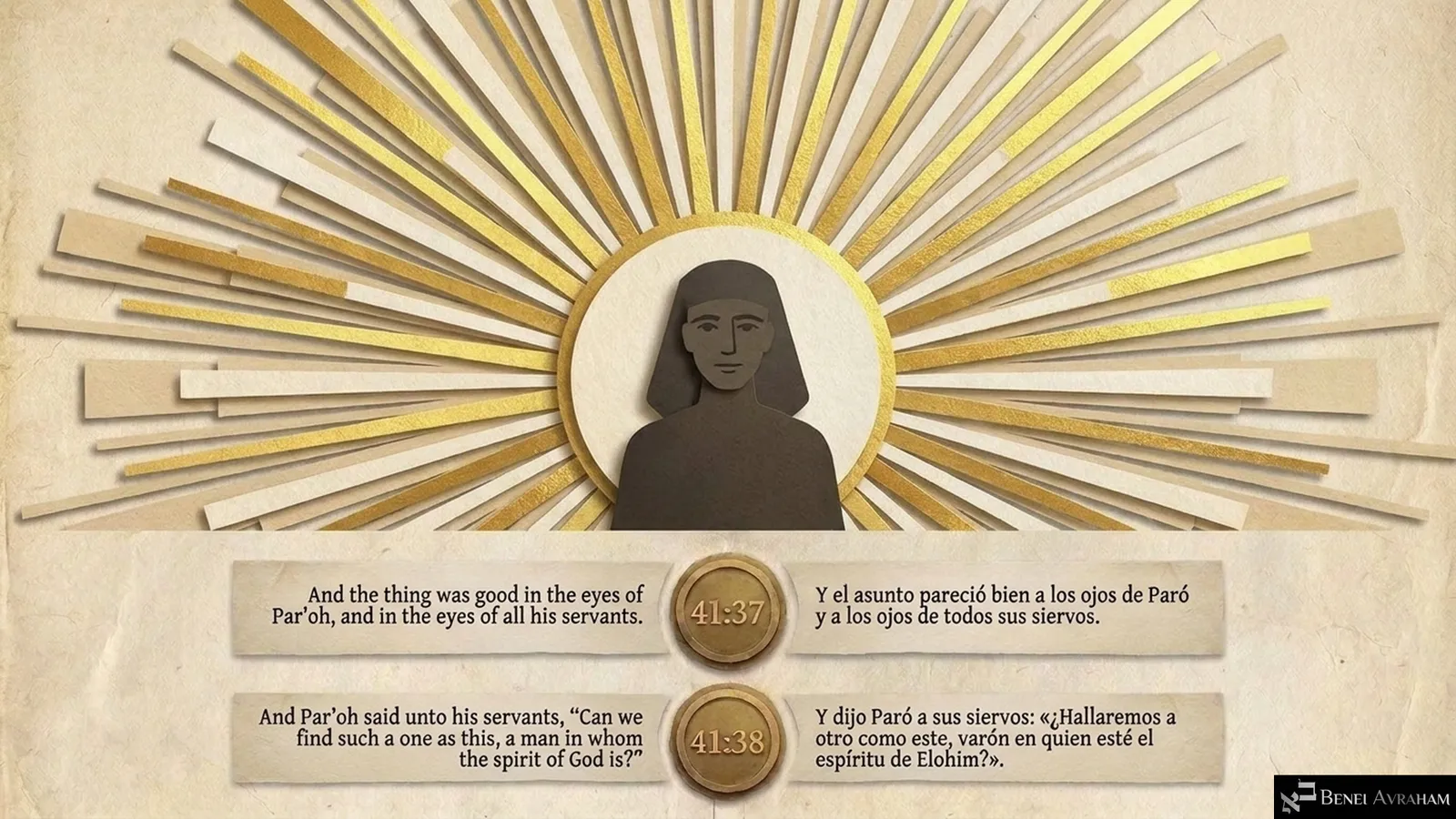
Yosef’s dark paper portrait framed in a burst of golden rays: “Can we find such a one as this, a man in whom the spirit of God is?” (Genesis 41:37–38).
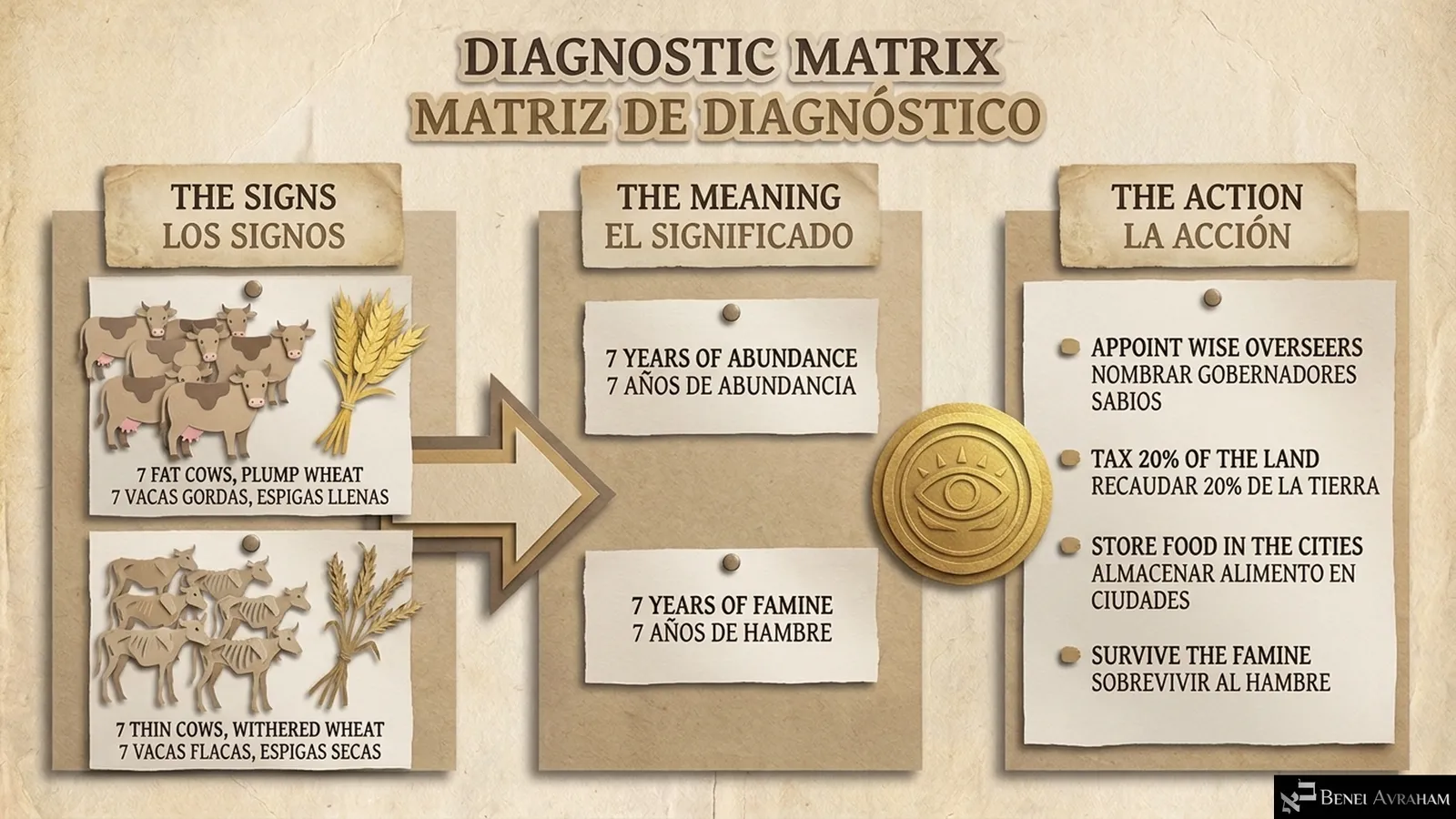
A paper chart of Par’oh’s dreams: the signs (seven fat cows and plump wheat, seven thin cows and withered wheat), the meaning (seven years of abundance, seven years of famine), and the action (appoint overseers, take a fifth, store food, survive the famine).
Shlishi · Genesis 41:39–52

Third Portion
Title card for the third portion framed by carved columns before a paper sunrise over the river: “Parashat Miketz, 3rd Portion (Shlishi), Genesis 41:39–52”.
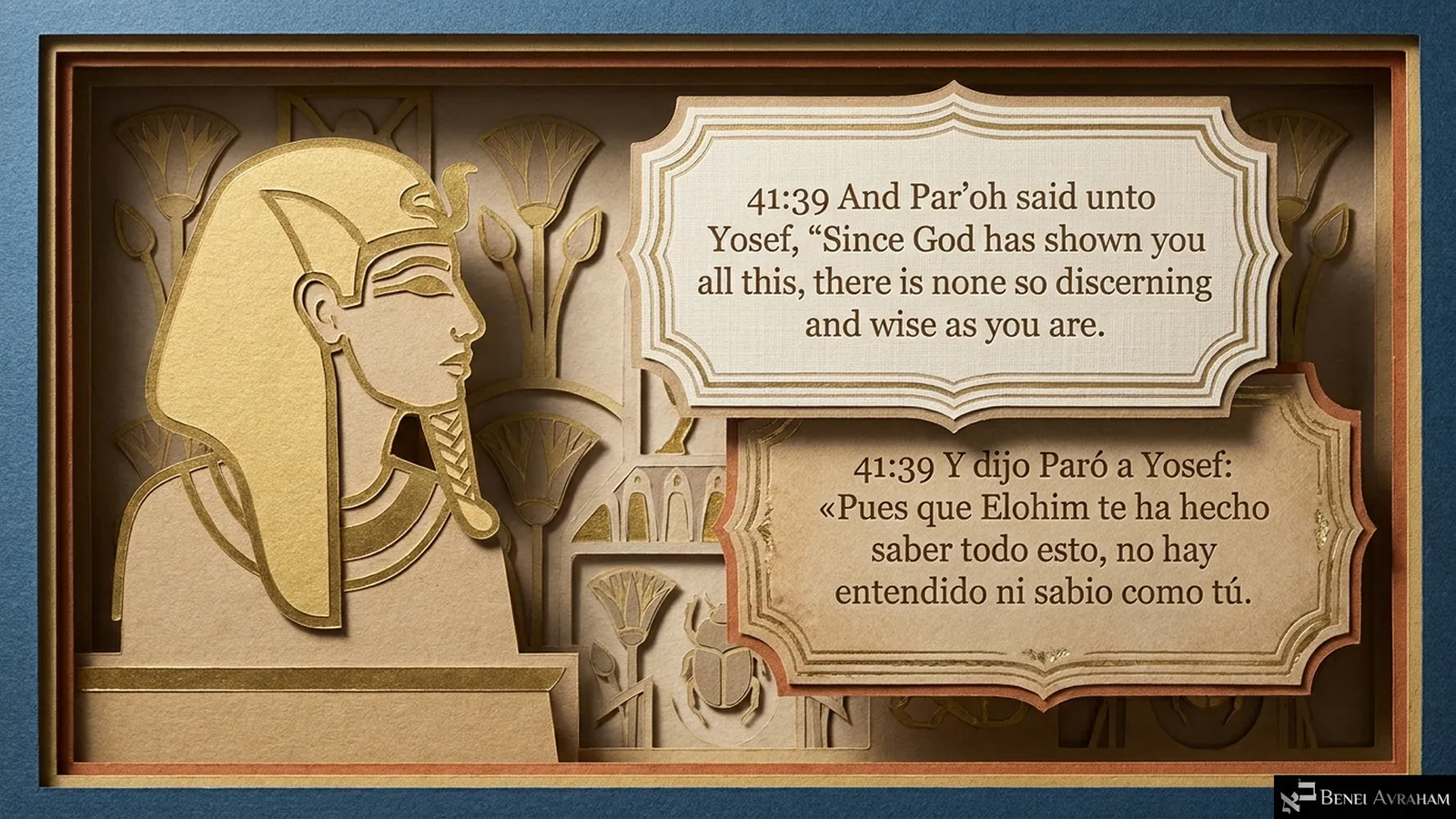
A golden paper Par’oh in profile among lotus and scarab carvings: “Since God has shown you all this, there is none so discerning and wise as you are” (Genesis 41:39).
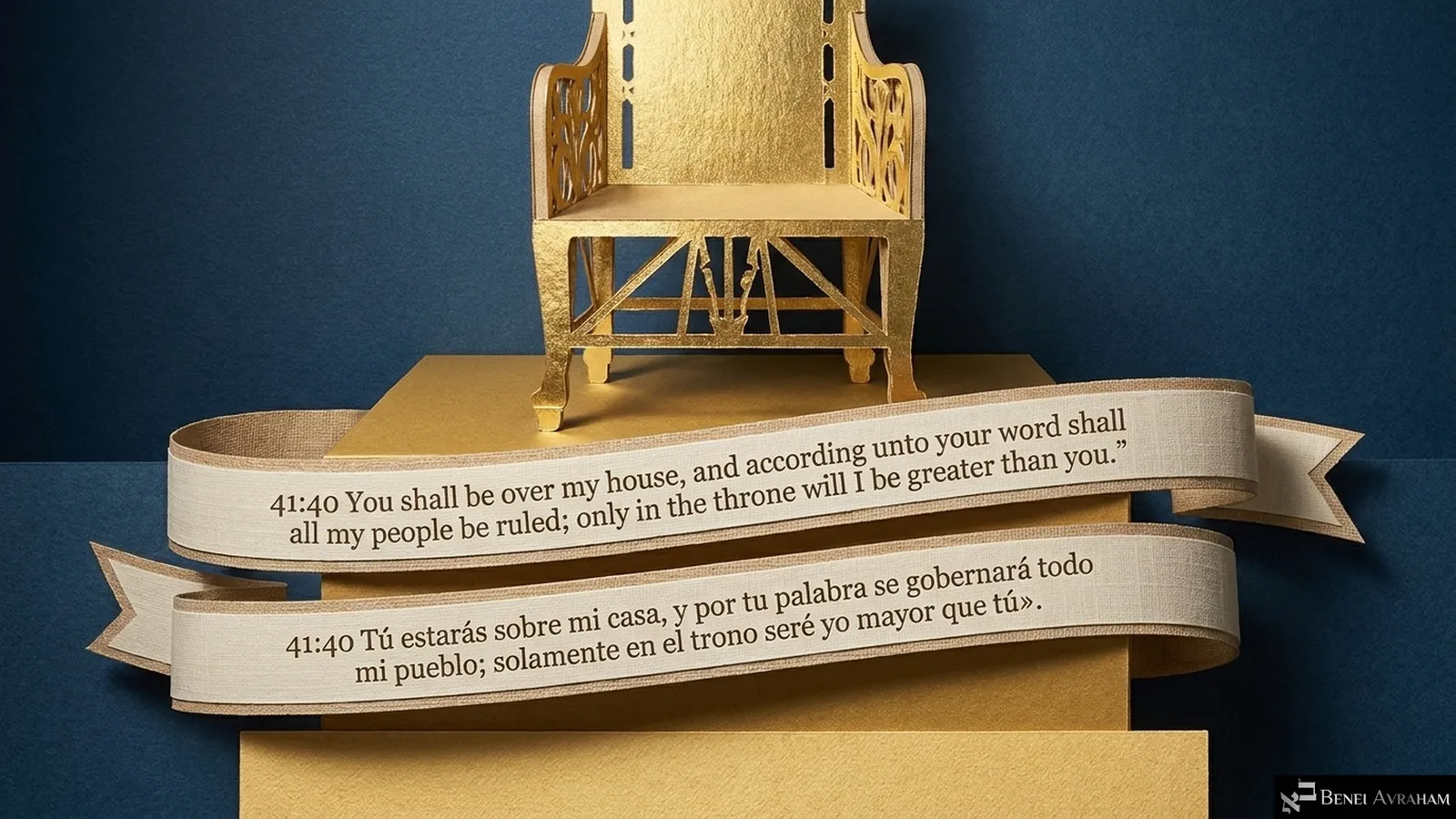
A golden throne on a high plinth with ribbon banners: “You shall be over my house … only in the throne will I be greater than you” (Genesis 41:40).
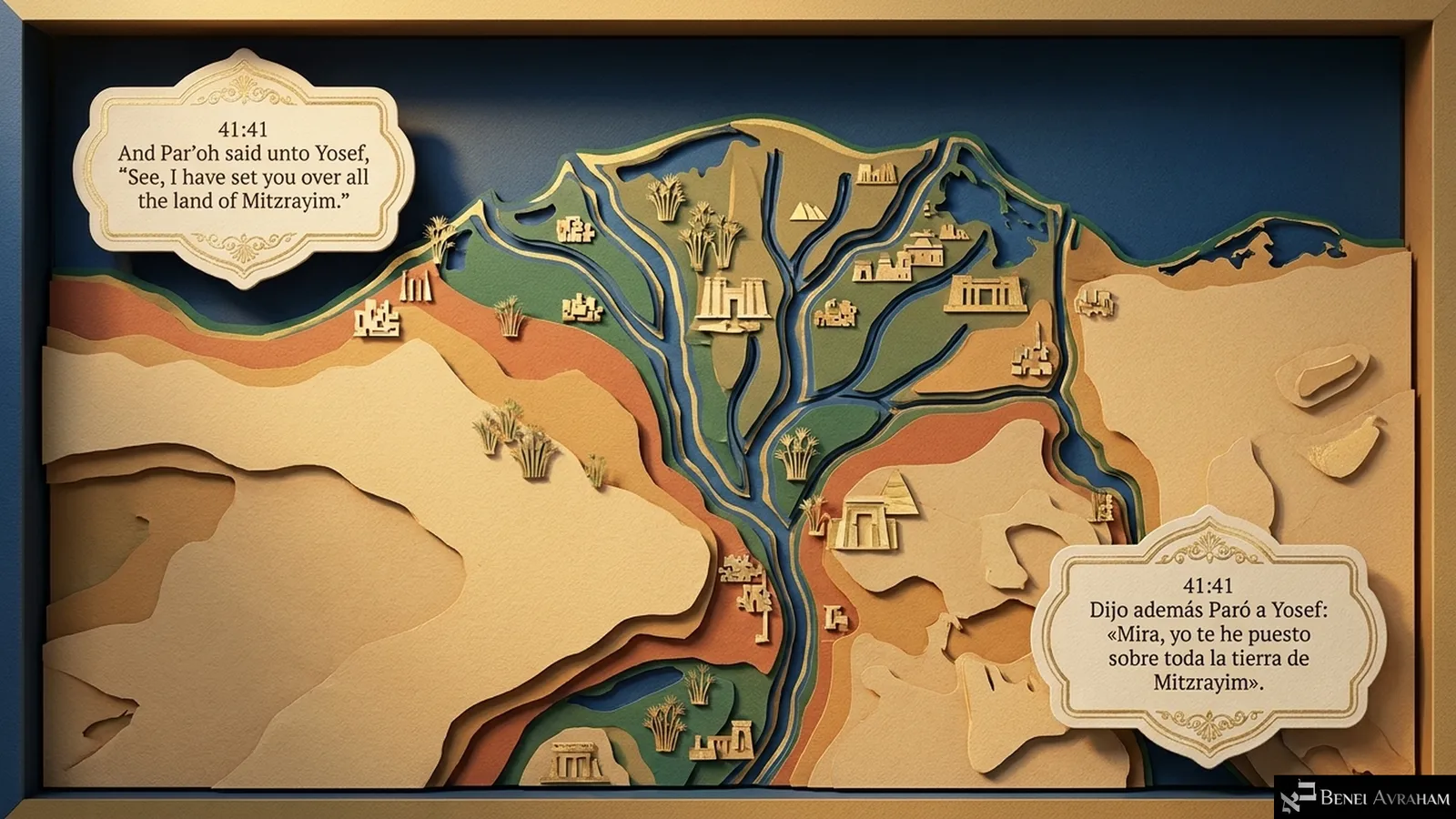
A layered paper map of Mitzrayim with the river branching through its towns: “See, I have set you over all the land of Mitzrayim” (Genesis 41:41).
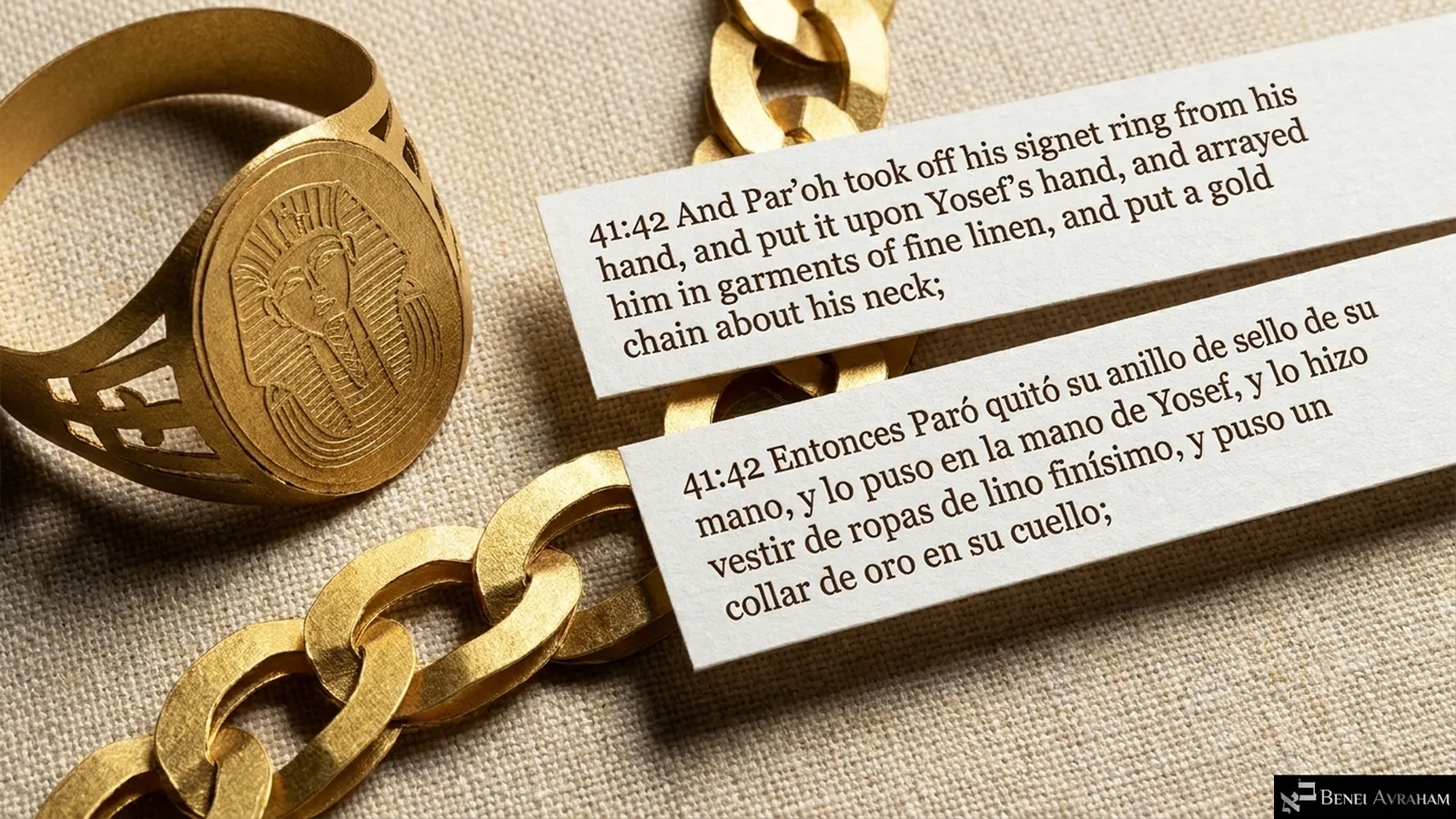
Par’oh’s golden signet ring and a heavy gold chain beside two paper strips: Par’oh put his signet ring upon Yosef’s hand, arrayed him in fine linen, and put a gold chain about his neck (Genesis 41:42).
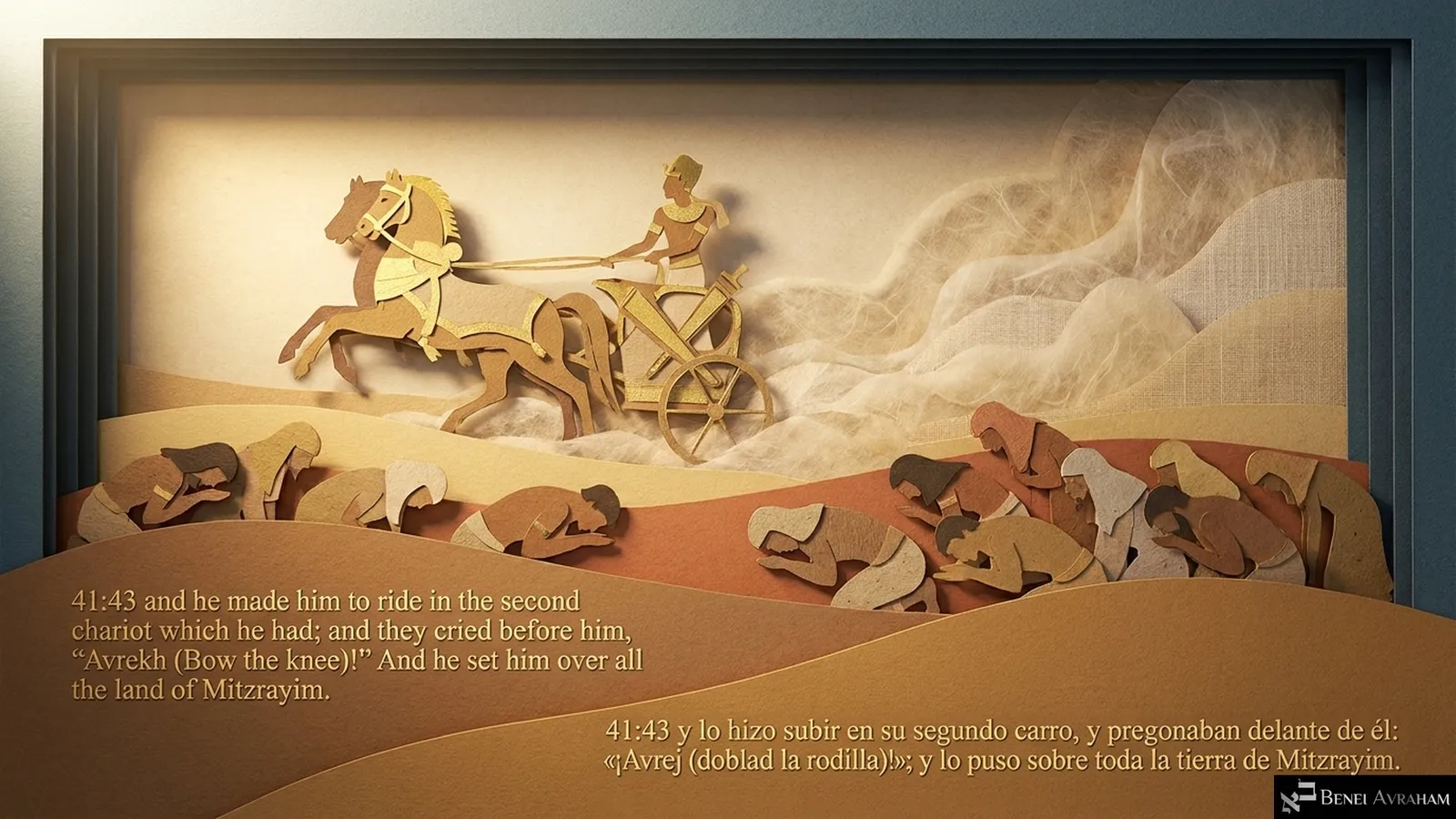
Yosef rides a golden paper chariot as the people bow down along the road: they cried before him, “Avrekh (Bow the knee)!” and he set him over all the land of Mitzrayim (Genesis 41:43).
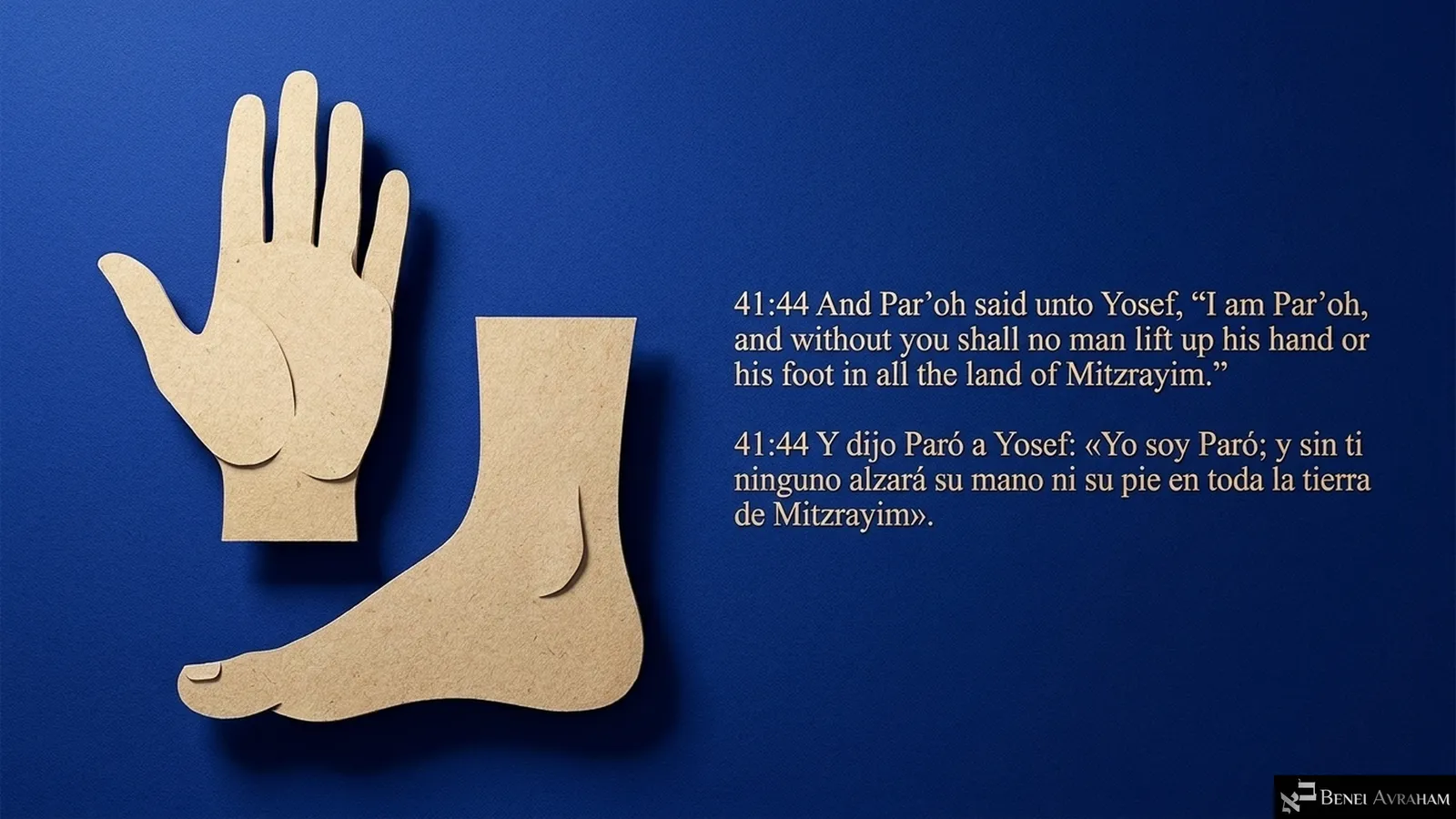
A paper hand and foot on deep blue: “I am Par’oh, and without you shall no man lift up his hand or his foot in all the land of Mitzrayim” (Genesis 41:44).
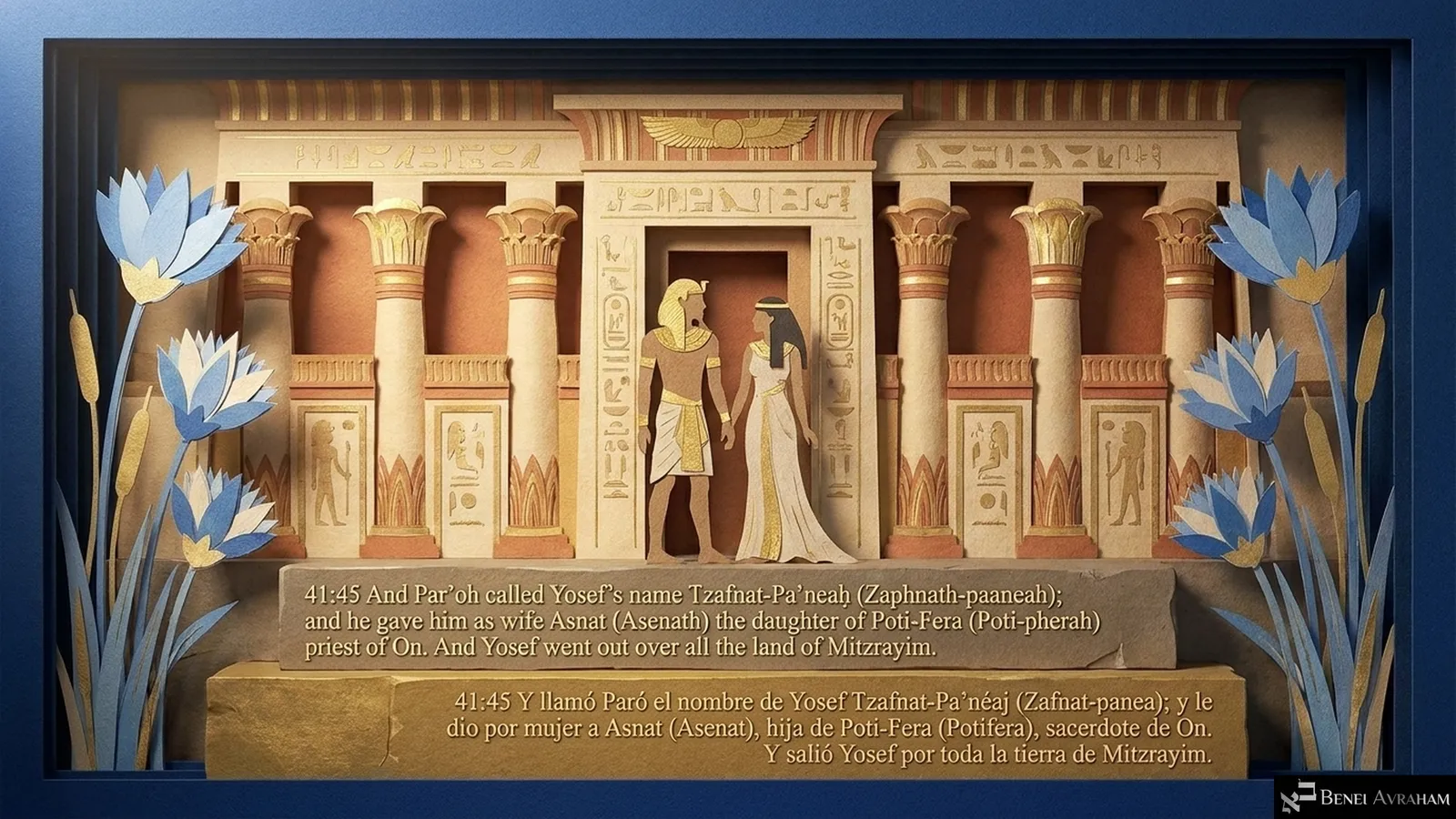
Yosef and Asnat stand hand in hand in a temple doorway among columns and blue lotus flowers: Par’oh called Yosef’s name Tzafnat-Pa’neaḥ and gave him Asnat, daughter of Poti-Fera priest of On, as wife (Genesis 41:45).
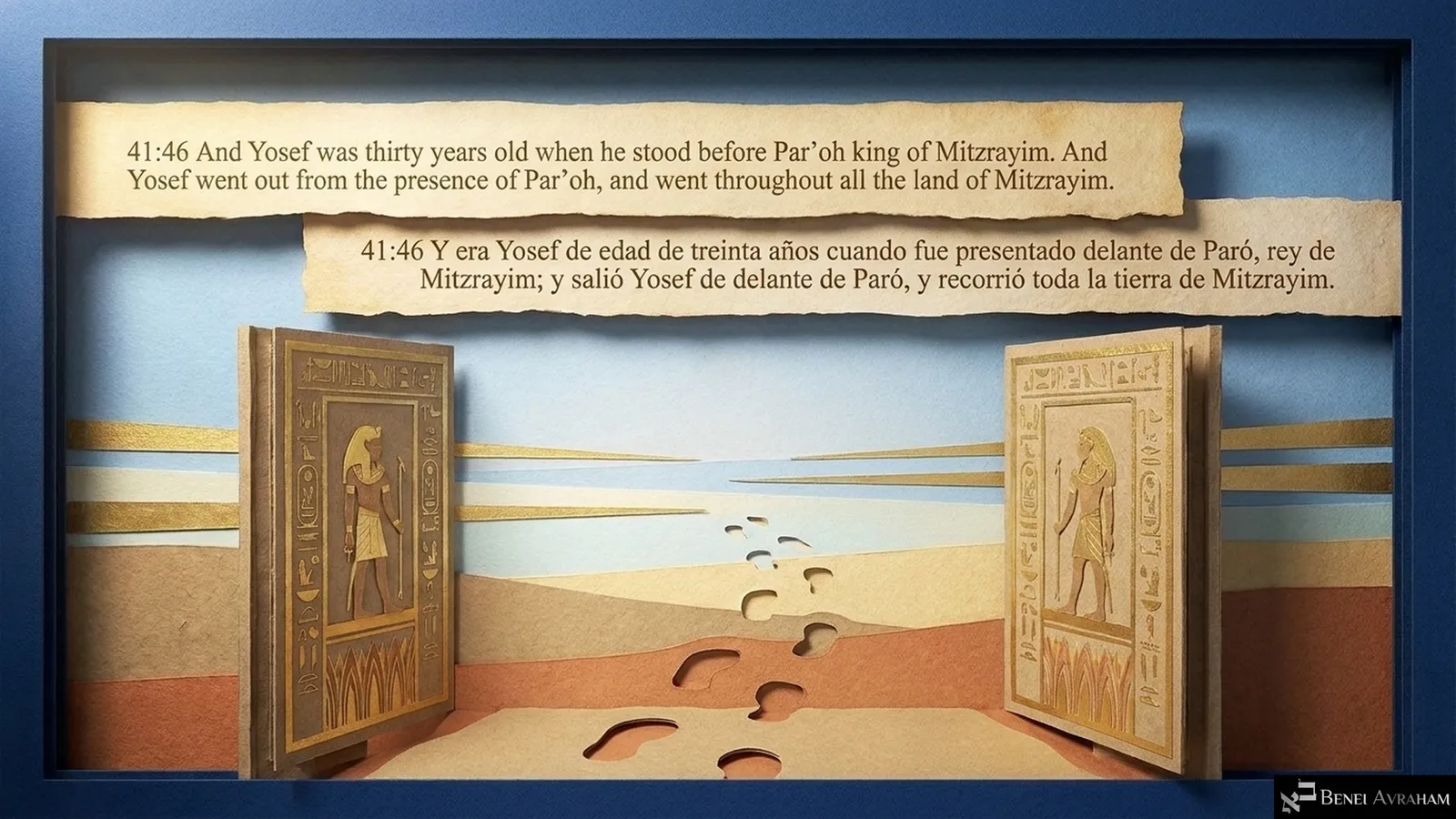
Two carved gates open onto a desert path of footprints: Yosef was thirty years old when he stood before Par’oh, and he went throughout all the land of Mitzrayim (Genesis 41:46).
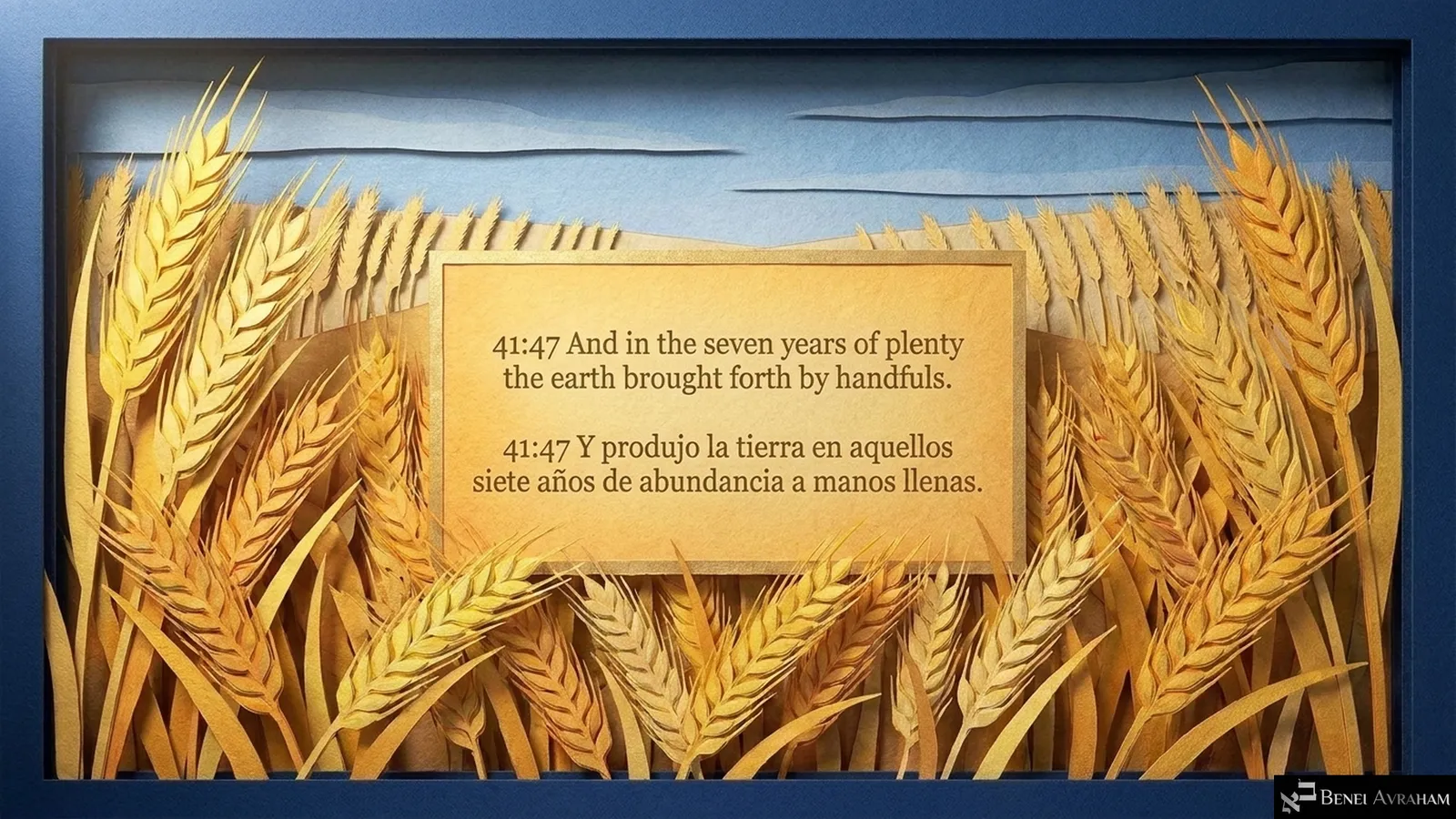
A golden paper wheat field stretches under a blue sky: in the seven years of plenty the earth brought forth by handfuls (Genesis 41:47).
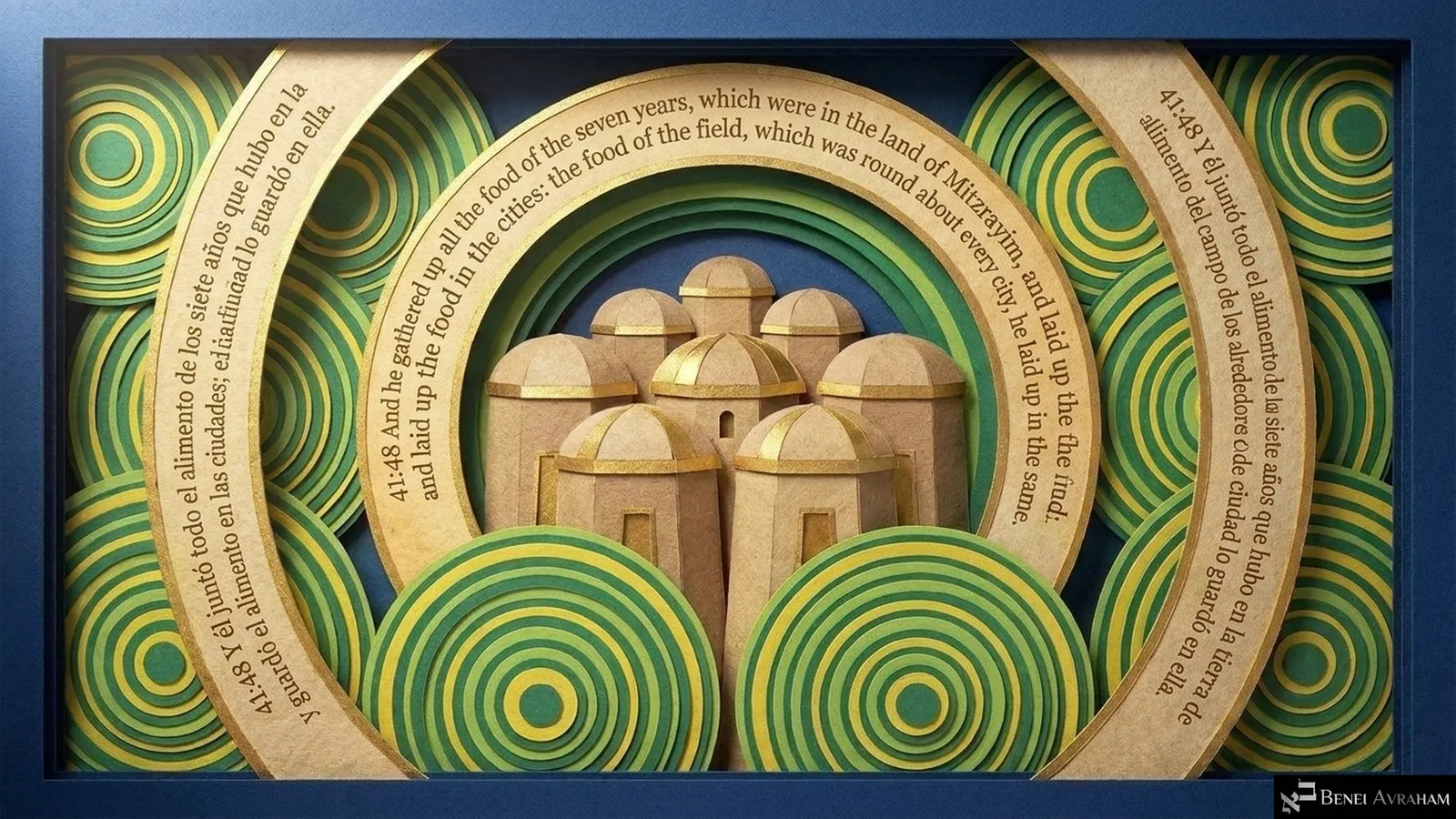
Domed paper storehouses at the centre of green and gold rings: Yosef gathered up all the food of the seven years and laid it up in the cities (Genesis 41:48).
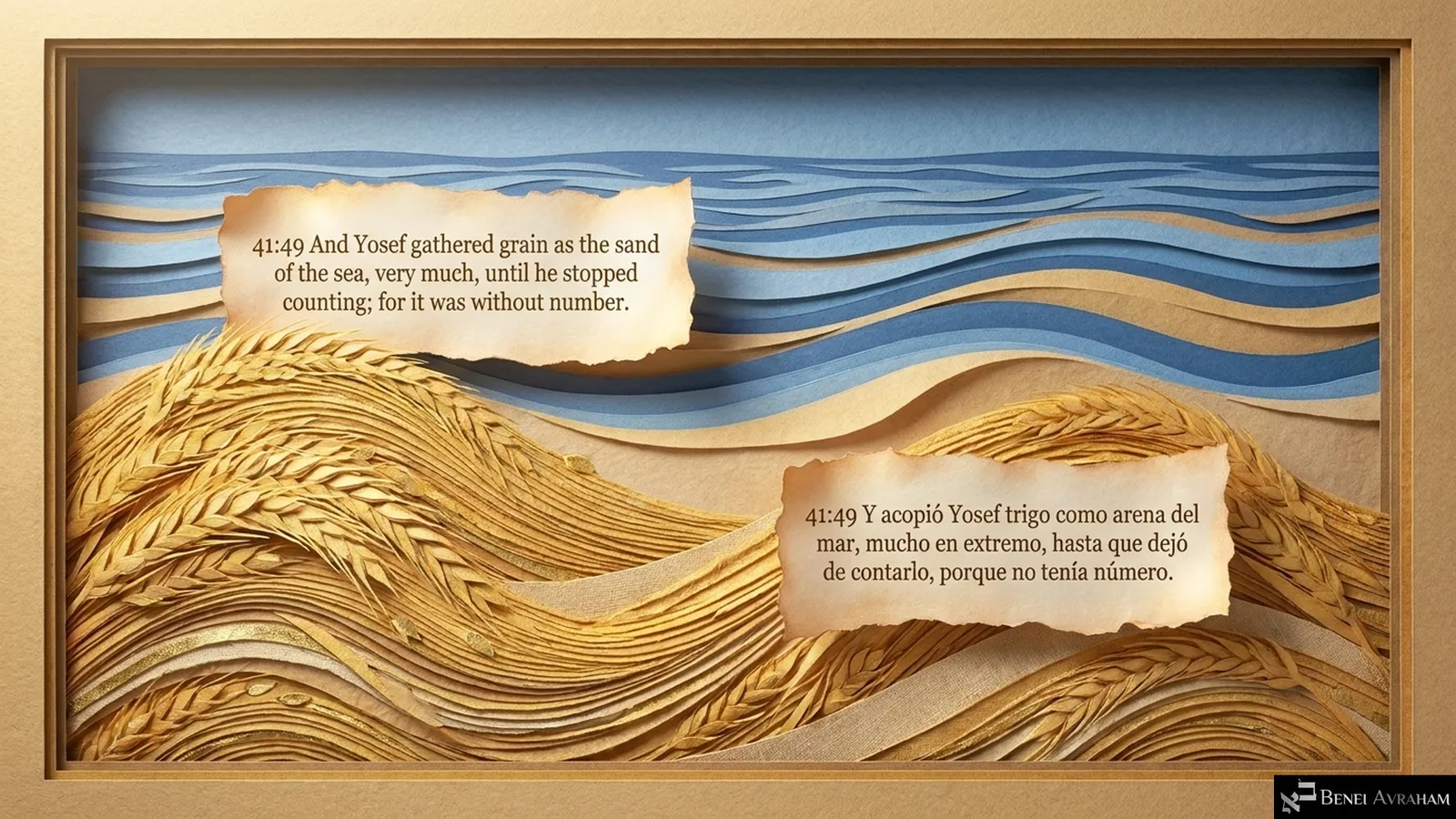
Waves of golden grain roll like the sea beneath layered blue waves: Yosef gathered grain as the sand of the sea, very much, until he stopped counting (Genesis 41:49).
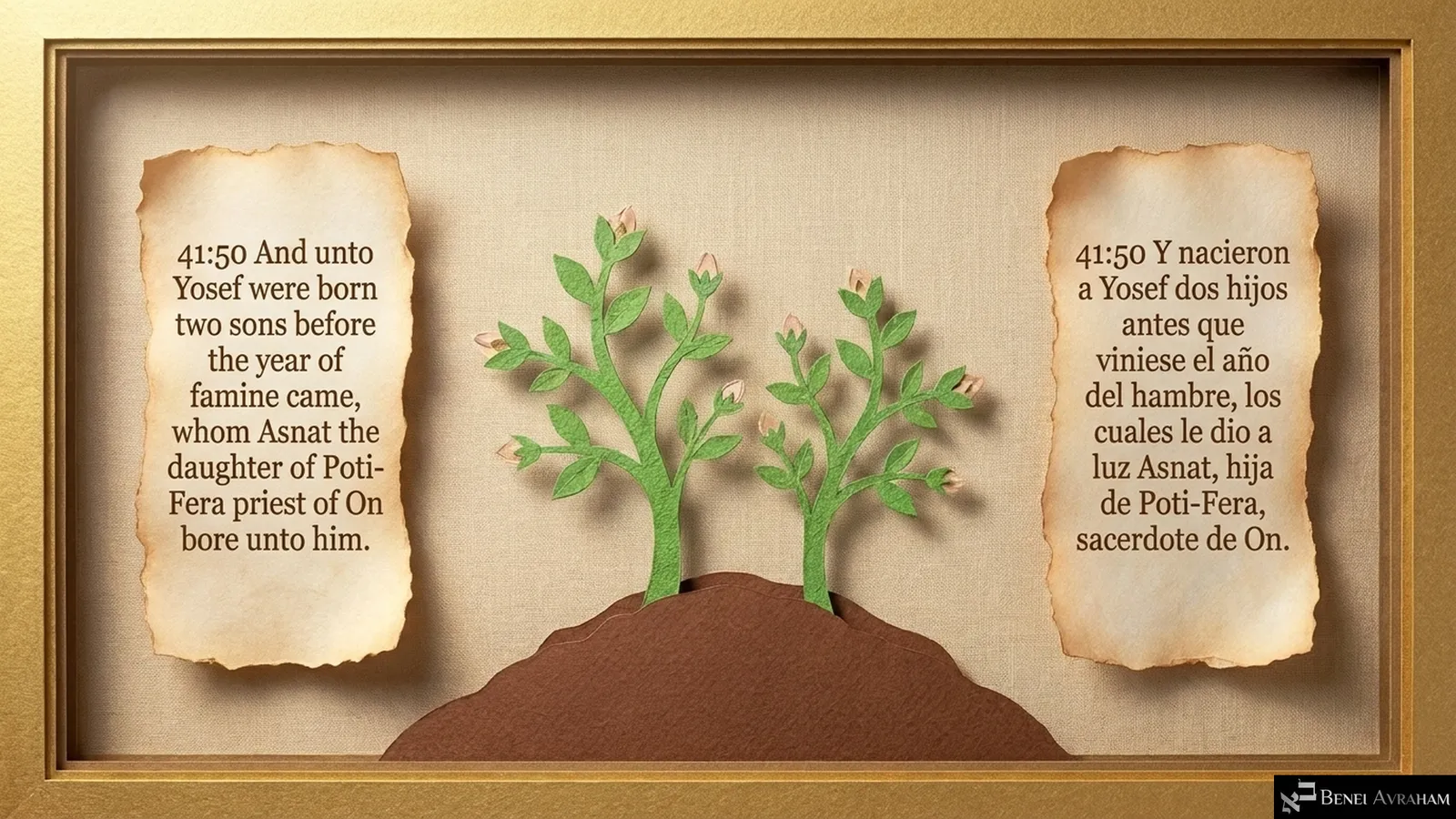
Two green paper saplings with pink buds grow from a mound of earth: unto Yosef were born two sons before the year of famine came (Genesis 41:50).
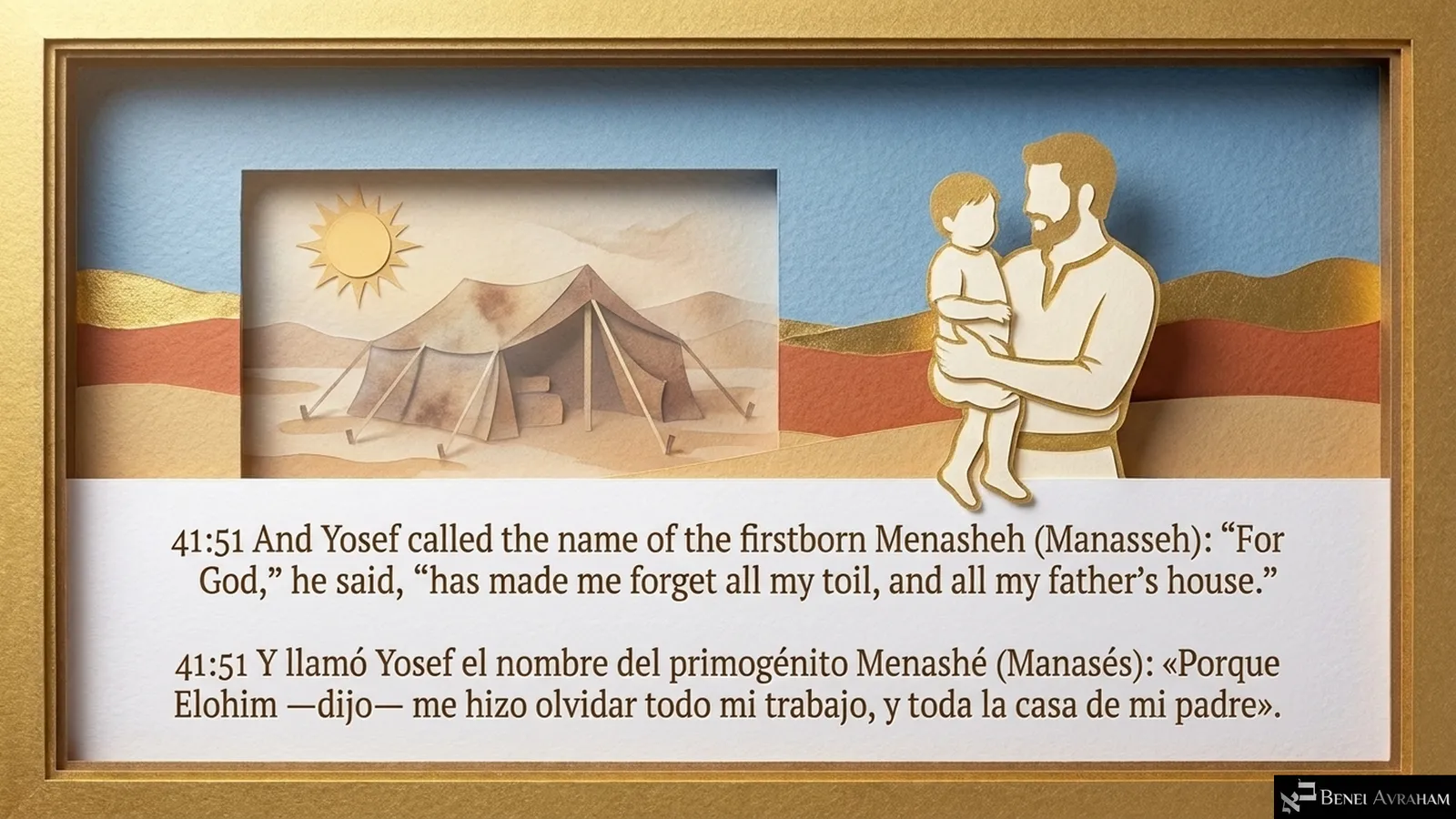
Yosef holds his firstborn son beside a faded picture of his father’s tent: Menasheh, “For God has made me forget all my toil, and all my father’s house” (Genesis 41:51).
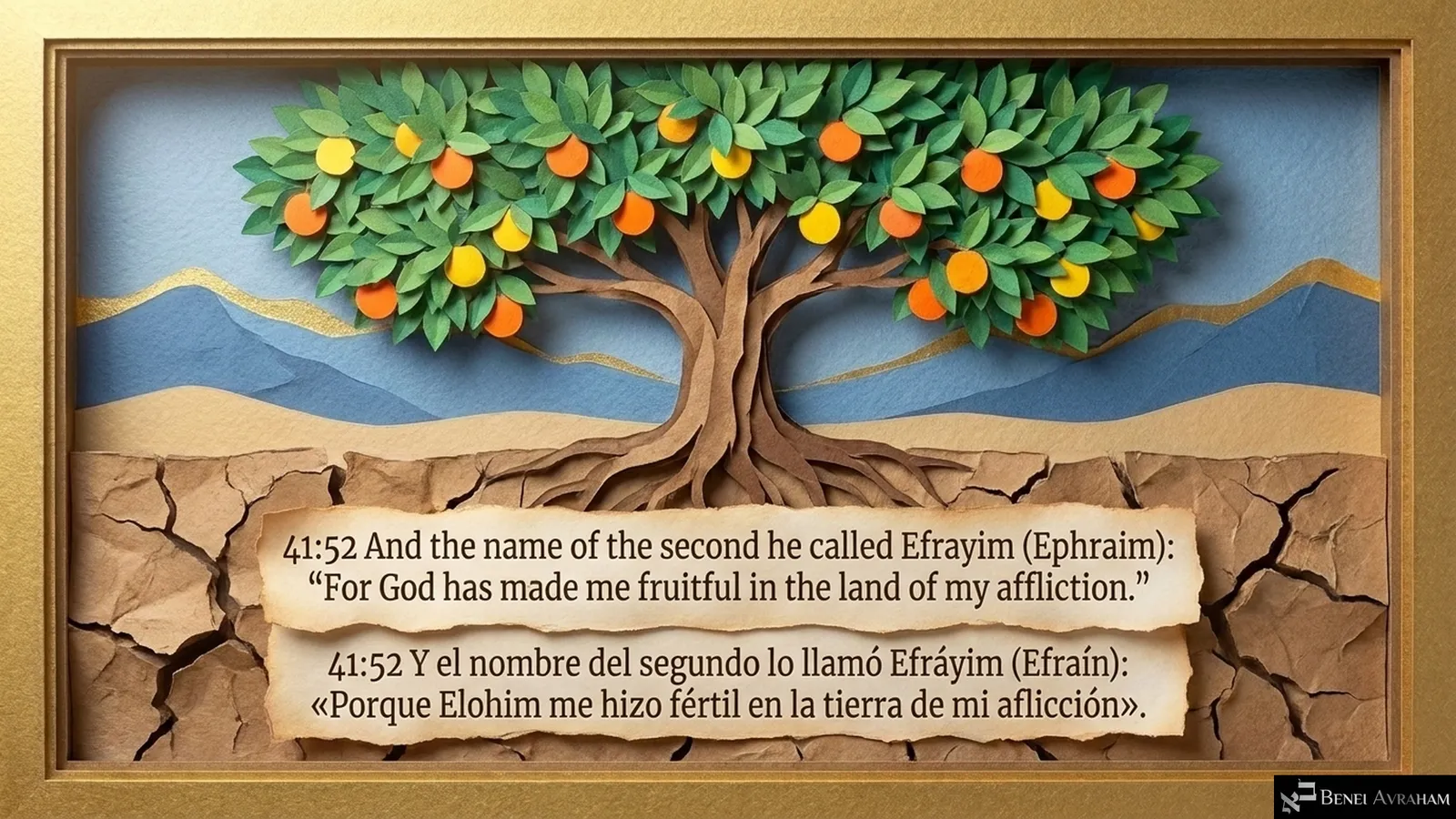
A fruit tree laden with oranges grows out of cracked dry earth: Efrayim, “For God has made me fruitful in the land of my affliction” (Genesis 41:52).
Revi’i · Genesis 41:53–42:18

Fourth Portion
Title card for the fourth portion above paper temples and palms: “Parashat Miketz, The Fourth Portion (Revi’i), Genesis 41:53–42:18”.
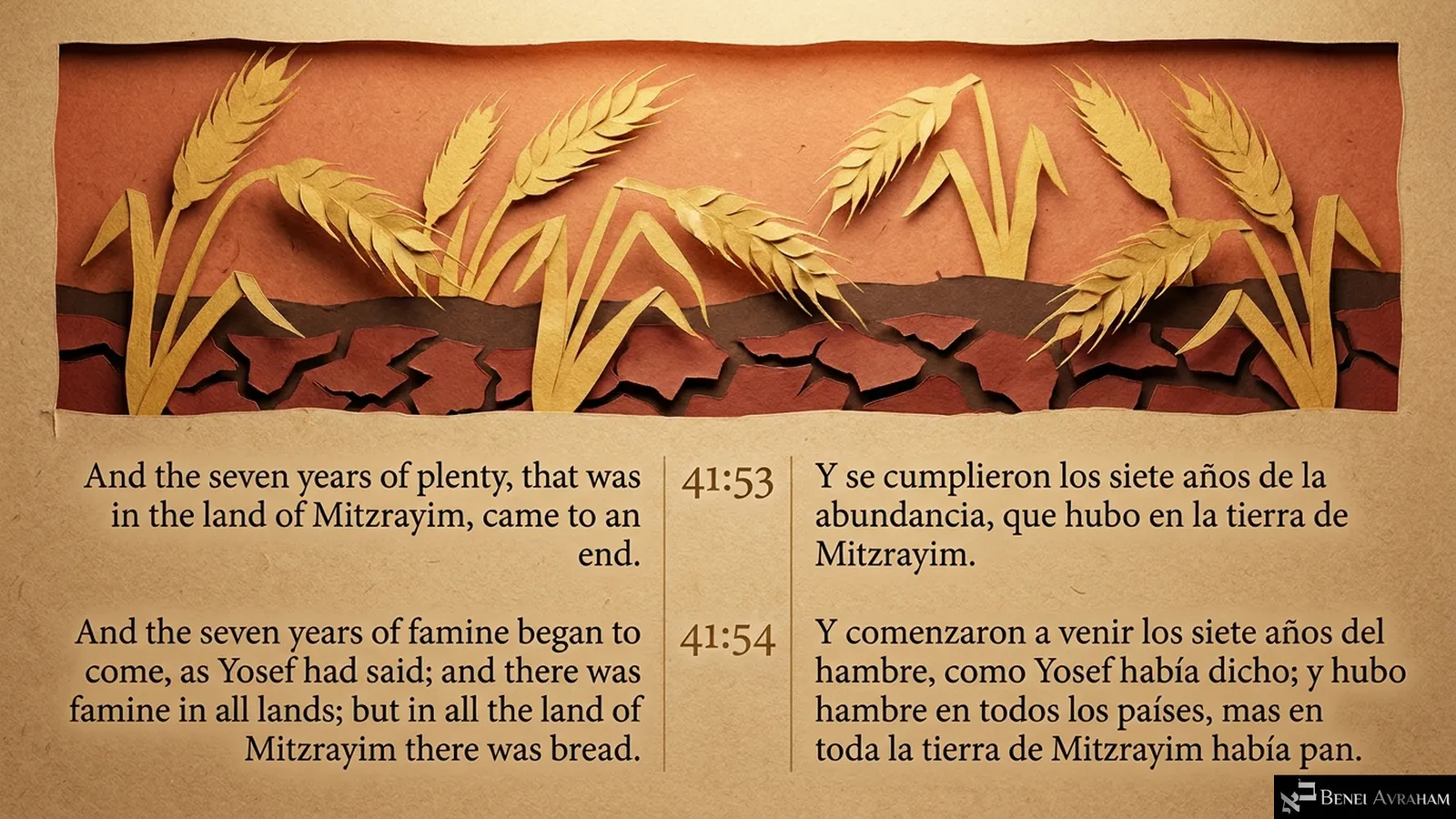
Wilting paper wheat bends over cracked red earth: the seven years of plenty came to an end and the seven years of famine began, but in all the land of Mitzrayim there was bread (Genesis 41:53–54).
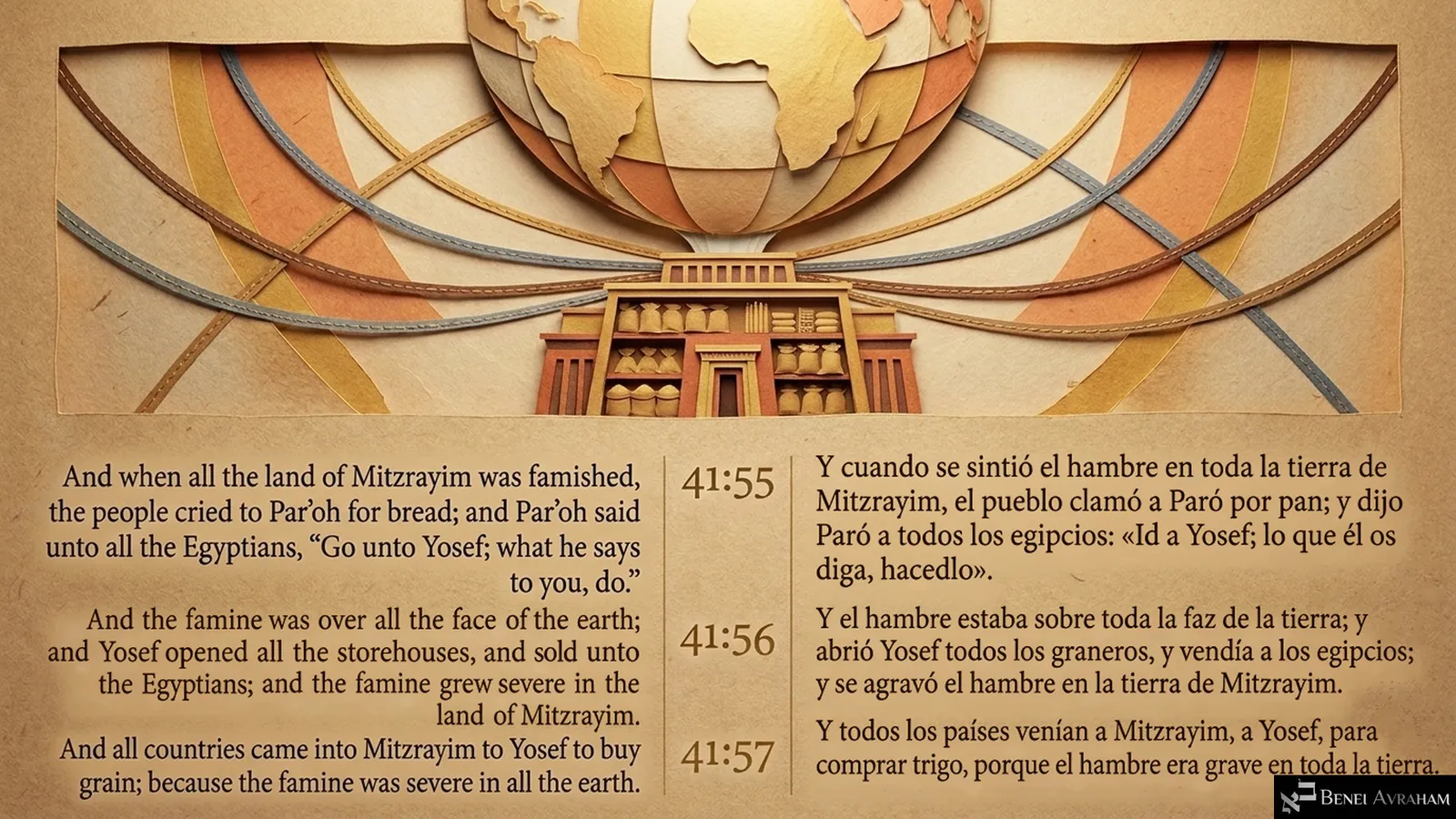
A paper globe of the world rests on Yosef’s storehouse, with roads converging from every side: “Go unto Yosef; what he says to you, do”; and all countries came into Mitzrayim to buy grain (Genesis 41:55–57).
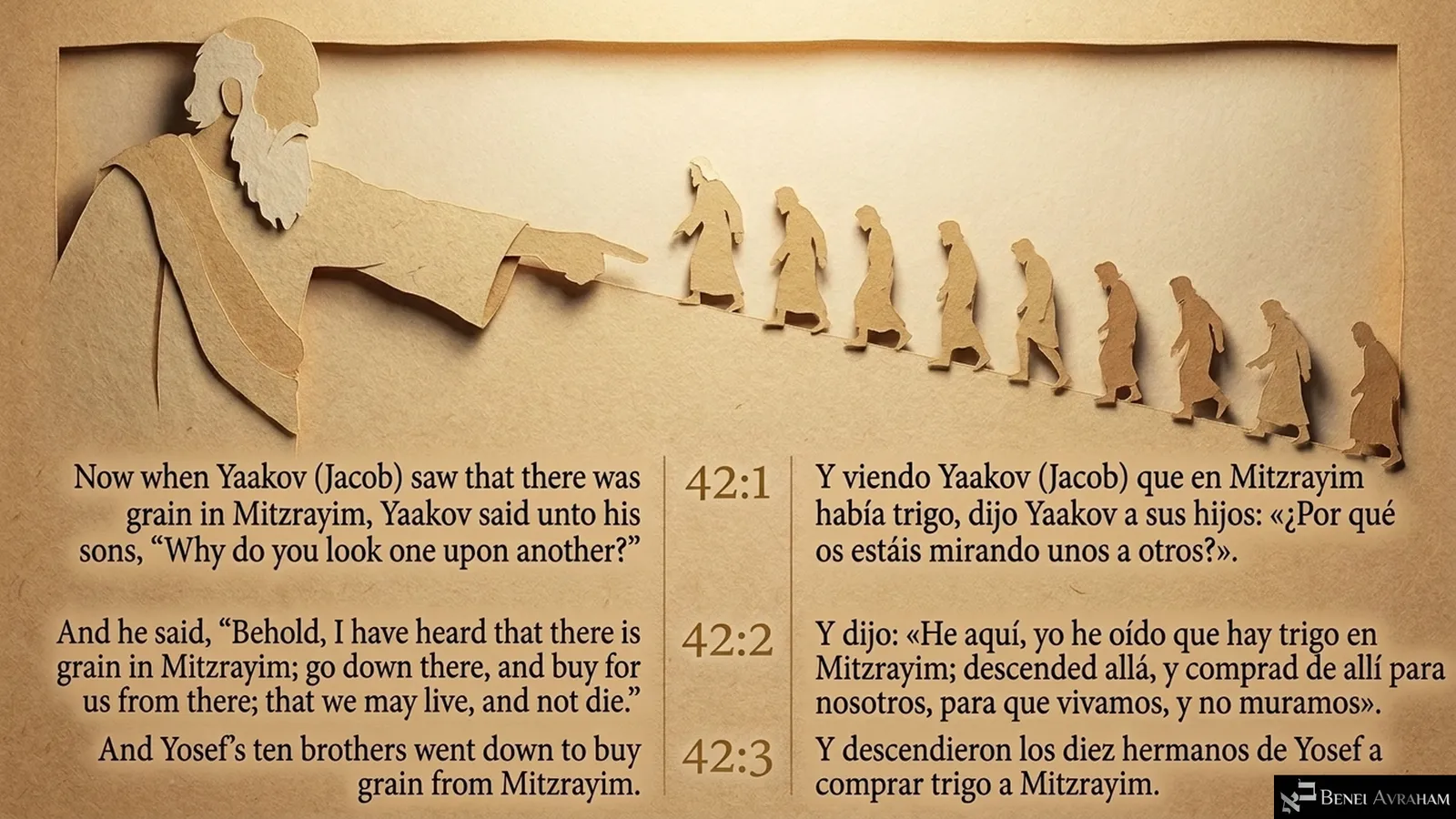
Old Yaakov points the way as ten paper figures walk off in a line: “Why do you look one upon another? … go down there, and buy for us”; and Yosef’s ten brothers went down (Genesis 42:1–3).
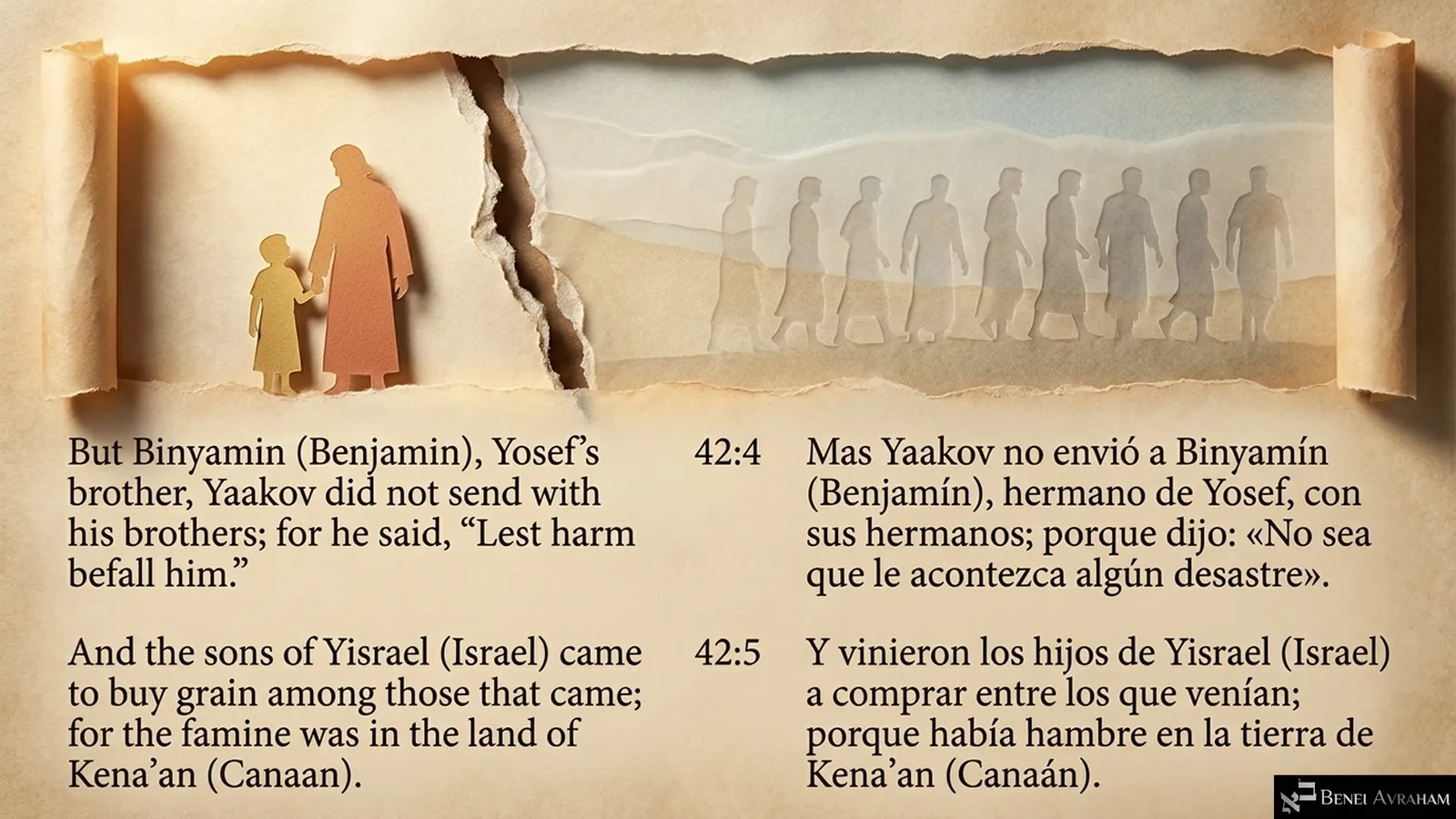
Yaakov keeps young Binyamin by his side as the ten brothers fade into the distance beyond a tear in the scroll: “Lest harm befall him”; for the famine was in the land of Kena’an (Genesis 42:4–5).
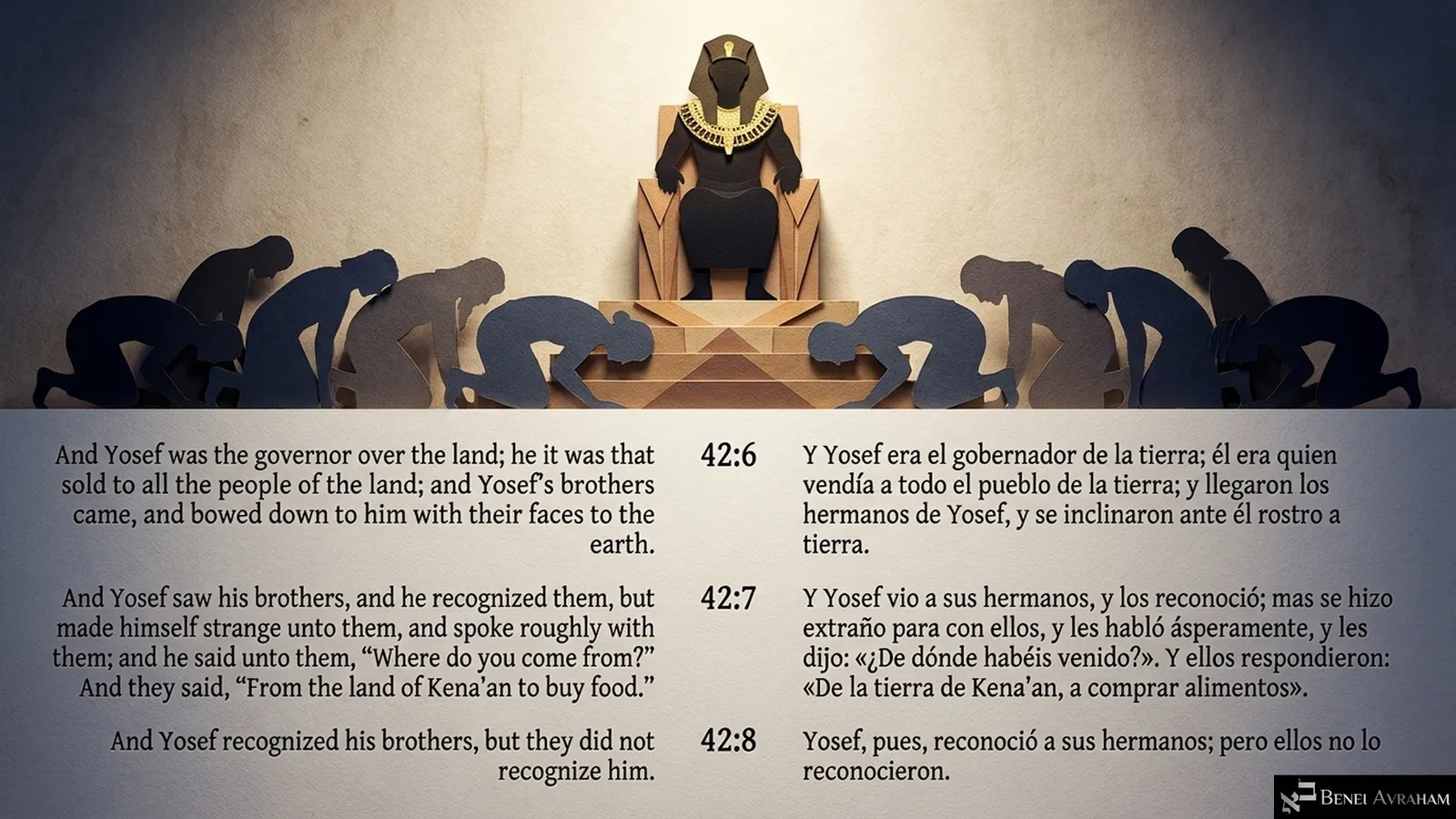
Yosef sits enthroned as his brothers bow down to him with their faces to the earth: he recognized them, but made himself strange unto them, and they did not recognize him (Genesis 42:6–8).
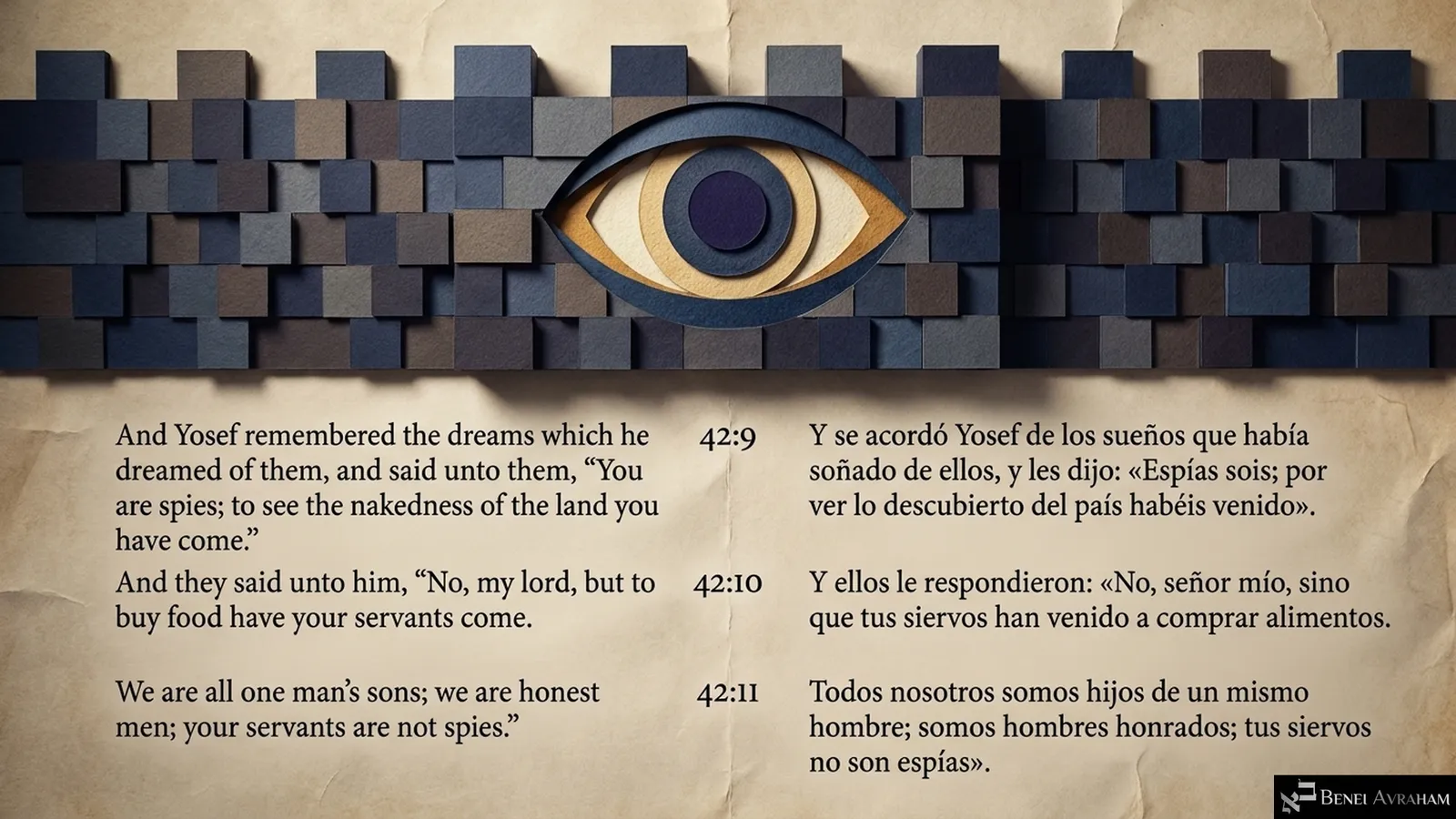
A watchful paper eye set in a wall of dark blocks: “You are spies; to see the nakedness of the land you have come.” “No, my lord … we are honest men” (Genesis 42:9–11).
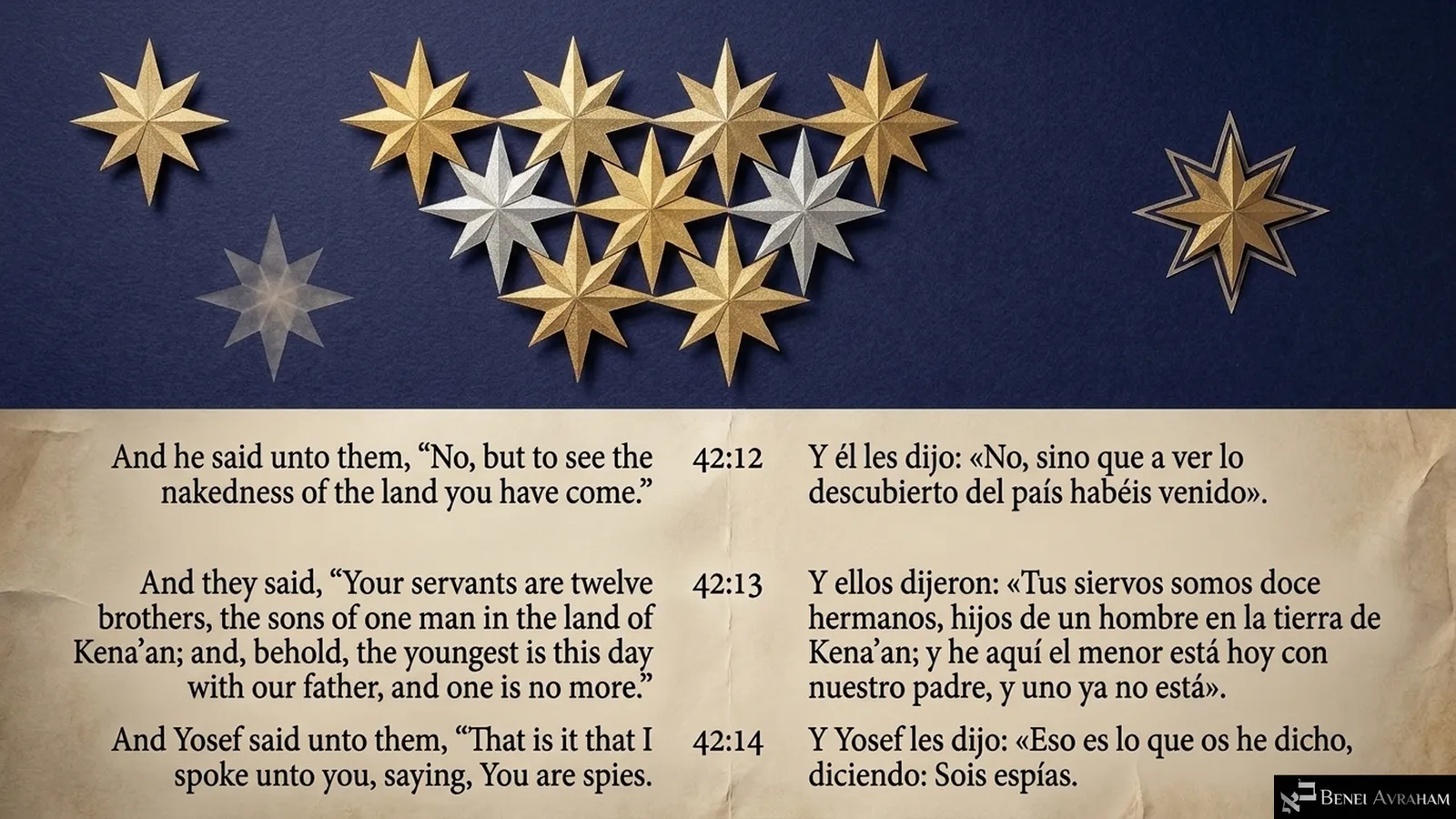
Paper stars on a deep blue sky, ten gold and silver together, one faint and one apart: “Your servants are twelve brothers … the youngest is this day with our father, and one is no more” (Genesis 42:12–14).
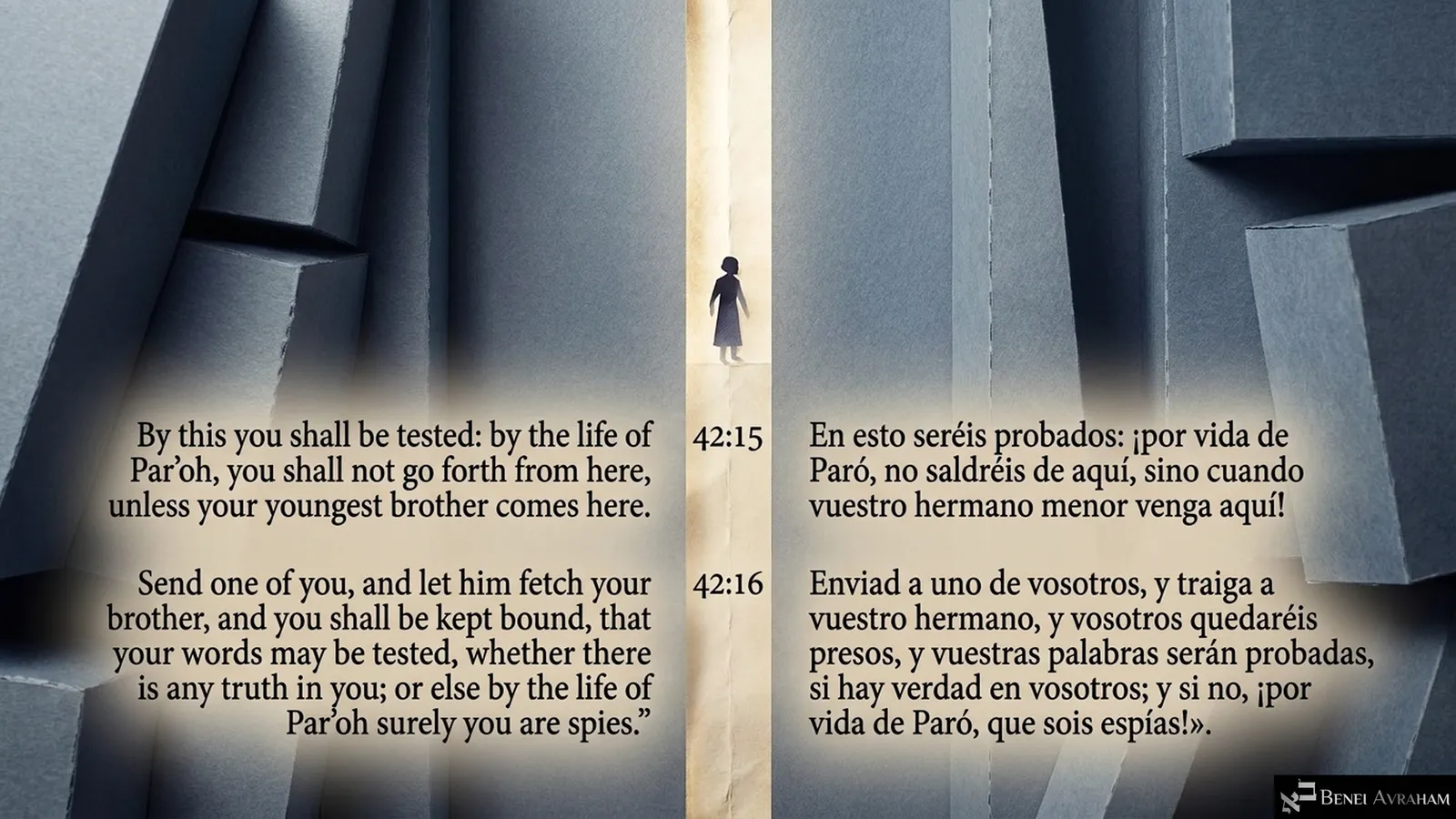
A small figure stands in a narrow beam of light between towering grey walls: “By this you shall be tested … send one of you, and let him fetch your brother, and you shall be kept bound” (Genesis 42:15–16).
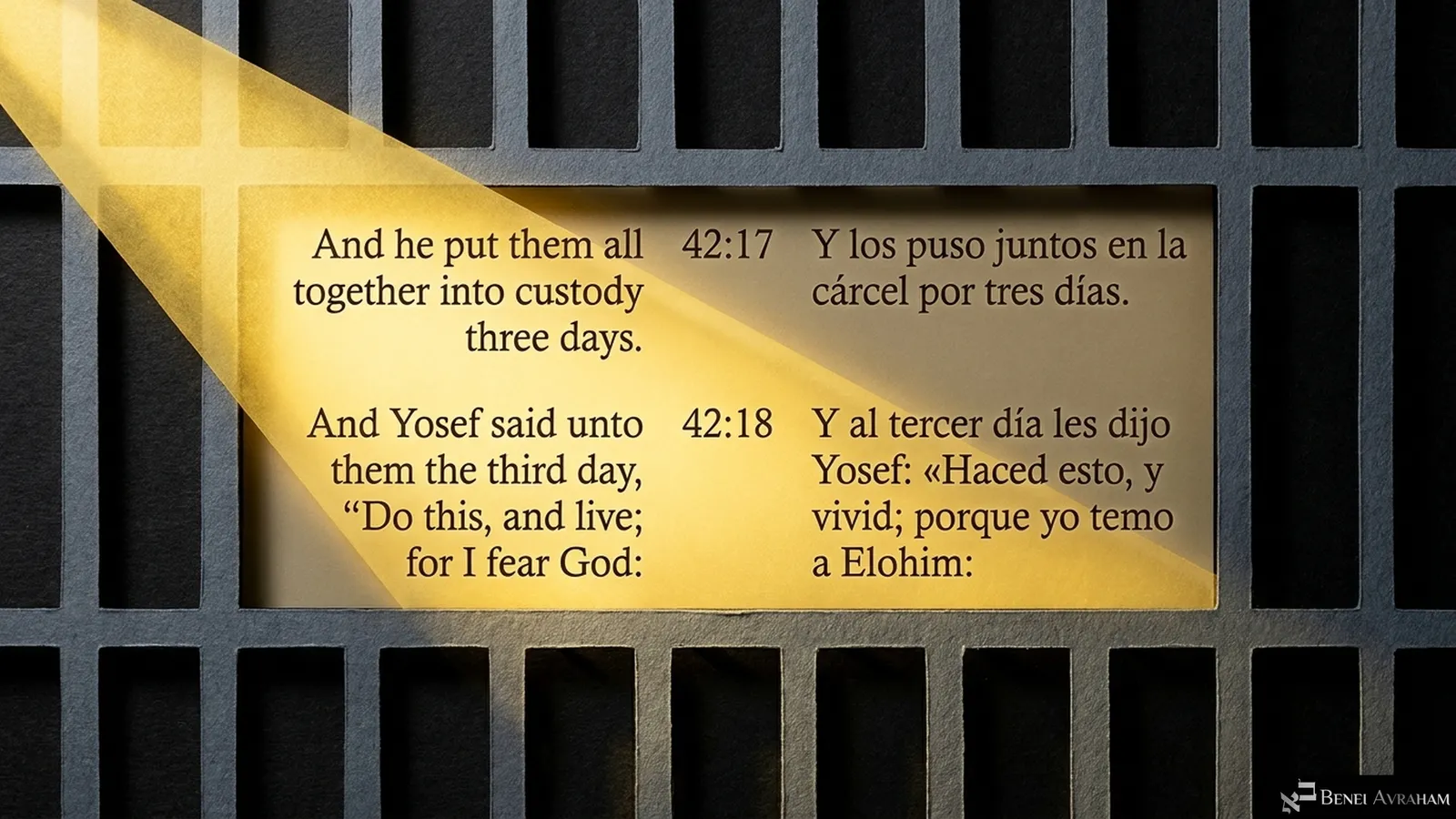
A shaft of golden light falls through dark prison bars: he put them all together into custody three days, and on the third day Yosef said, “Do this, and live; for I fear God” (Genesis 42:17–18).
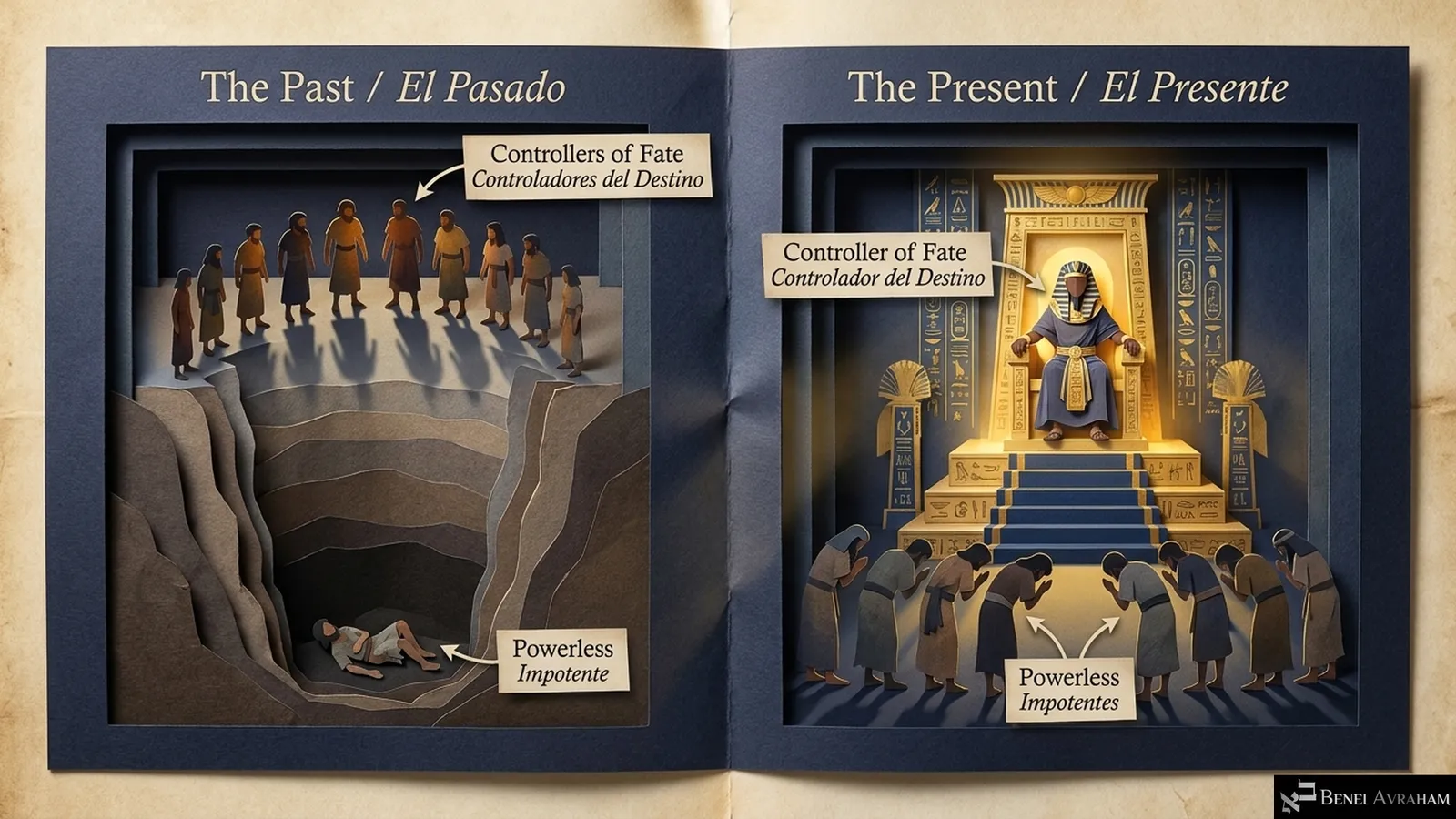
Two paper scenes side by side: in the past the brothers stood over Yosef lying powerless in the pit; in the present Yosef sits enthroned while the brothers bow, powerless before him.
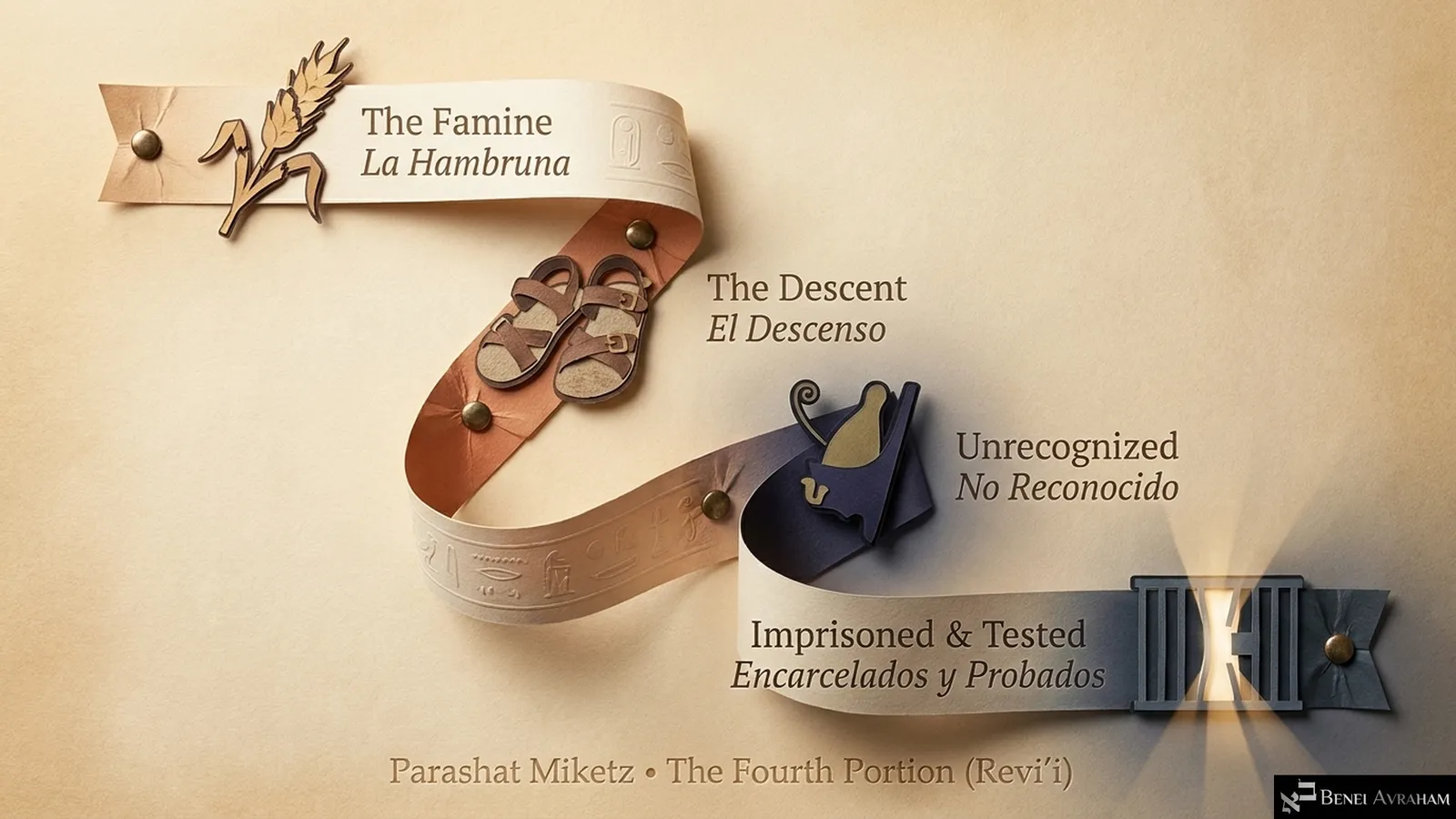
A winding paper ribbon traces the fourth portion: the famine, the descent to Mitzrayim, unrecognized, and imprisoned and tested.
Chamishi · Genesis 42:19–43:15

Fifth Portion
Title card for the fifth portion with a silver goblet and tall paper wheat: “Parashat Miketz, 5th Portion (Chamishi), Genesis 42:19–43:15”.
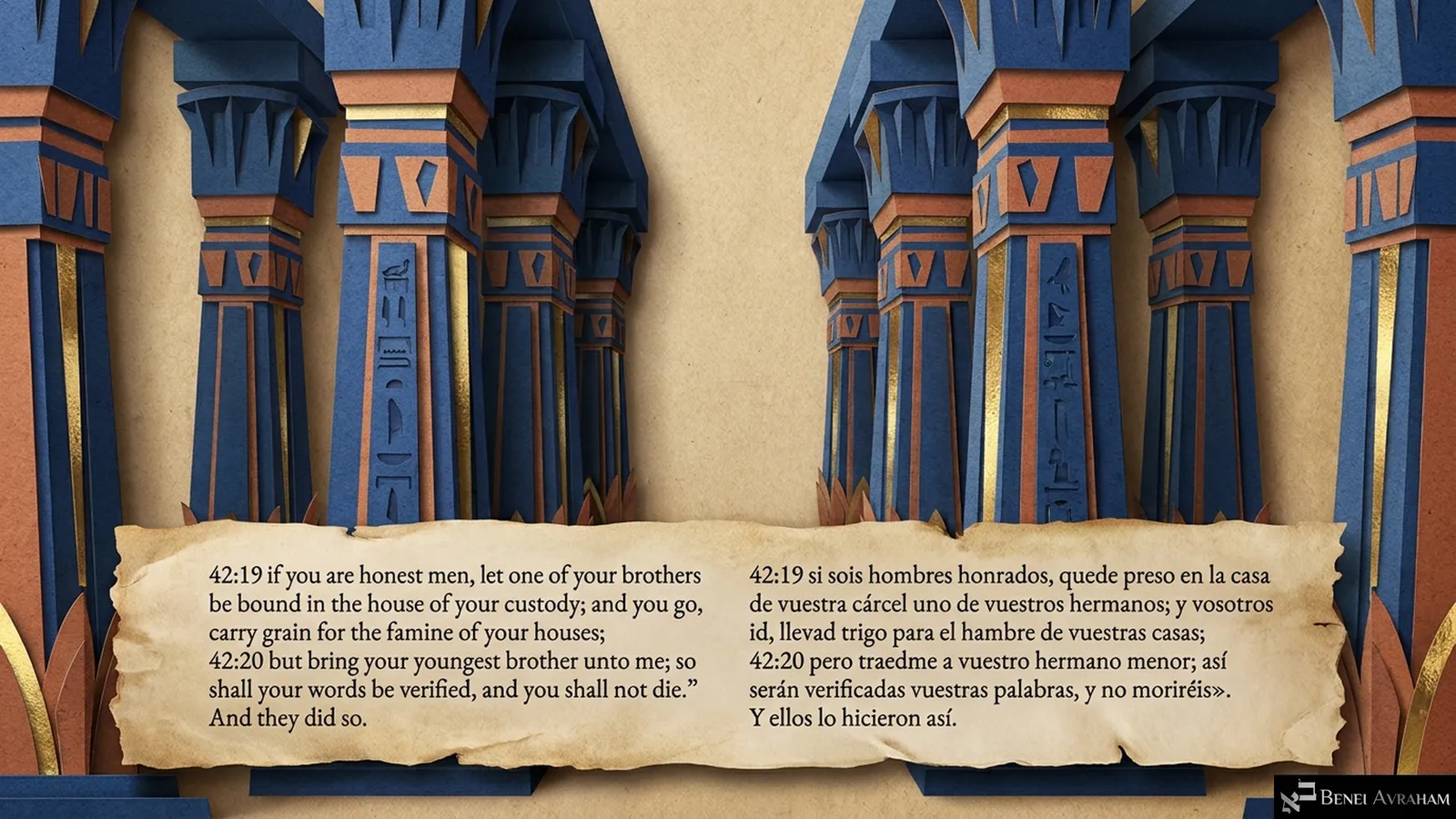
Blue and copper paper columns of an Egyptian hall: “Let one of your brothers be bound … but bring your youngest brother unto me; so shall your words be verified” (Genesis 42:19–20).
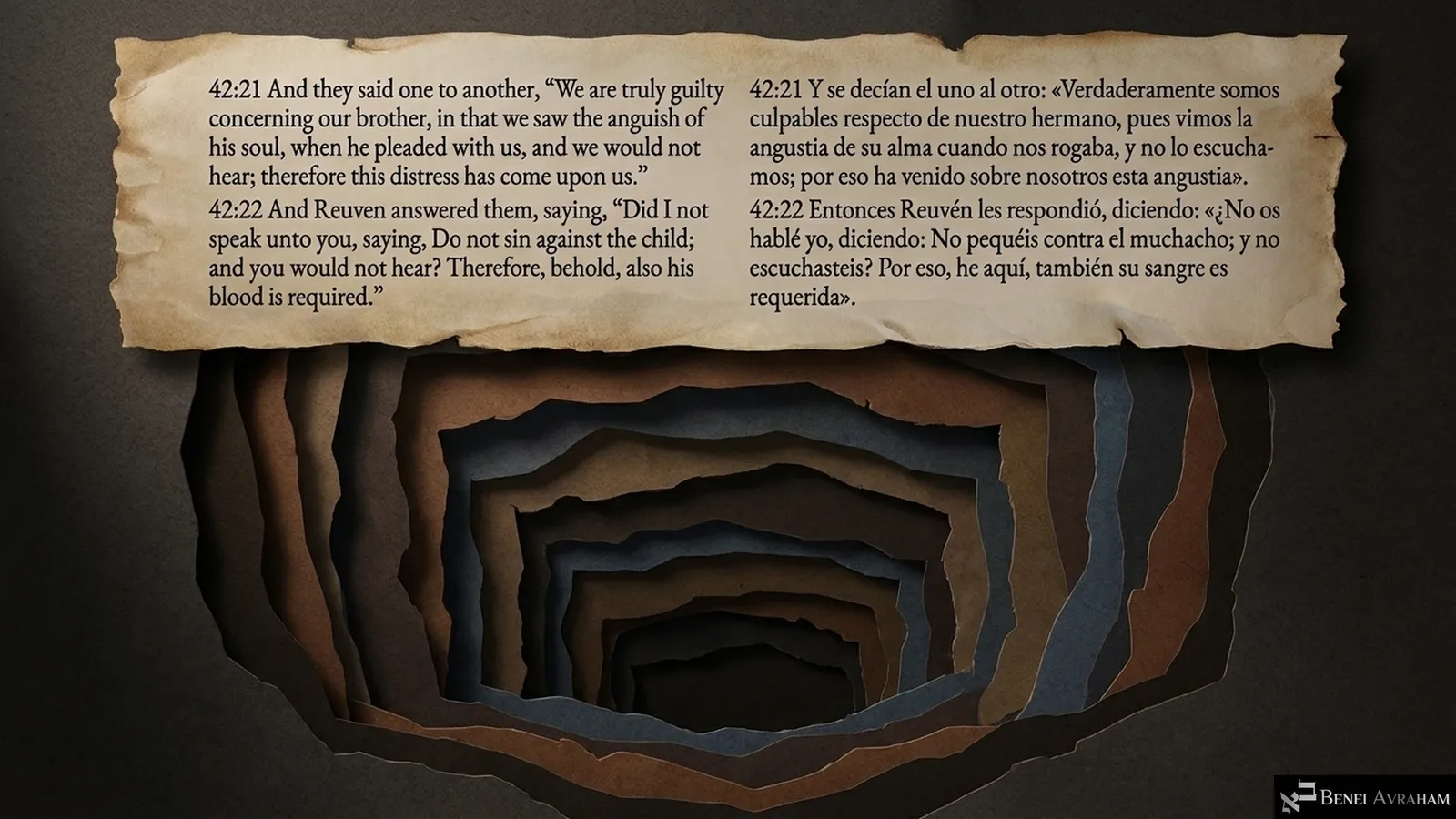
A deep layered pit of torn brown and blue paper beneath the verses: “We are truly guilty concerning our brother … therefore this distress has come upon us”; “Did I not speak unto you, Do not sin against the child?” (Genesis 42:21–22).
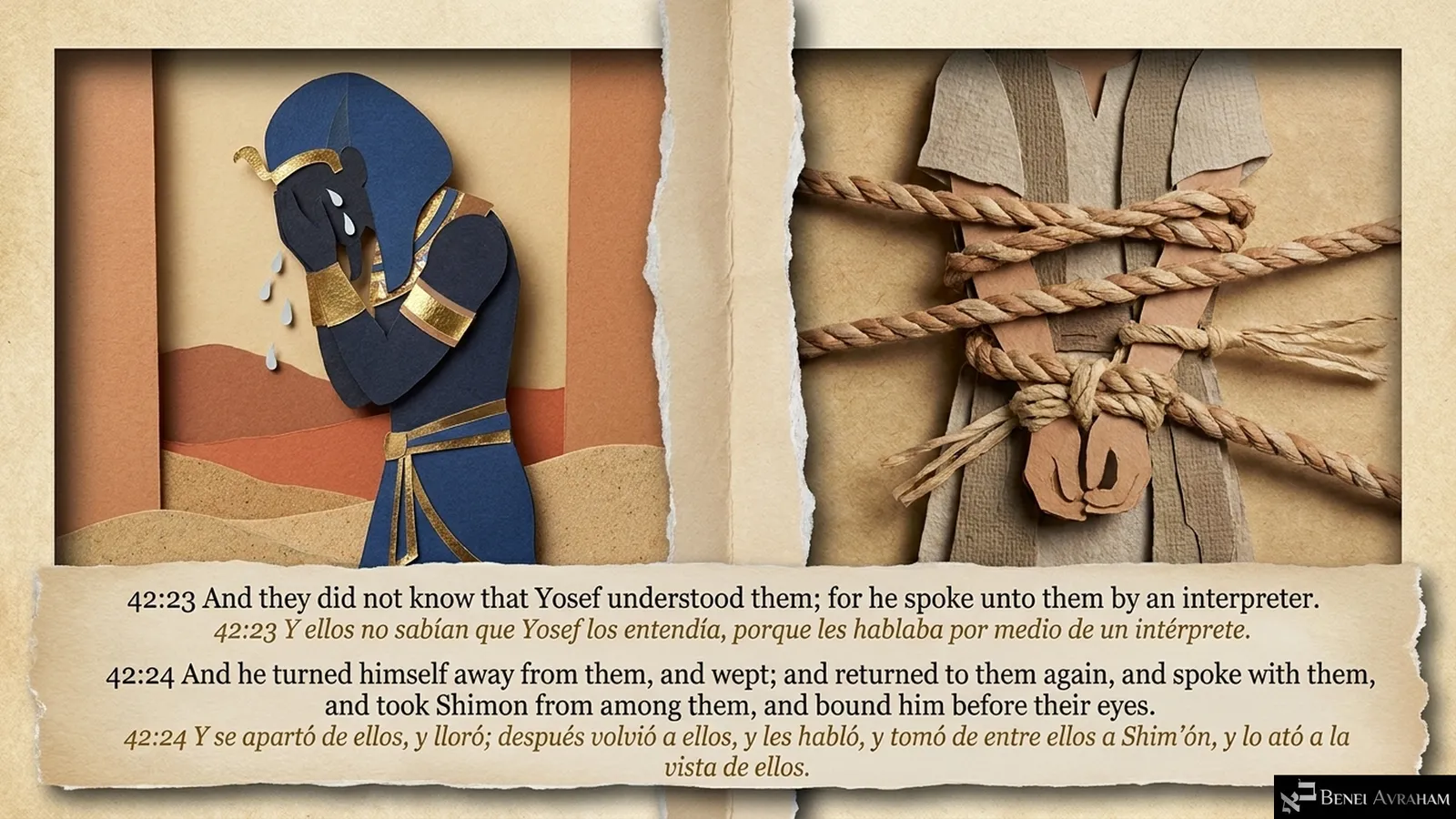
Yosef turns away weeping on one side, and Shimon’s hands are bound with rope on the other: they did not know that Yosef understood them; he wept, and took Shimon and bound him before their eyes (Genesis 42:23–24).
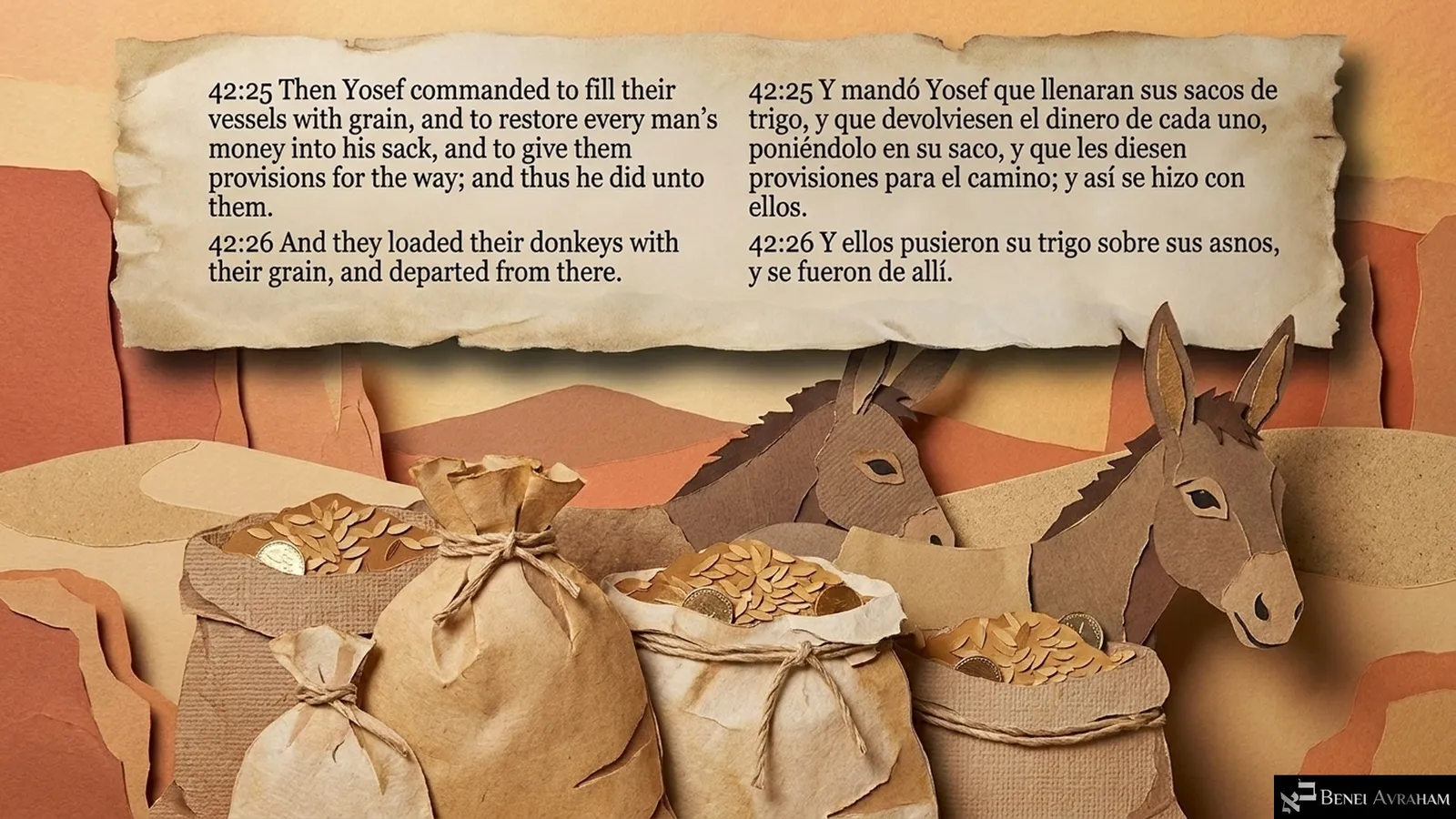
Paper sacks of grain, with coins tucked among the kernels, and two donkeys among red desert rocks: Yosef filled their vessels with grain and restored every man’s money into his sack (Genesis 42:25–26).
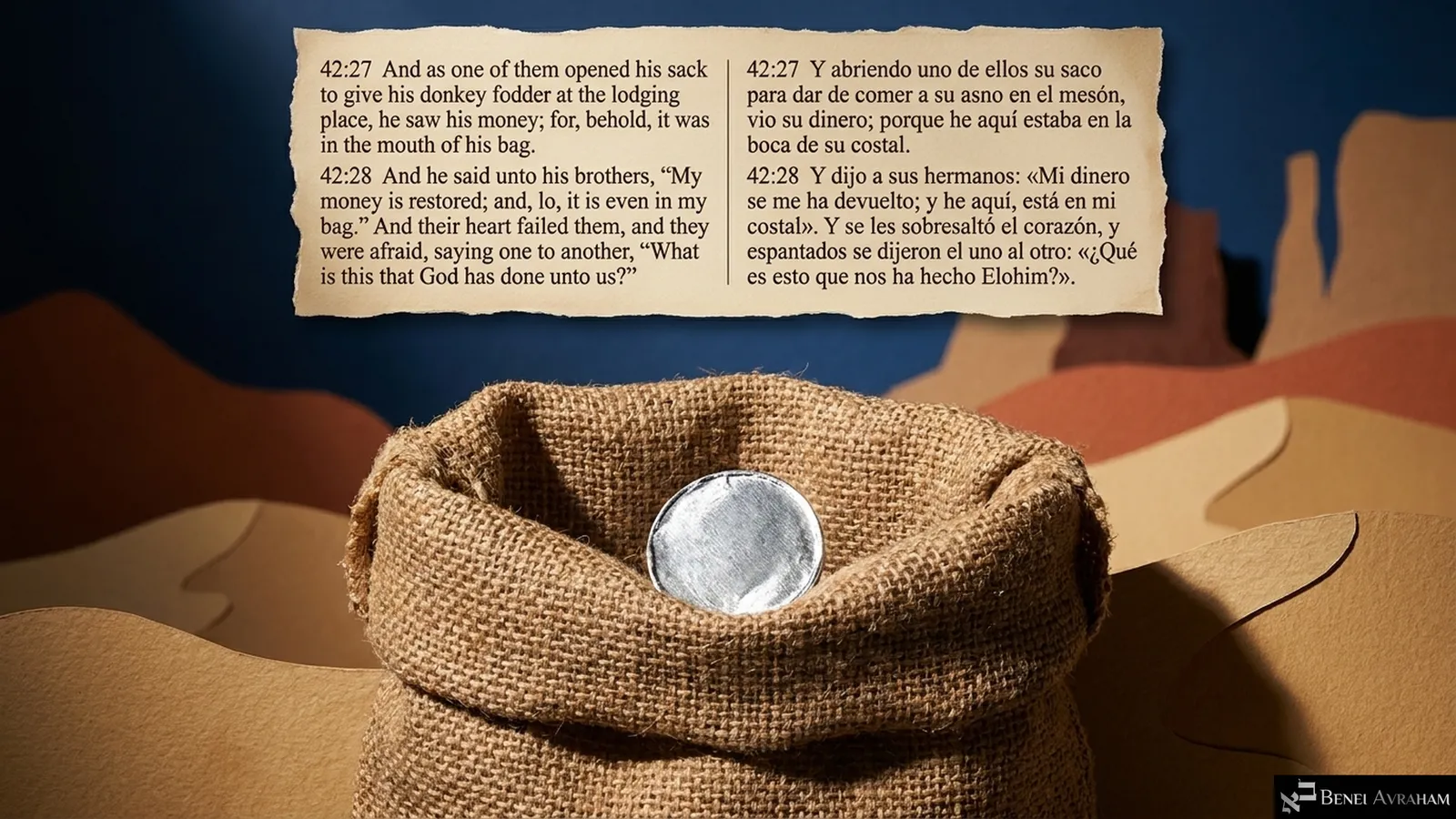
A burlap sack opens to show a silver coin in its mouth: “My money is restored … What is this that God has done unto us?” (Genesis 42:27–28).
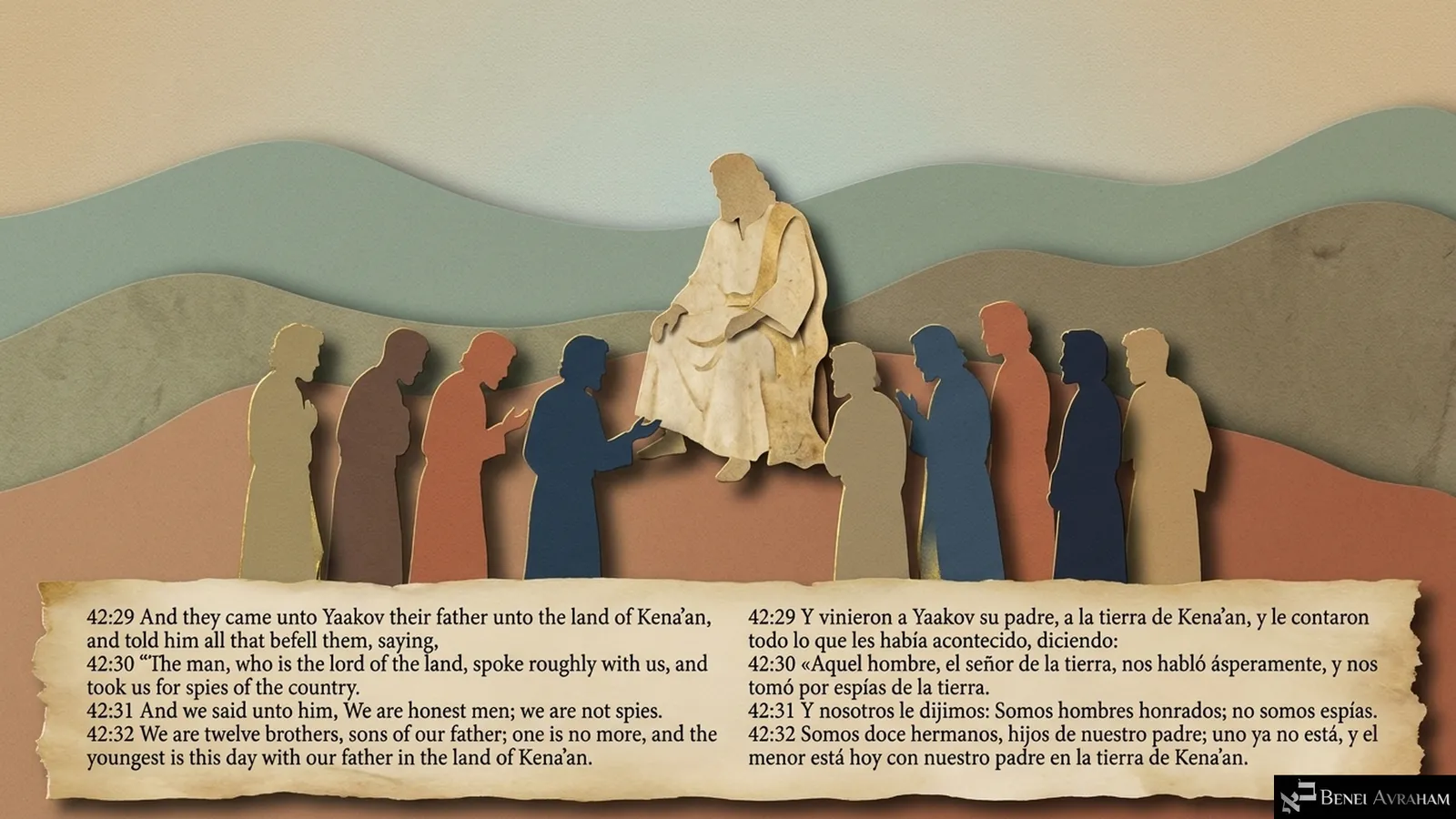
Paper figures of the brothers gather around Yaakov seated on the hills: they told him all that befell them, “The man, who is the lord of the land, spoke roughly with us” (Genesis 42:29–32).
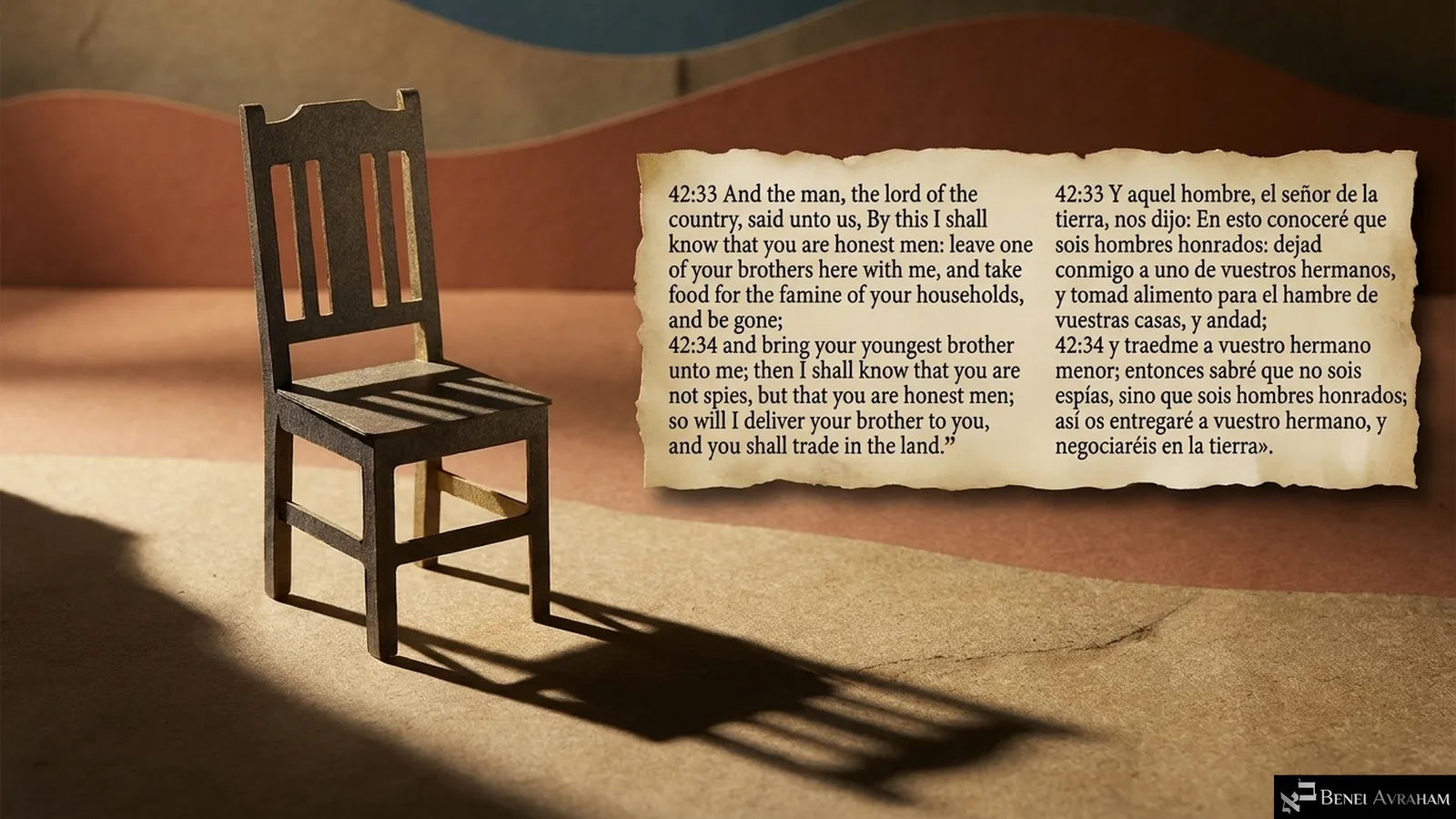
An empty wooden chair casts a long shadow across the floor: “Leave one of your brothers here with me … and bring your youngest brother unto me” (Genesis 42:33–34).
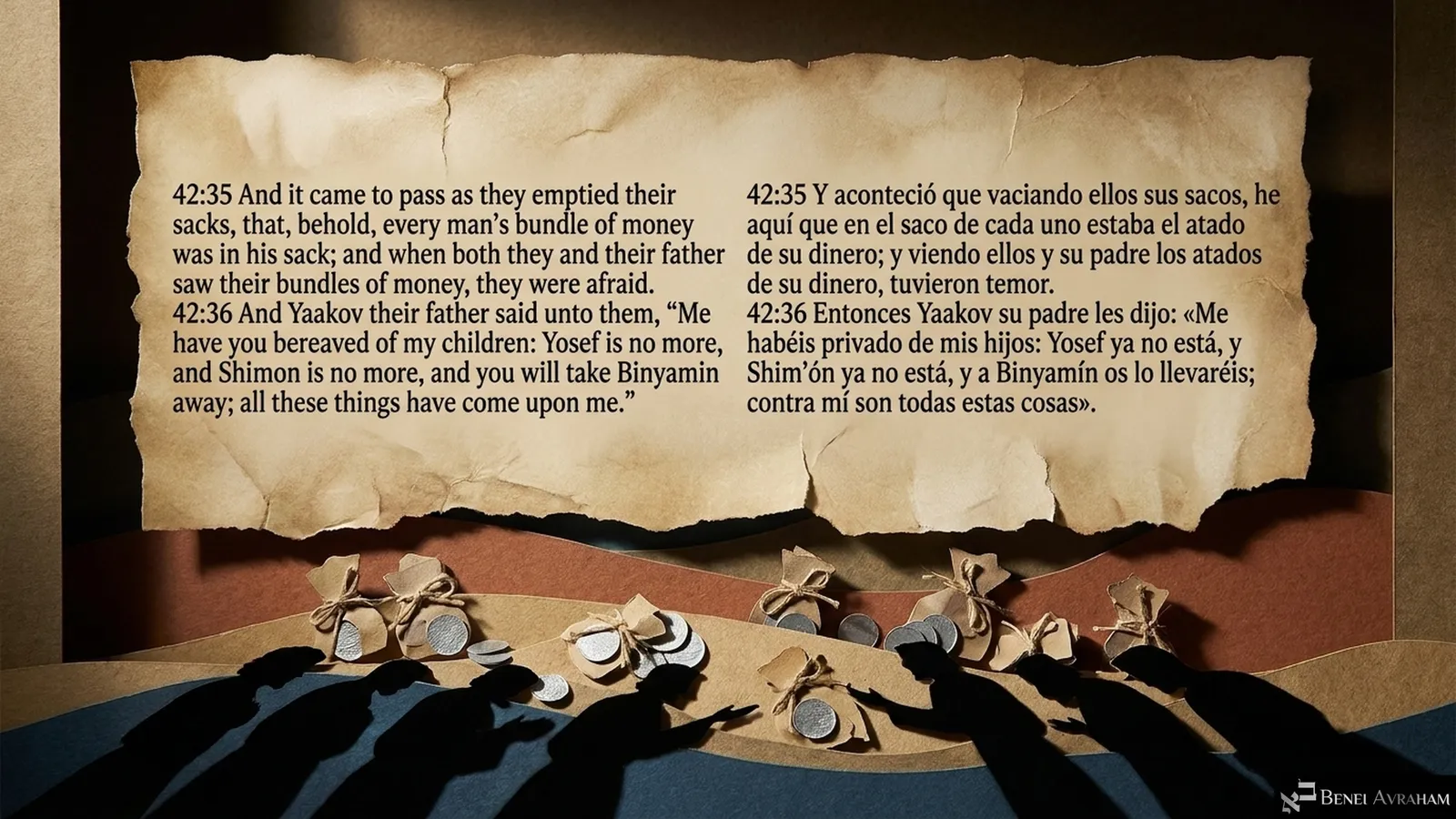
Dark paper silhouettes reach for opened money bundles spilling silver: every man’s bundle of money was in his sack; “Me have you bereaved of my children … all these things have come upon me” (Genesis 42:35–36).
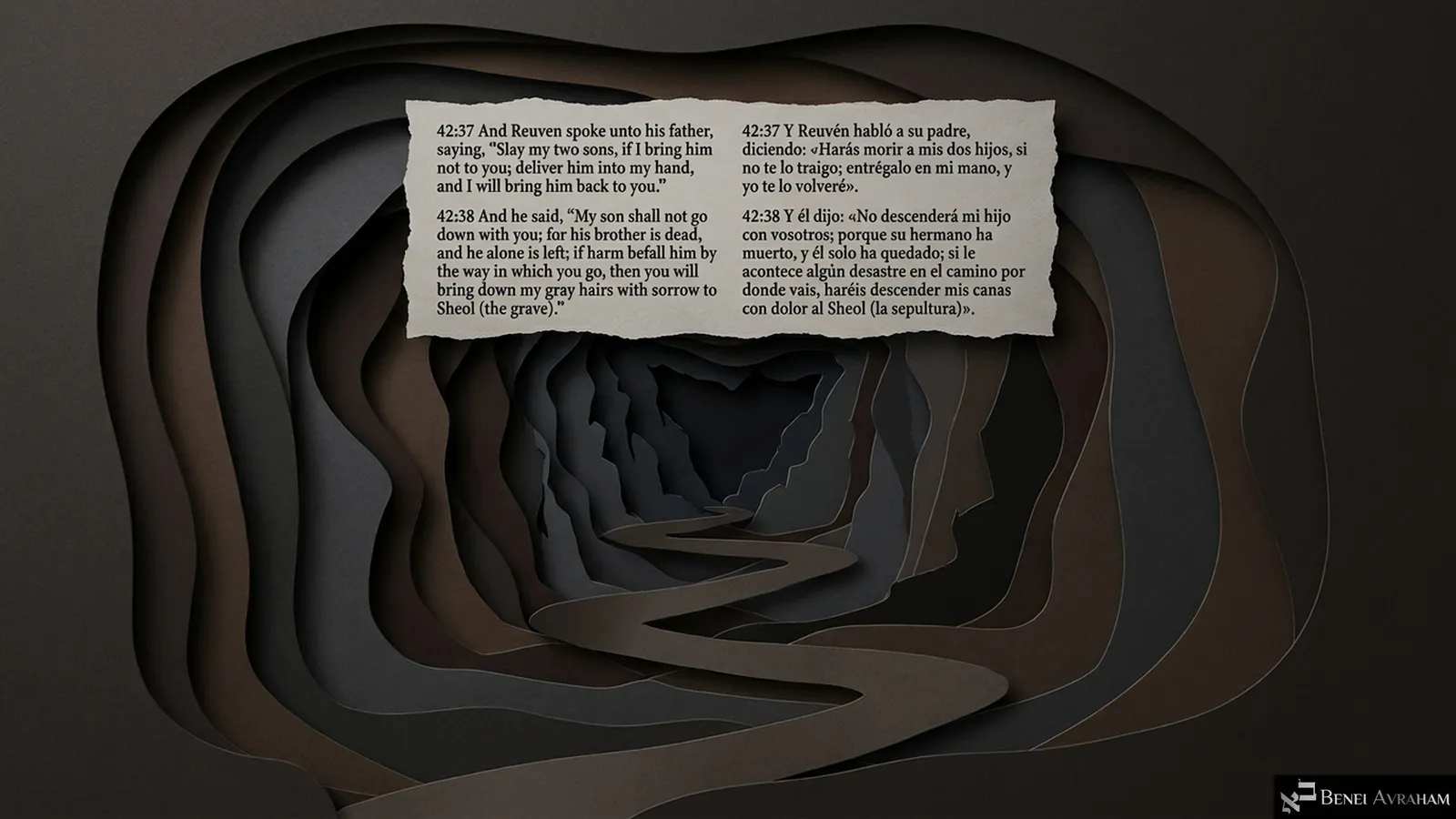
A narrow path winds down into a deep layered pit of grey paper: “My son shall not go down with you … you will bring down my gray hairs with sorrow to Sheol” (Genesis 42:37–38).
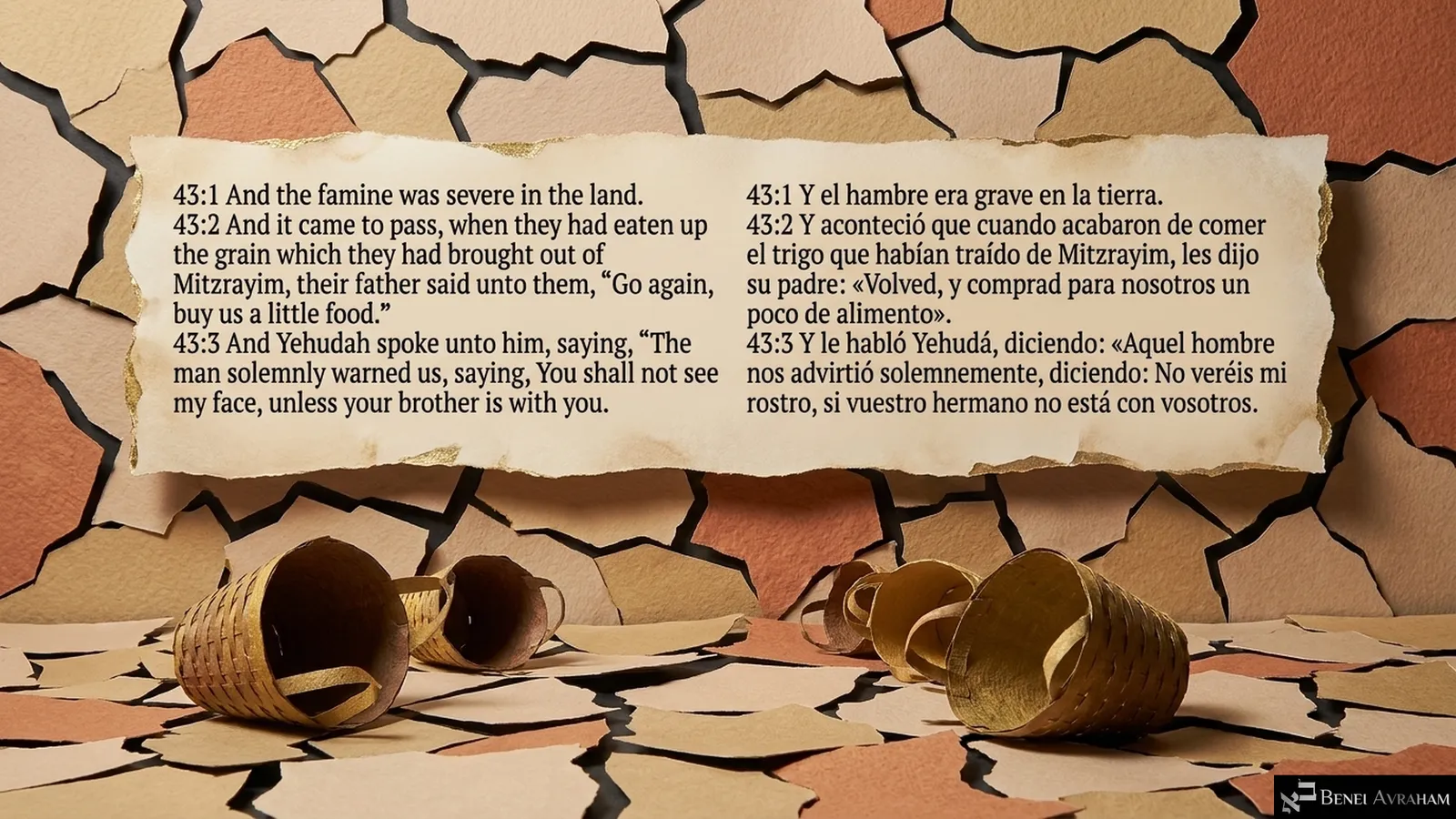
Empty woven baskets lie tipped over on cracked paper earth: the famine was severe in the land; “Go again, buy us a little food”; “You shall not see my face, unless your brother is with you” (Genesis 43:1–3).
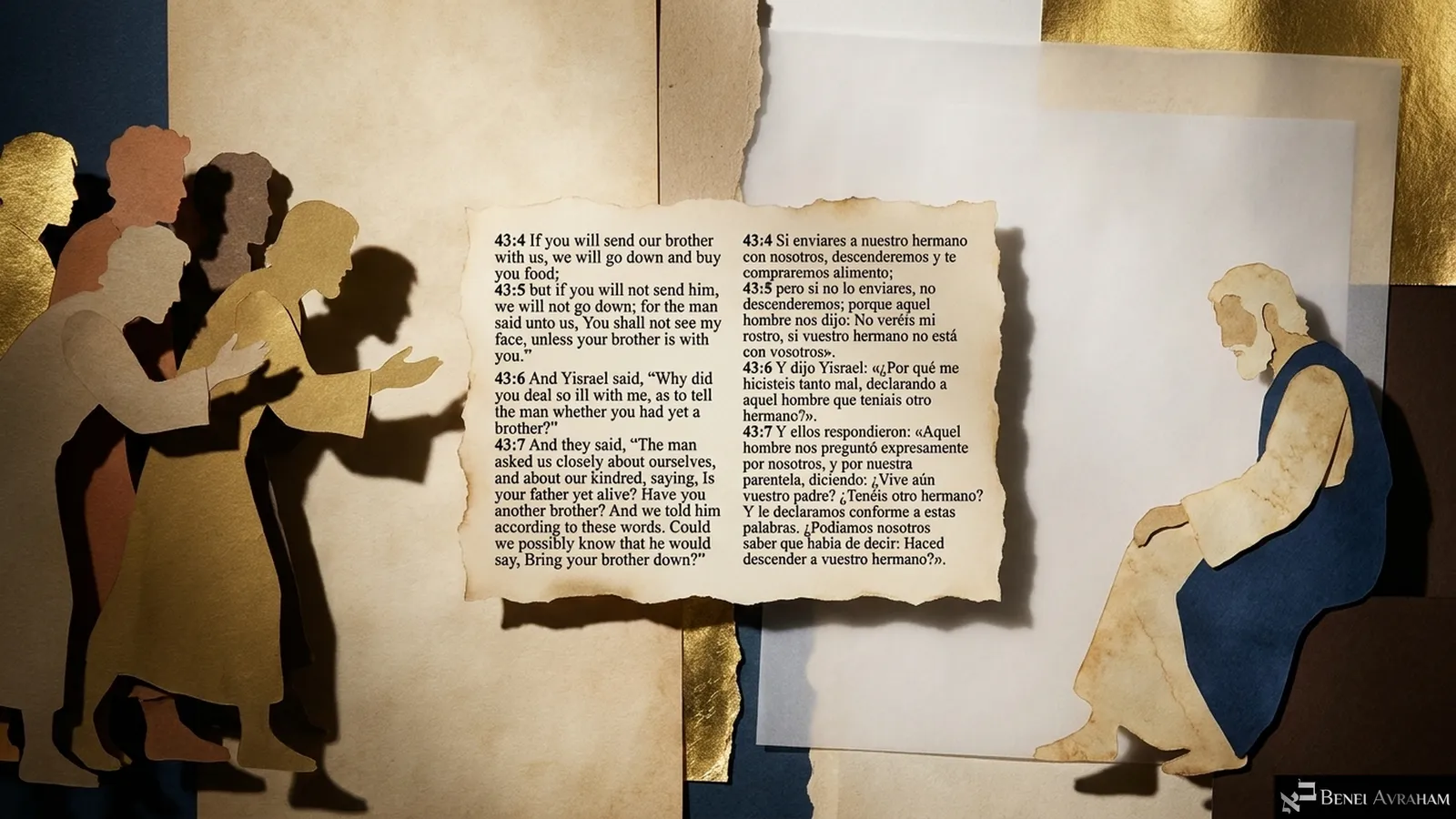
The brothers plead with their father, seated alone in a blue robe: “If you will send our brother with us, we will go down”; “Why did you deal so ill with me?” (Genesis 43:4–7).
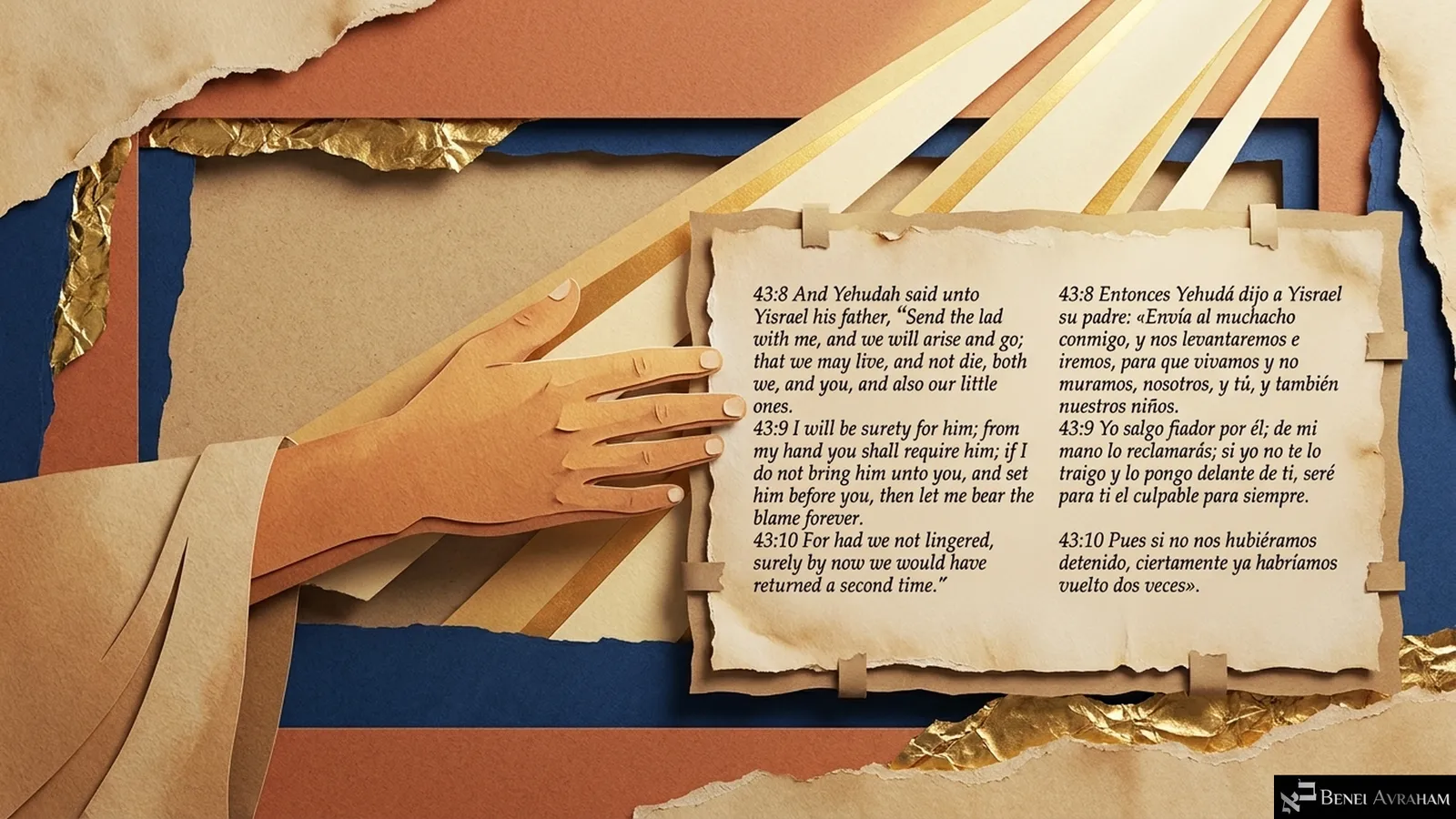
Yehudah’s open hand reaches out in a beam of golden light: “Send the lad with me … I will be surety for him; from my hand you shall require him” (Genesis 43:8–10).
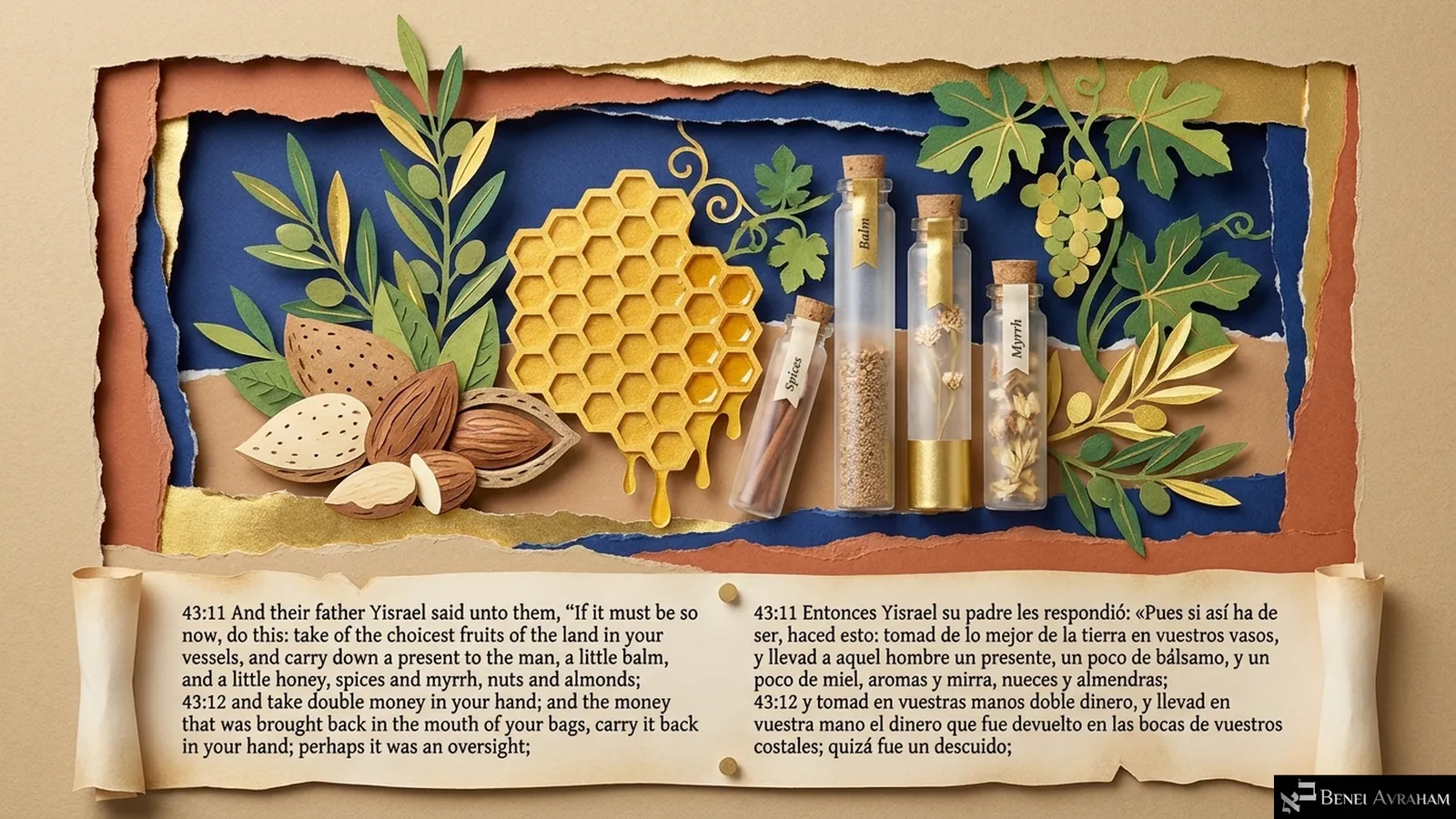
Almonds, a golden honeycomb, glass vials of spices and myrrh, and green vines: carry down a present to the man, a little balm and a little honey, spices and myrrh, nuts and almonds, and take double money in your hand (Genesis 43:11–12).
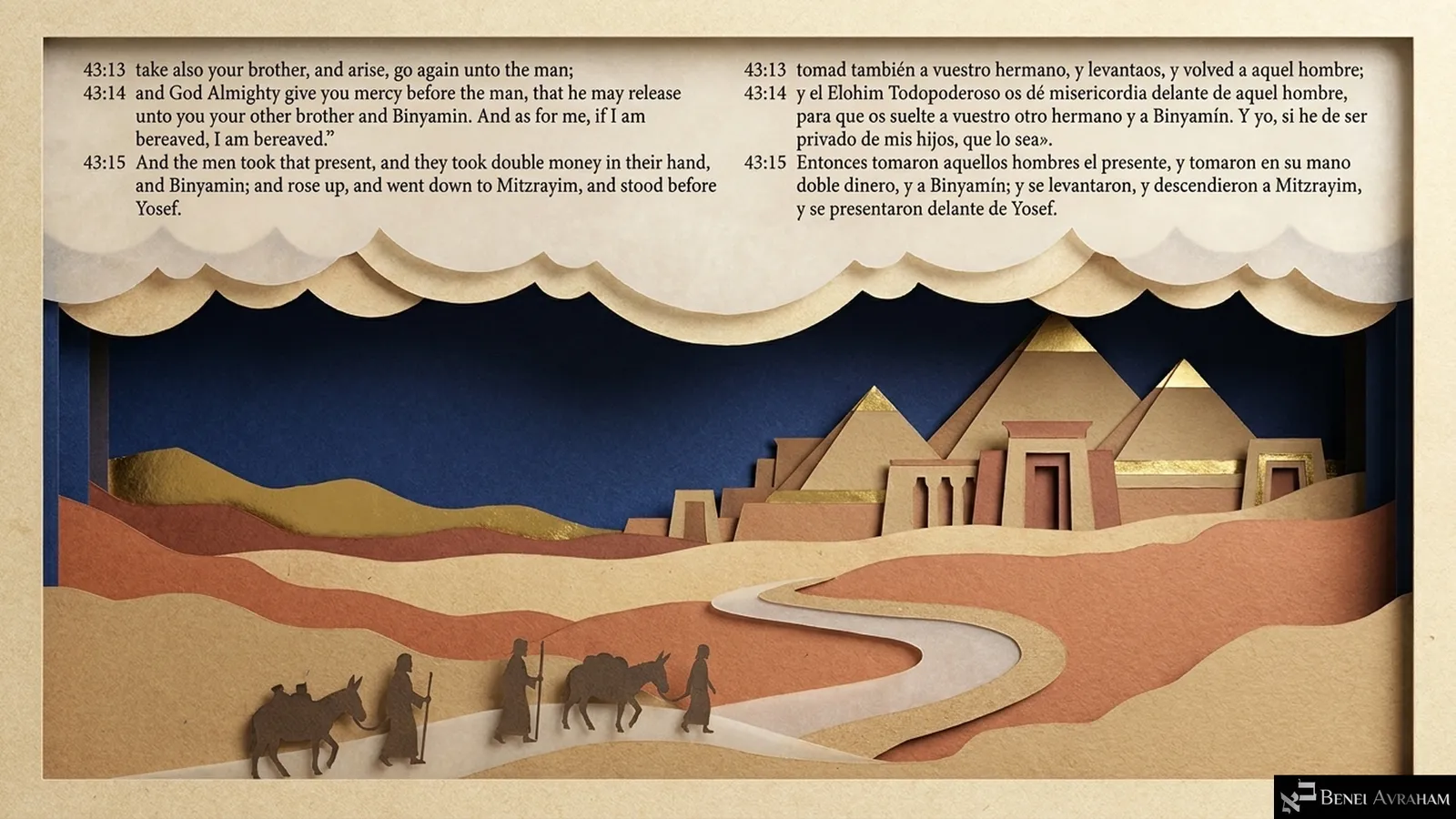
The brothers and their laden donkeys walk a winding road toward the pyramids: “God Almighty give you mercy before the man”; and they took the present, double money, and Binyamin, and stood before Yosef (Genesis 43:13–15).
Shishi · Genesis 43:16–29

Sixth Portion
Title card for the sixth portion among paper obelisks, pyramids and wheat: “Parashat Miketz, 6th Portion (Shishi), Genesis 43:16–29”.
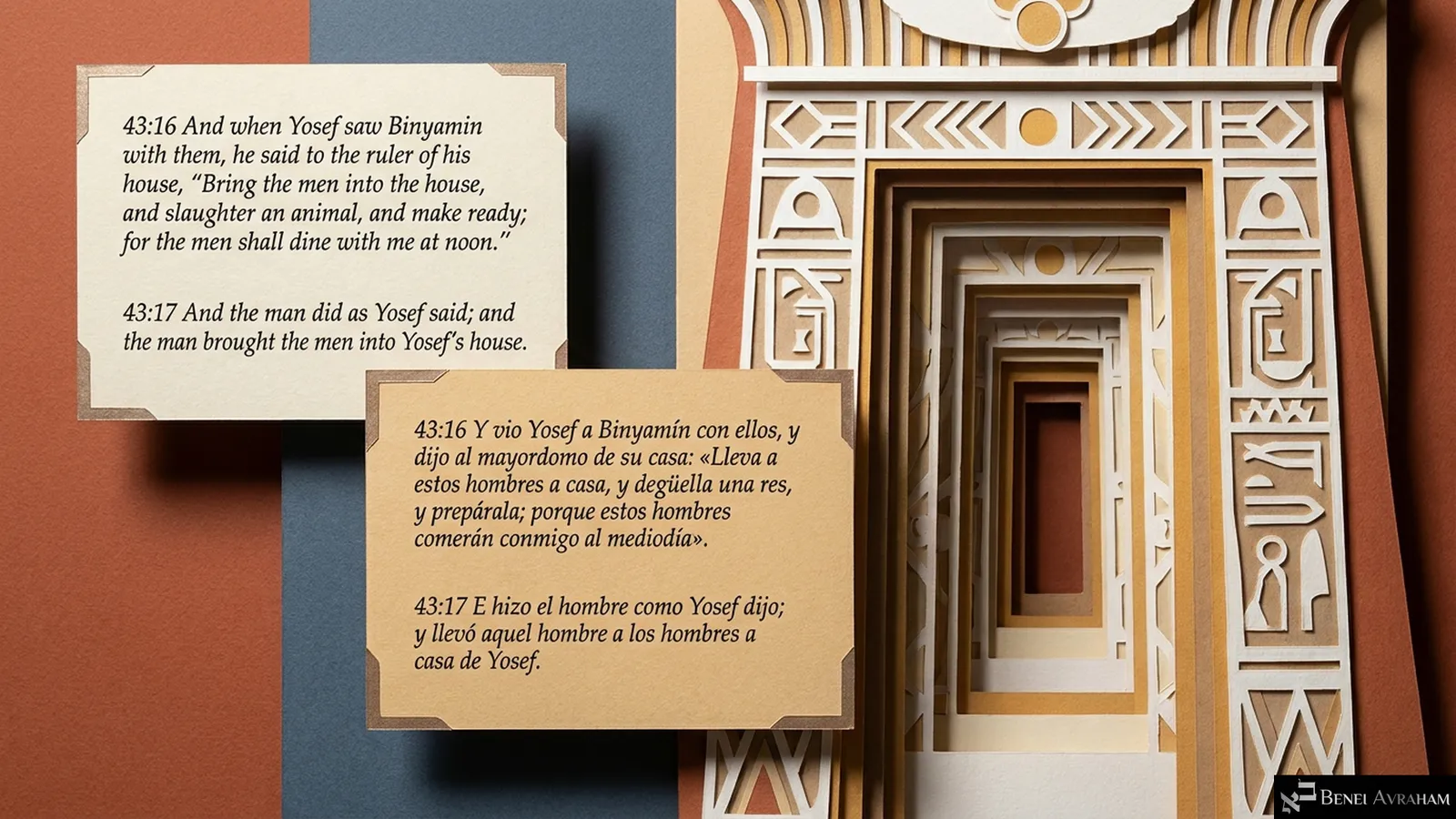
A carved paper doorway of Yosef’s house opens into receding frames: “Bring the men into the house, and slaughter an animal, and make ready; for the men shall dine with me at noon” (Genesis 43:16–17).
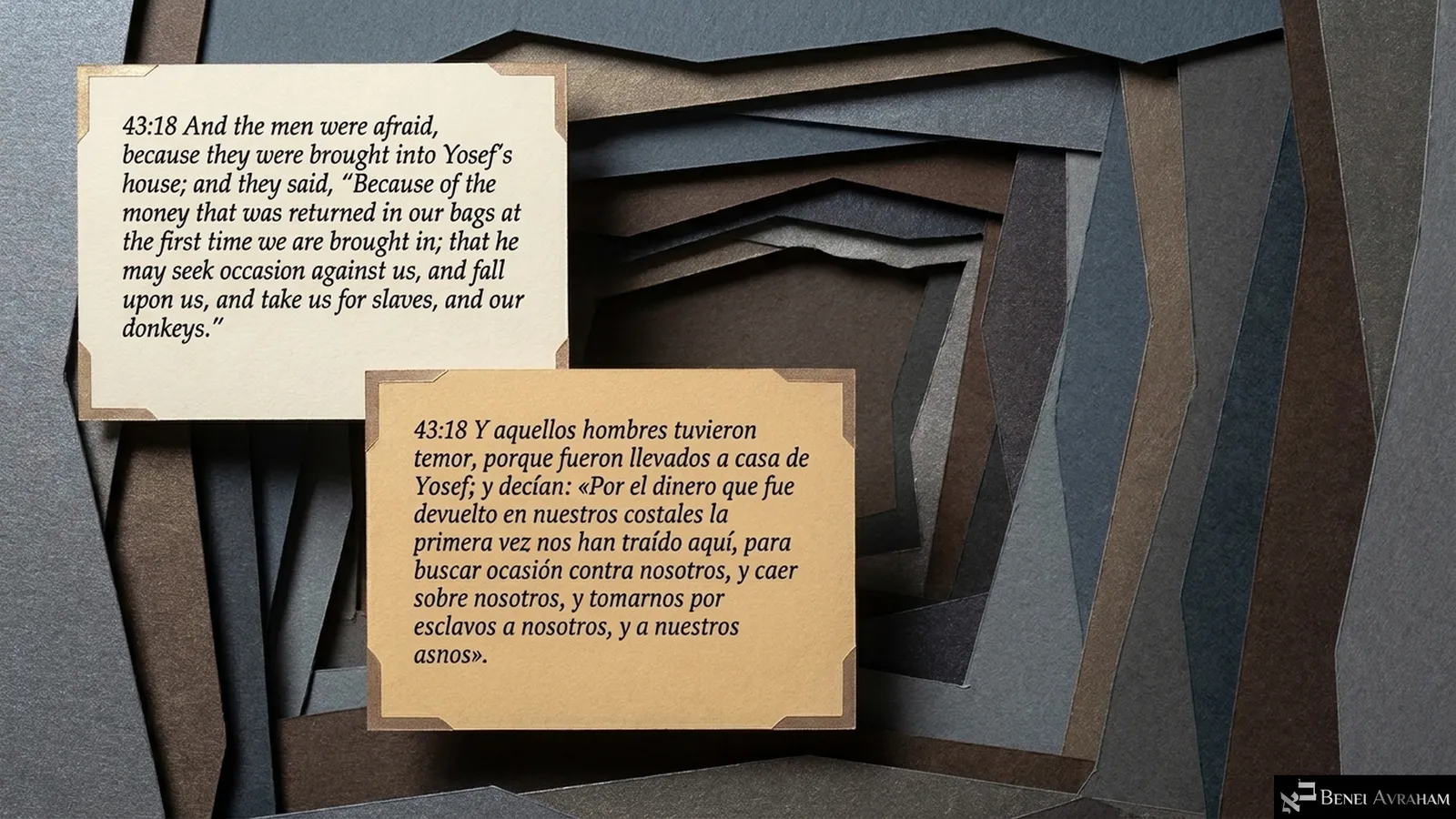
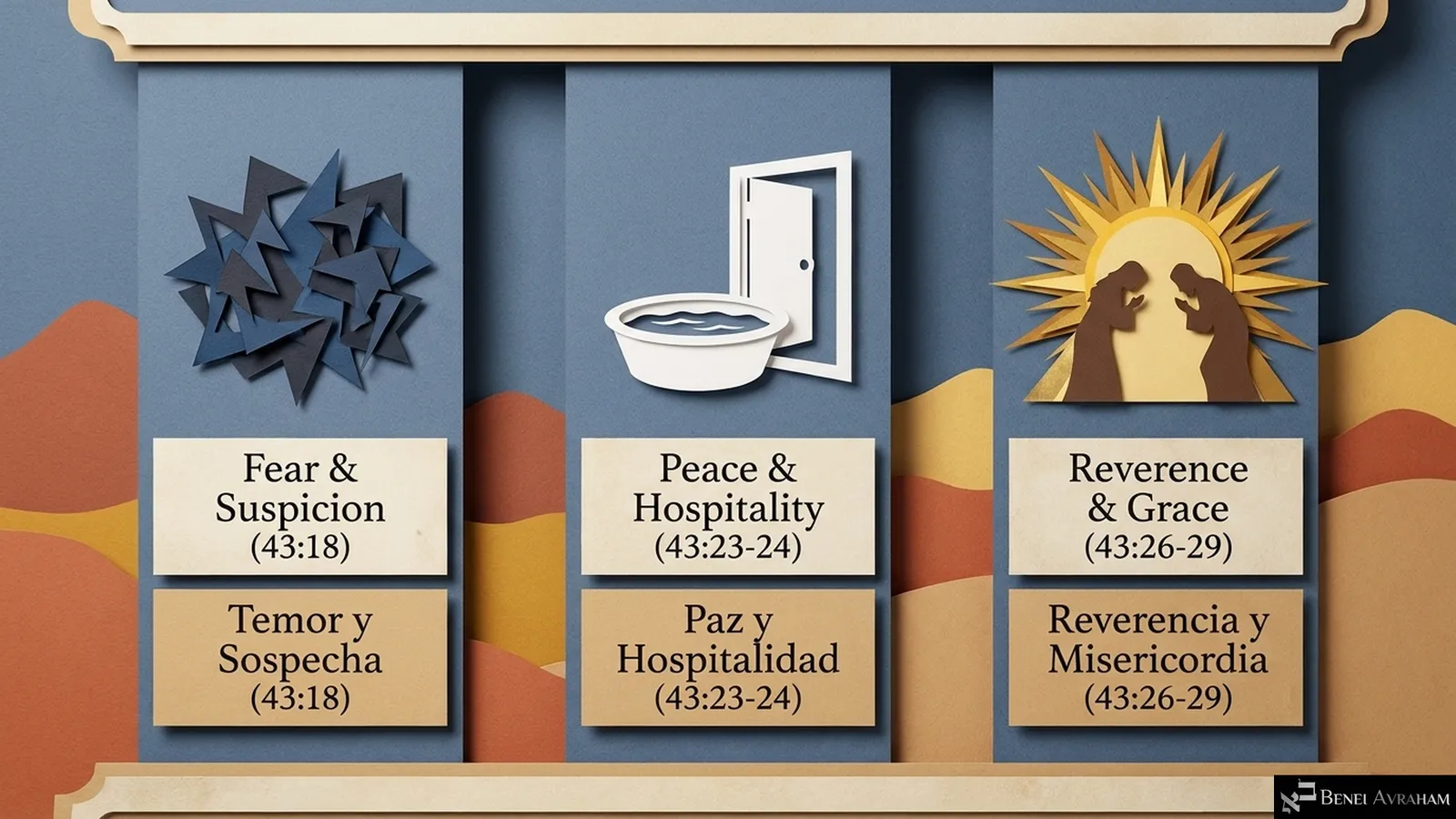
Jagged grey and brown paper layers close in like a tunnel: the men were afraid, “Because of the money that was returned in our bags … that he may take us for slaves” (Genesis 43:18).
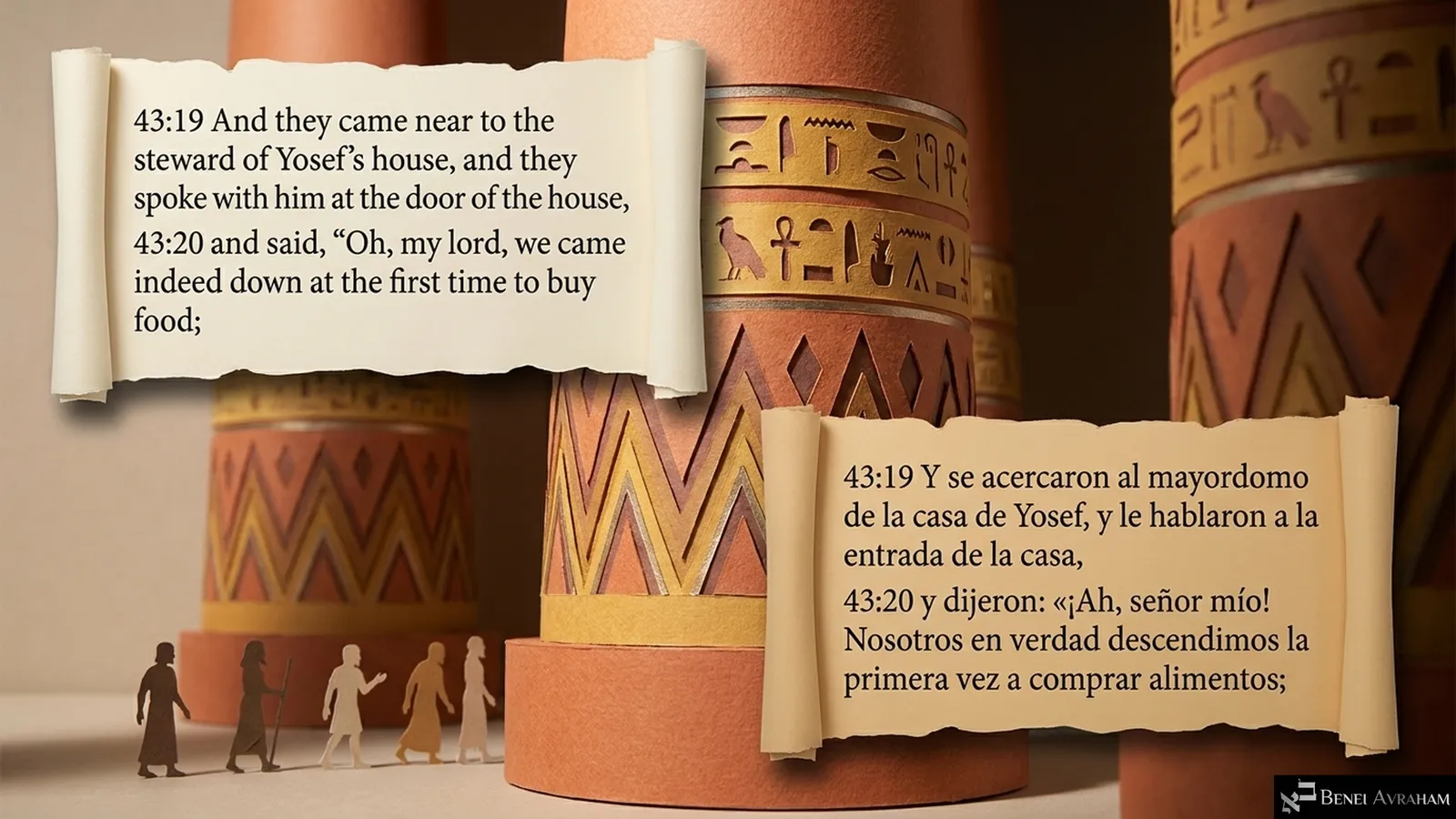
Paper figures approach the great painted columns of Yosef’s house: they came near to the steward at the door, “Oh, my lord, we came indeed down at the first time to buy food” (Genesis 43:19–20).
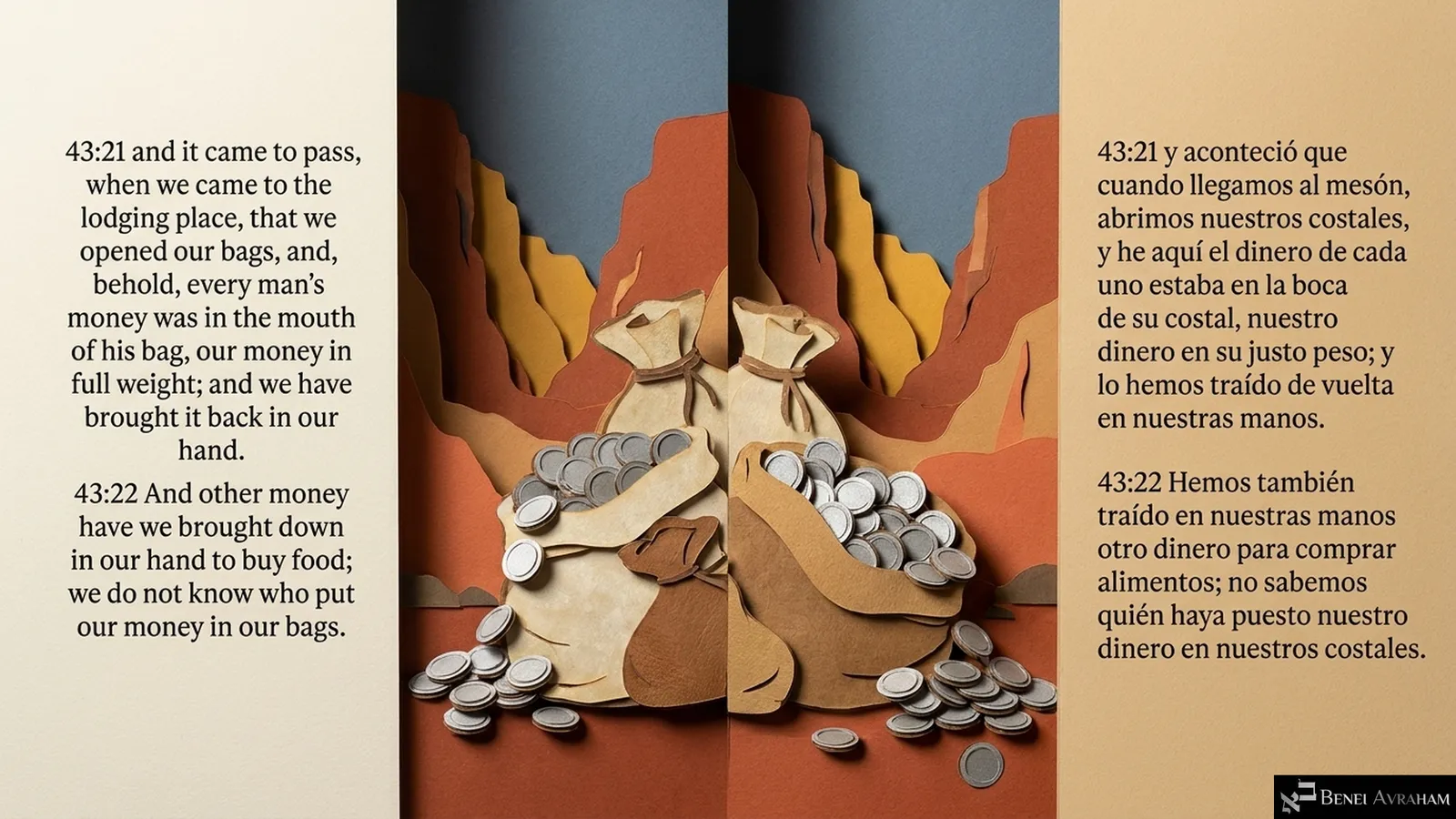
Two money bags spill silver coins between red canyon walls: every man’s money was in the mouth of his bag, and we have brought it back, and other money to buy food (Genesis 43:21–22).
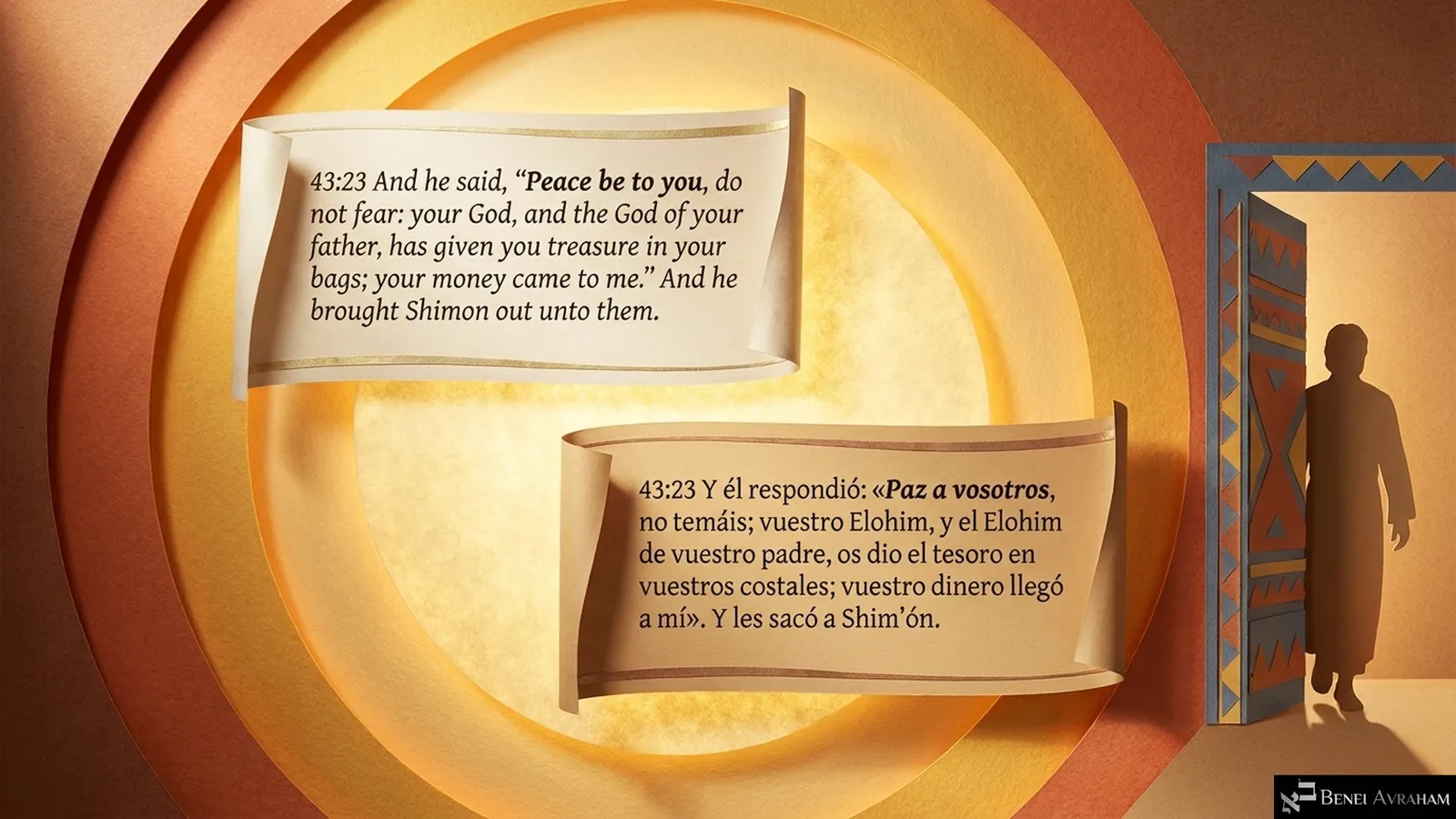
A glowing sun of layered paper, with Shimon stepping out through a patterned doorway: “Peace be to you, do not fear: your God … has given you treasure in your bags”; and he brought Shimon out unto them (Genesis 43:23).
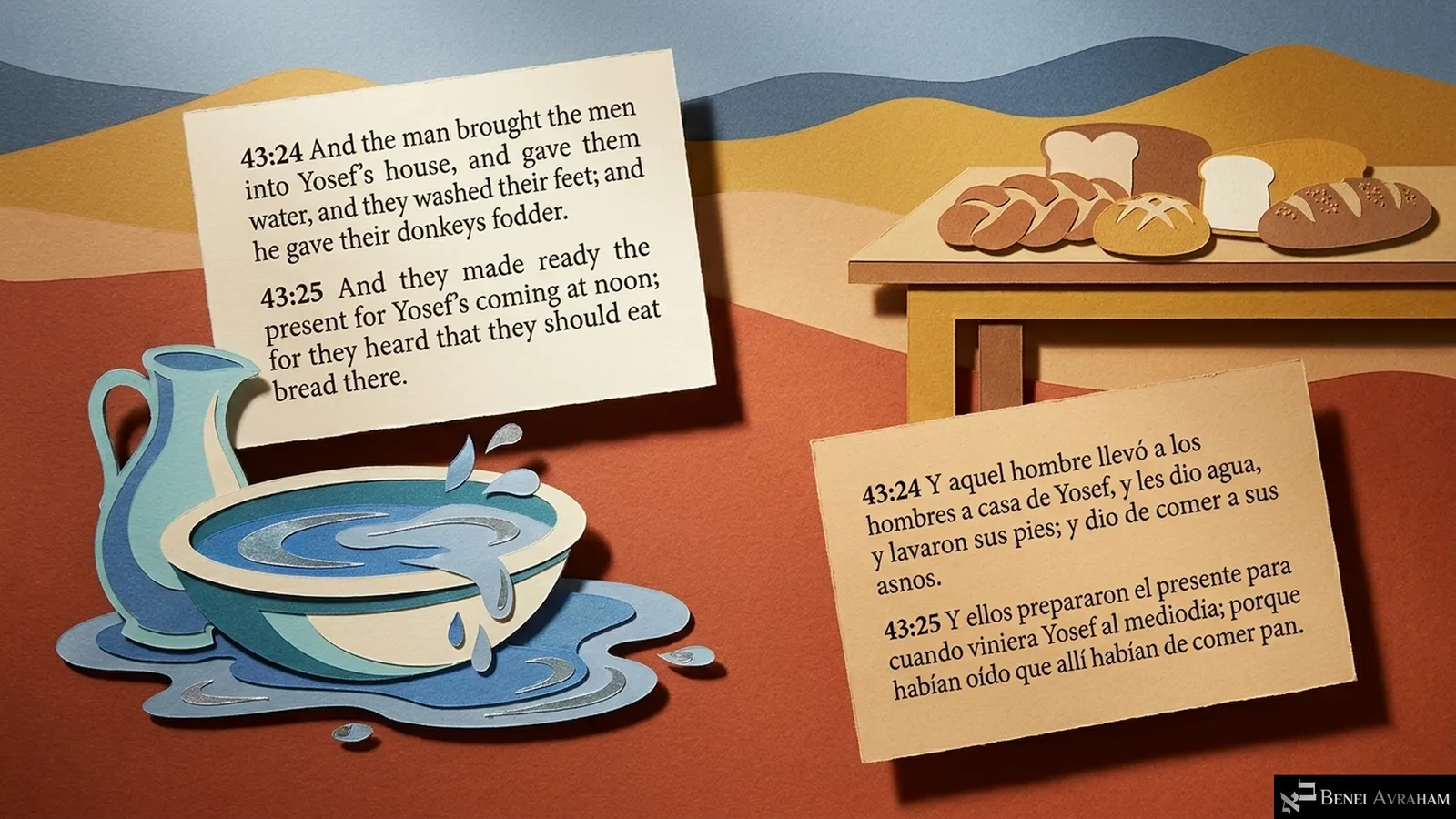
A blue jug and basin of water on one side and a table of loaves on the other: they were given water to wash their feet, and made ready the present for Yosef’s coming at noon (Genesis 43:24–25).
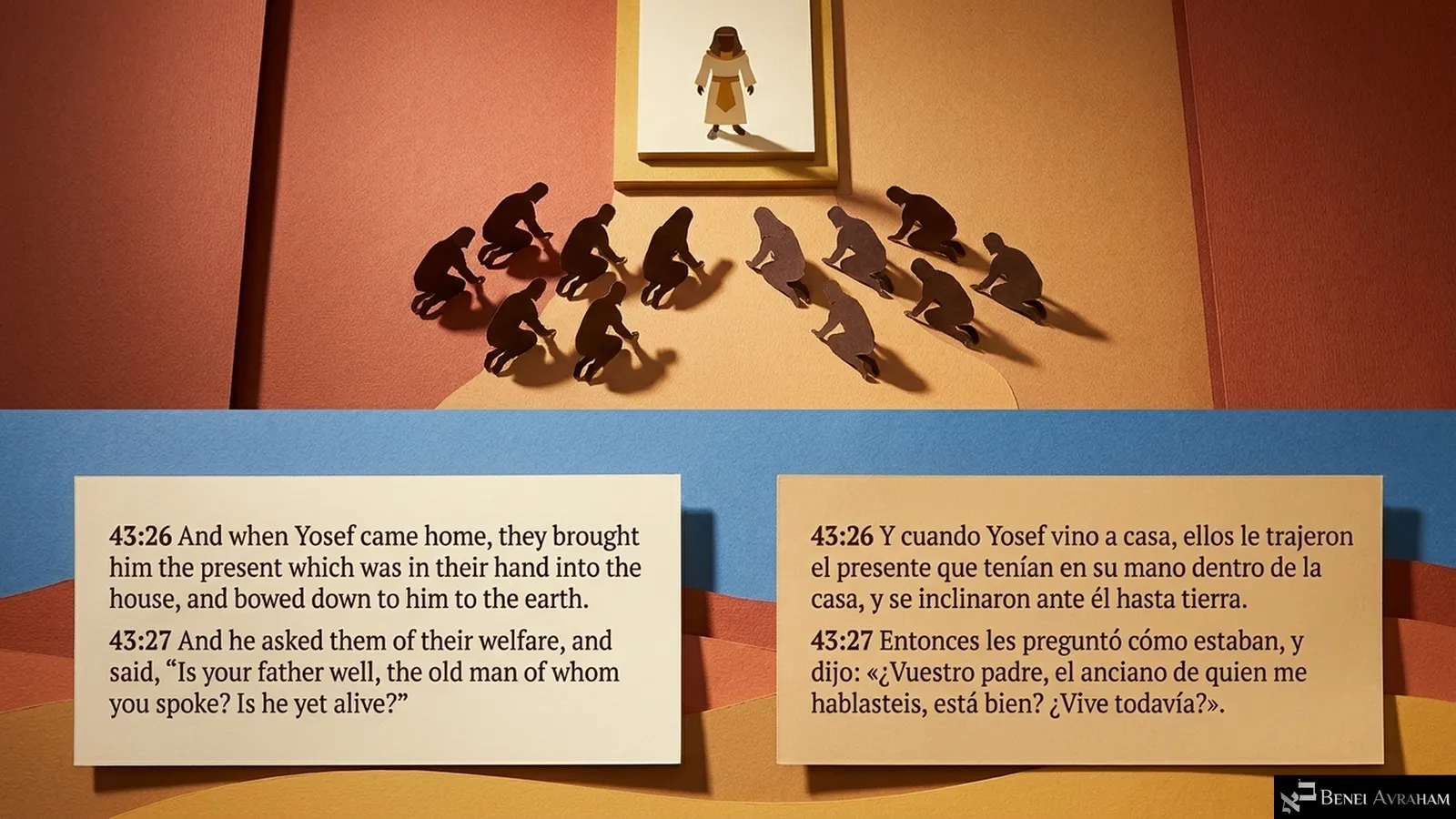
The eleven brothers kneel in a ring before Yosef: they brought him the present and bowed down to the earth; “Is your father well, the old man of whom you spoke? Is he yet alive?” (Genesis 43:26–27).
A paper olive branch beside the cards: “Your servant our father is well, he is yet alive.” And they bowed their heads, and bowed down (Genesis 43:28).
Two glowing golden rings overlap behind the verses: Yosef lifted up his eyes and saw Binyamin, his mother’s son, “God be gracious unto you, my son” (Genesis 43:29).
Three paper panels trace the sixth portion: fear and suspicion (43:18), peace and hospitality (43:23–24), and reverence and grace (43:26–29).
Shevi’i · Genesis 43:30–44:17

Seventh Portion

Title card for the seventh portion hanging from chains among carved columns and palms: “Parashat Miketz, 7th Portion, Génesis 43:30–44:17, Séptima Porción (Shevi’i)”.
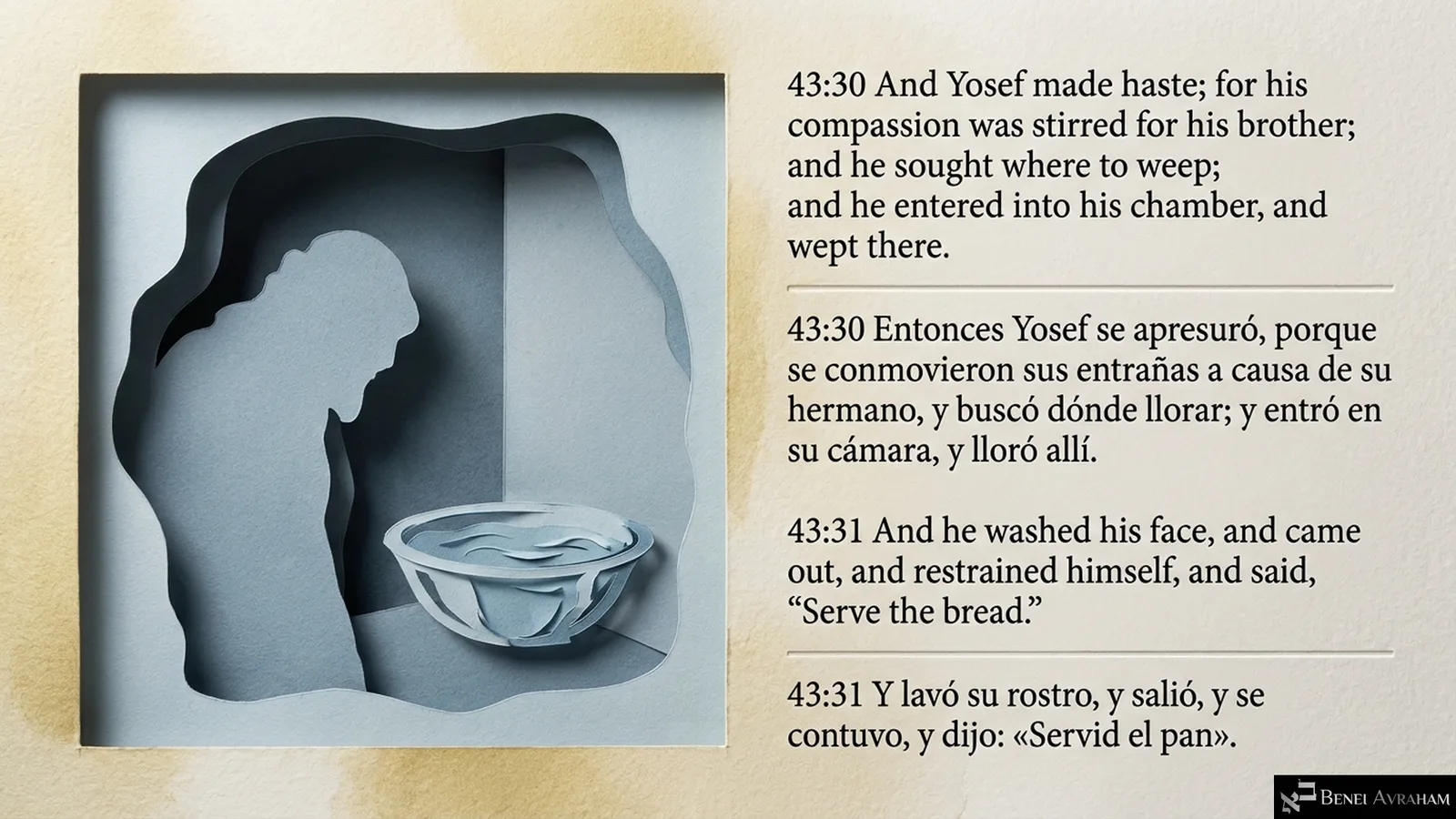
Yosef bows his head over a basin of water in a quiet blue chamber: his compassion was stirred for his brother; he entered into his chamber and wept there, then washed his face and said, “Serve the bread” (Genesis 43:30–31).
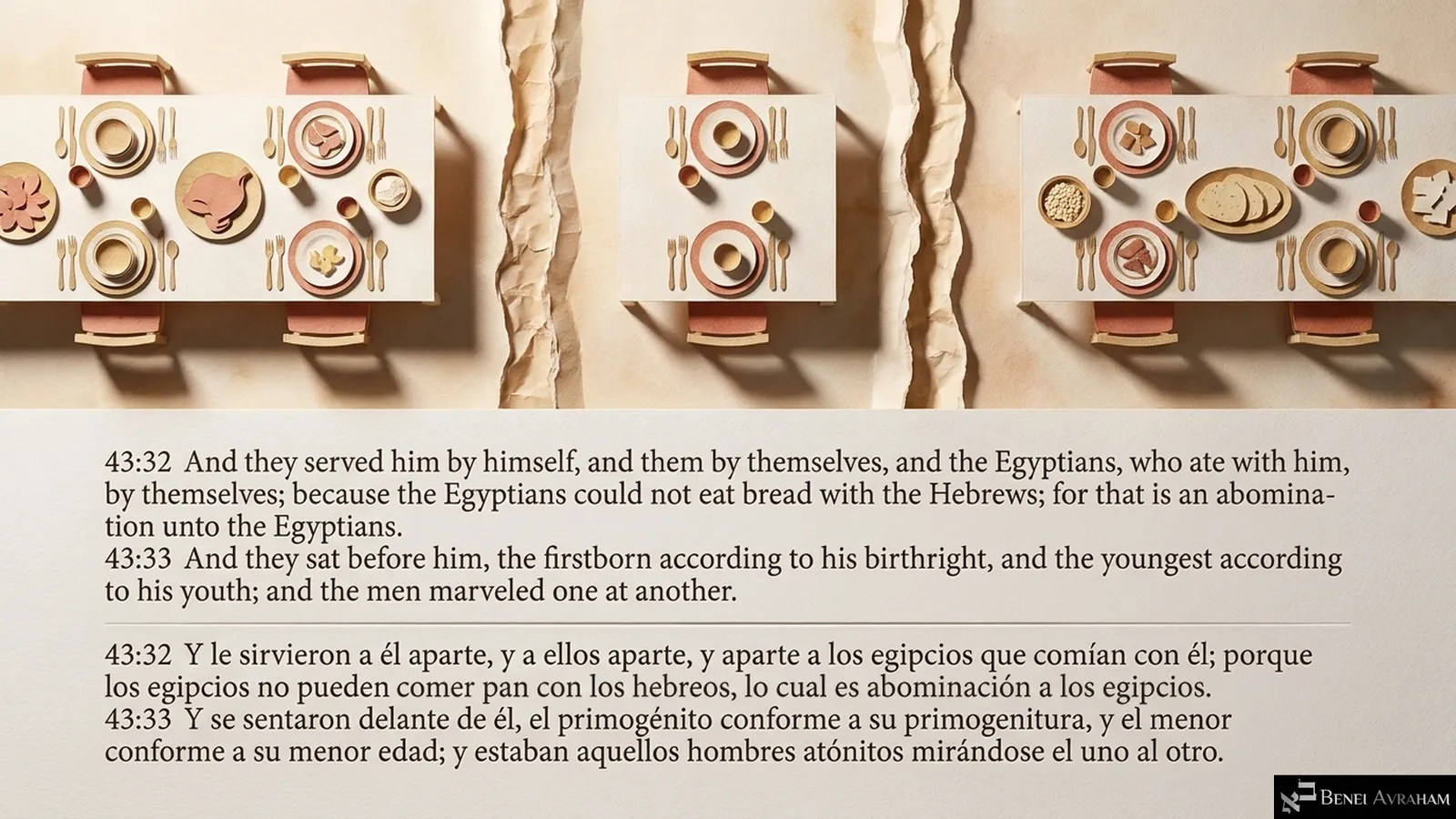
Three paper tables set apart, seen from above, with a torn paper divider between them: they served him by himself, and them by themselves, and the Egyptians by themselves; and the brothers sat in order of age and marveled (Genesis 43:32–33).
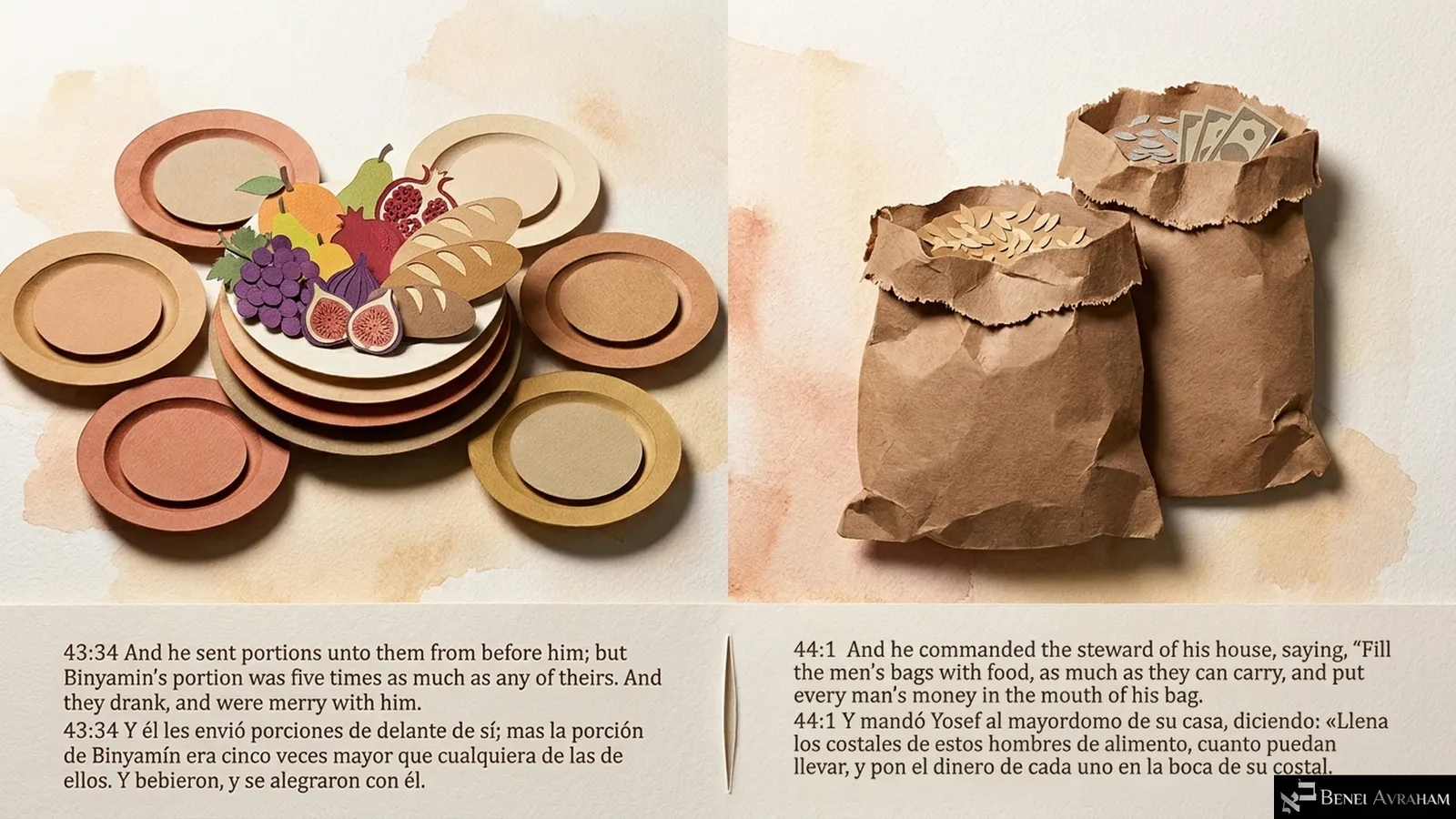
A heaped platter of bread, figs, grapes and pomegranate among empty plates, and two paper sacks of grain with money in their mouths: Binyamin’s portion was five times as much as any of theirs; fill the men’s bags with food (Genesis 43:34–44:1).
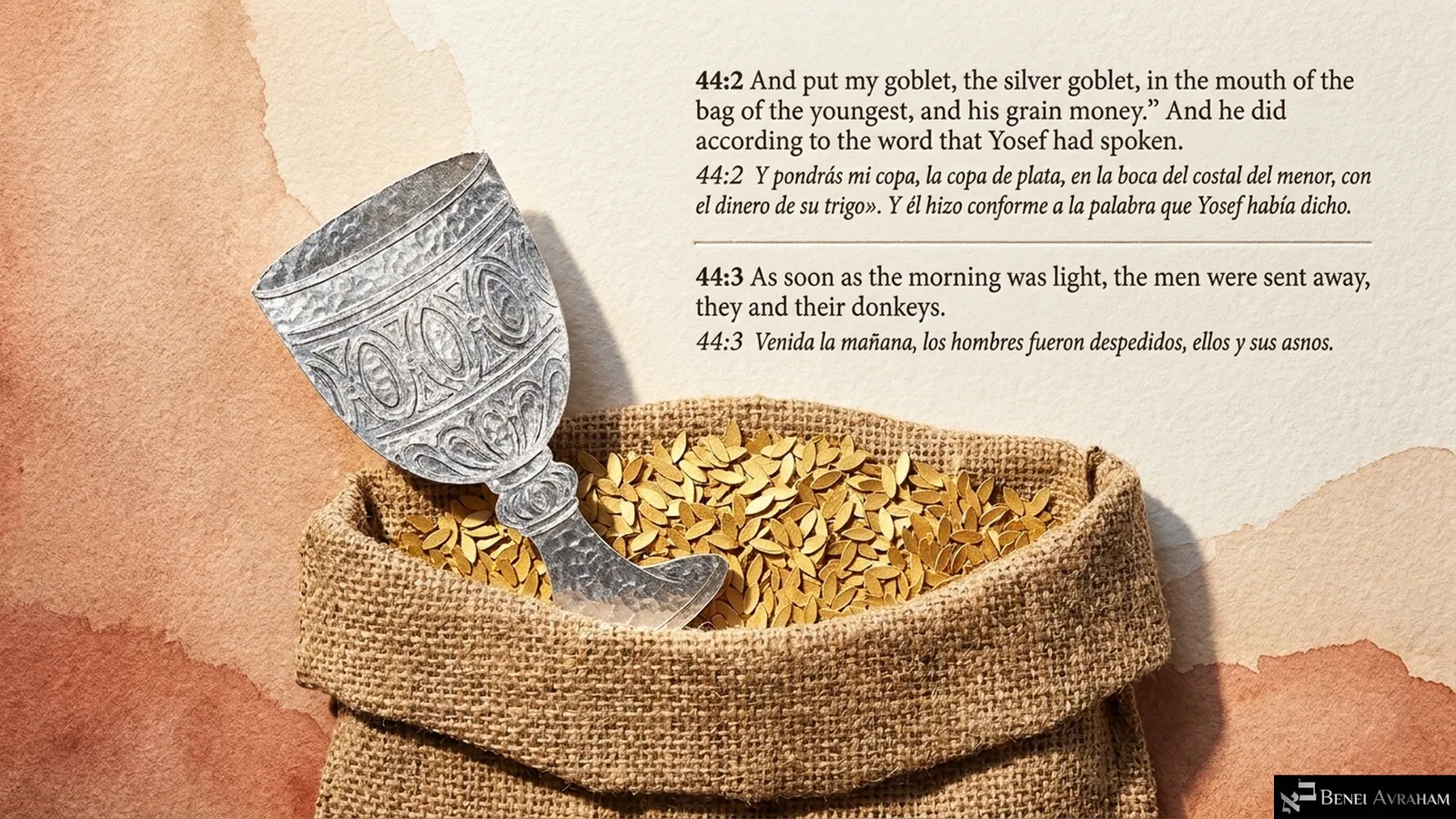
A silver goblet set into a burlap sack of grain: put my goblet, the silver goblet, in the mouth of the bag of the youngest; and in the morning the men were sent away (Genesis 44:2–3).
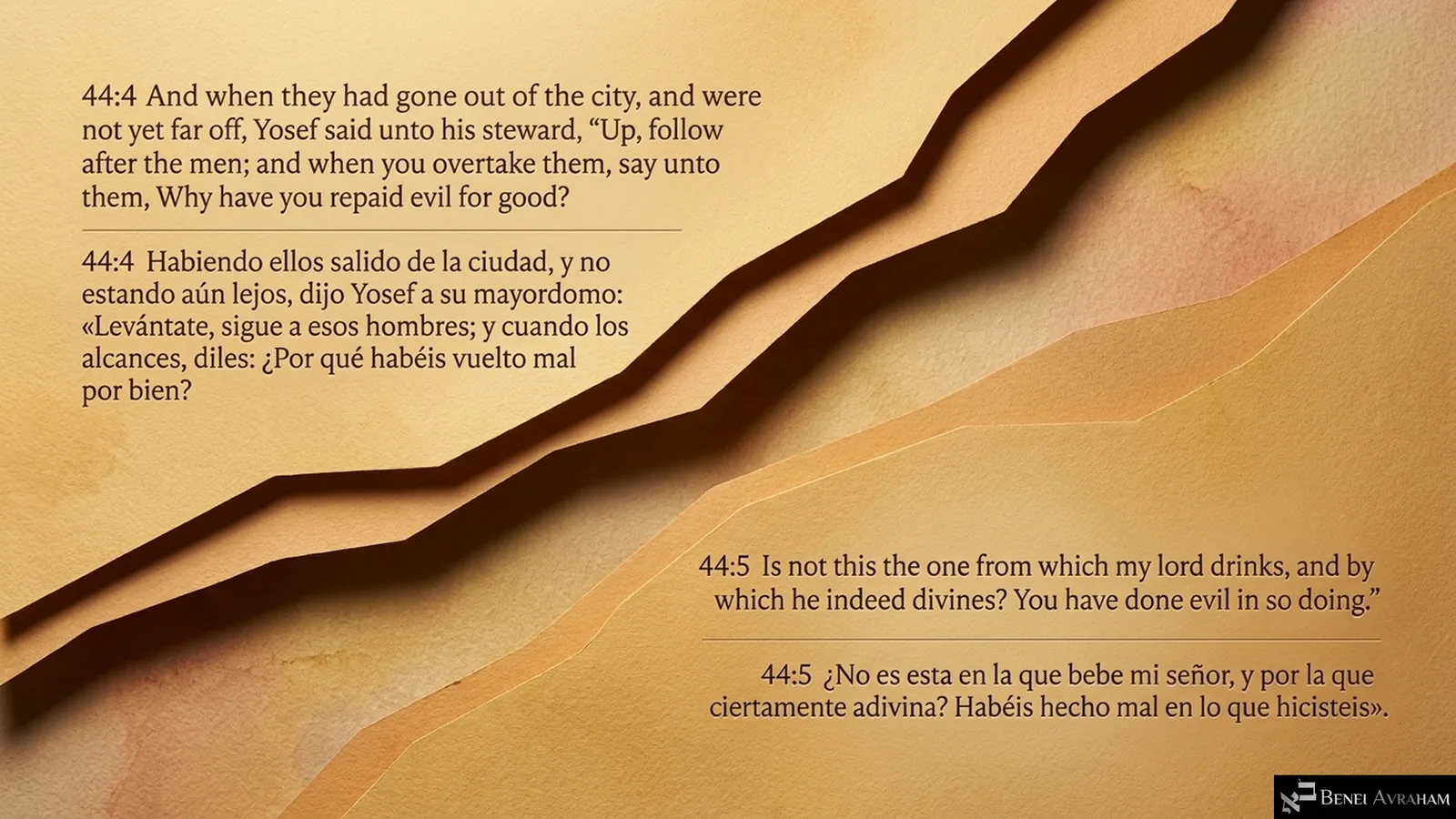
A jagged paper road climbs across the page: “Up, follow after the men … Why have you repaid evil for good? Is not this the one from which my lord drinks?” (Genesis 44:4–5).
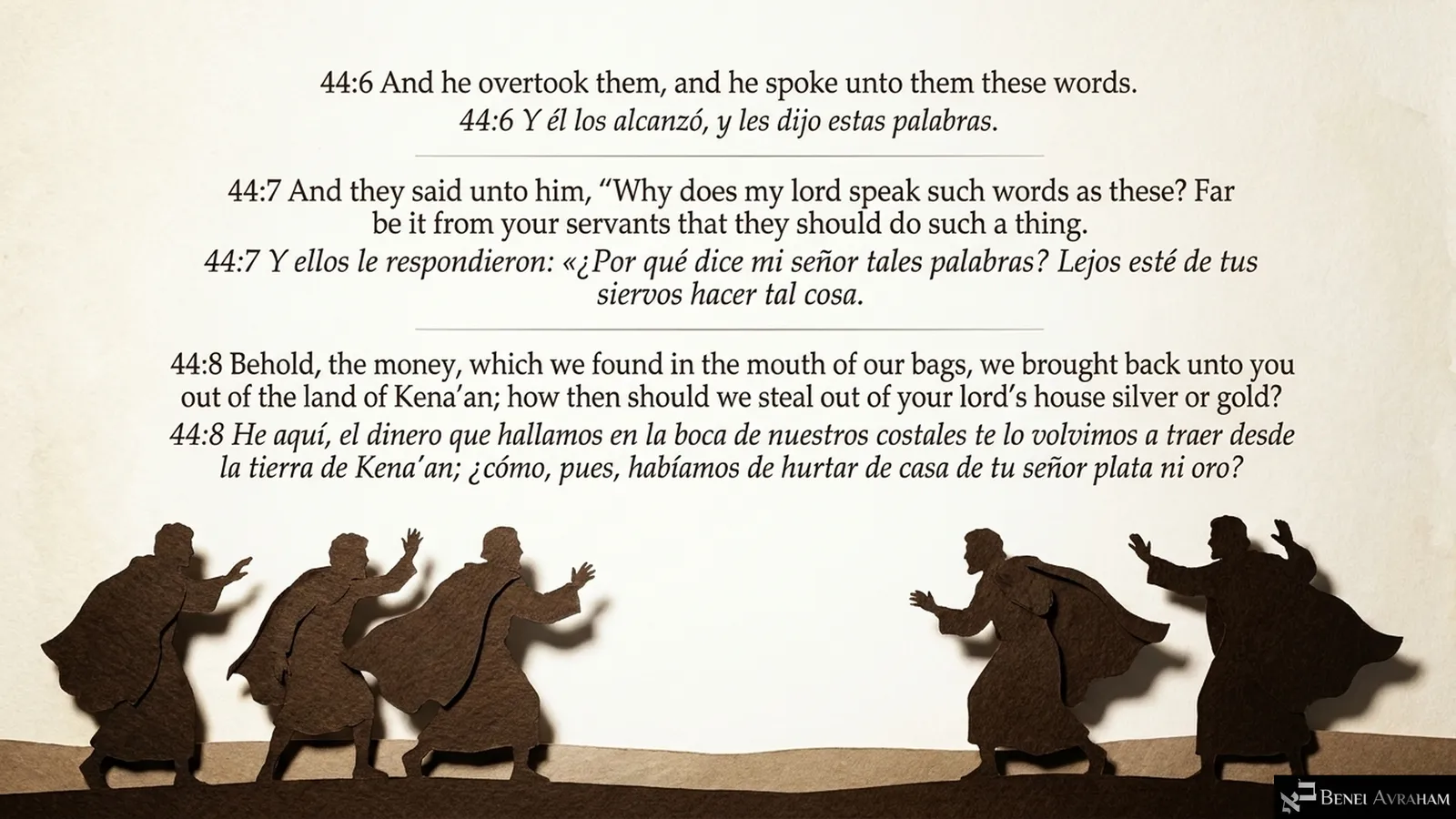
Dark paper silhouettes of the brothers throw up their hands as the steward overtakes them: “Why does my lord speak such words as these? … how then should we steal out of your lord’s house silver or gold?” (Genesis 44:6–8).
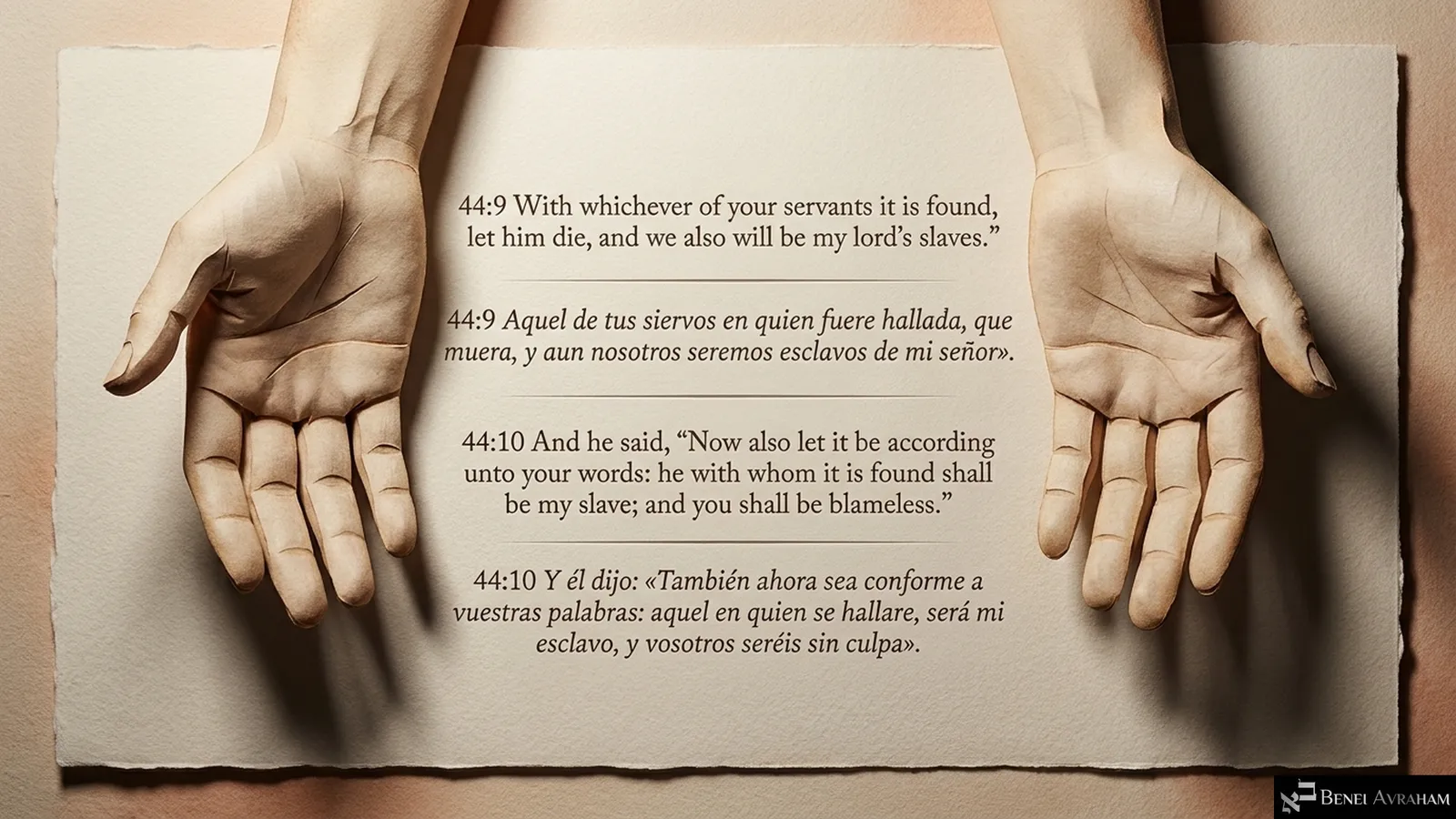
Two open paper hands held out empty: “With whichever of your servants it is found, let him die”; “he with whom it is found shall be my slave; and you shall be blameless” (Genesis 44:9–10).
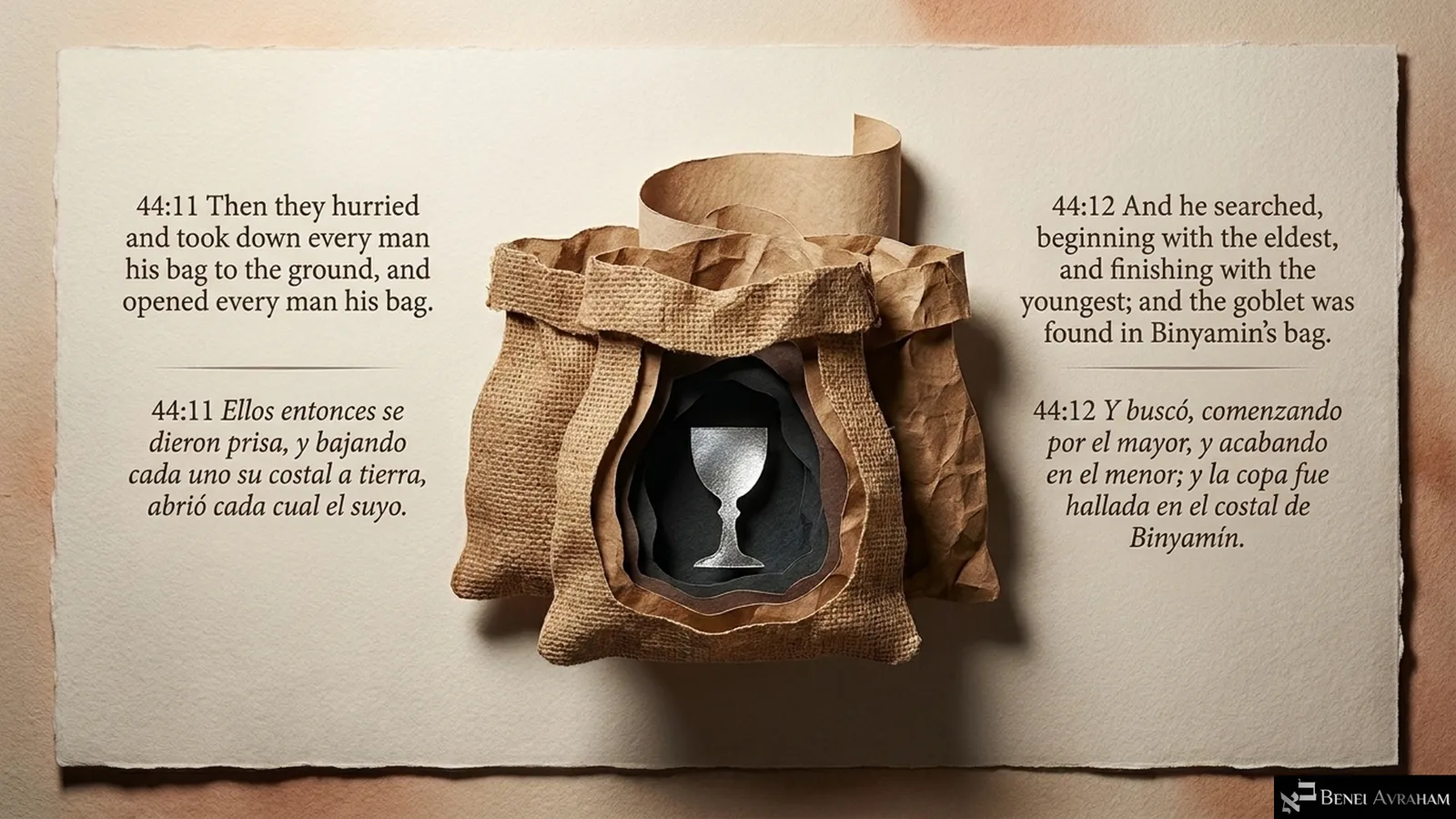
A burlap bag opens to reveal the silver goblet deep inside: he searched, beginning with the eldest and finishing with the youngest, and the goblet was found in Binyamin’s bag (Genesis 44:11–12).
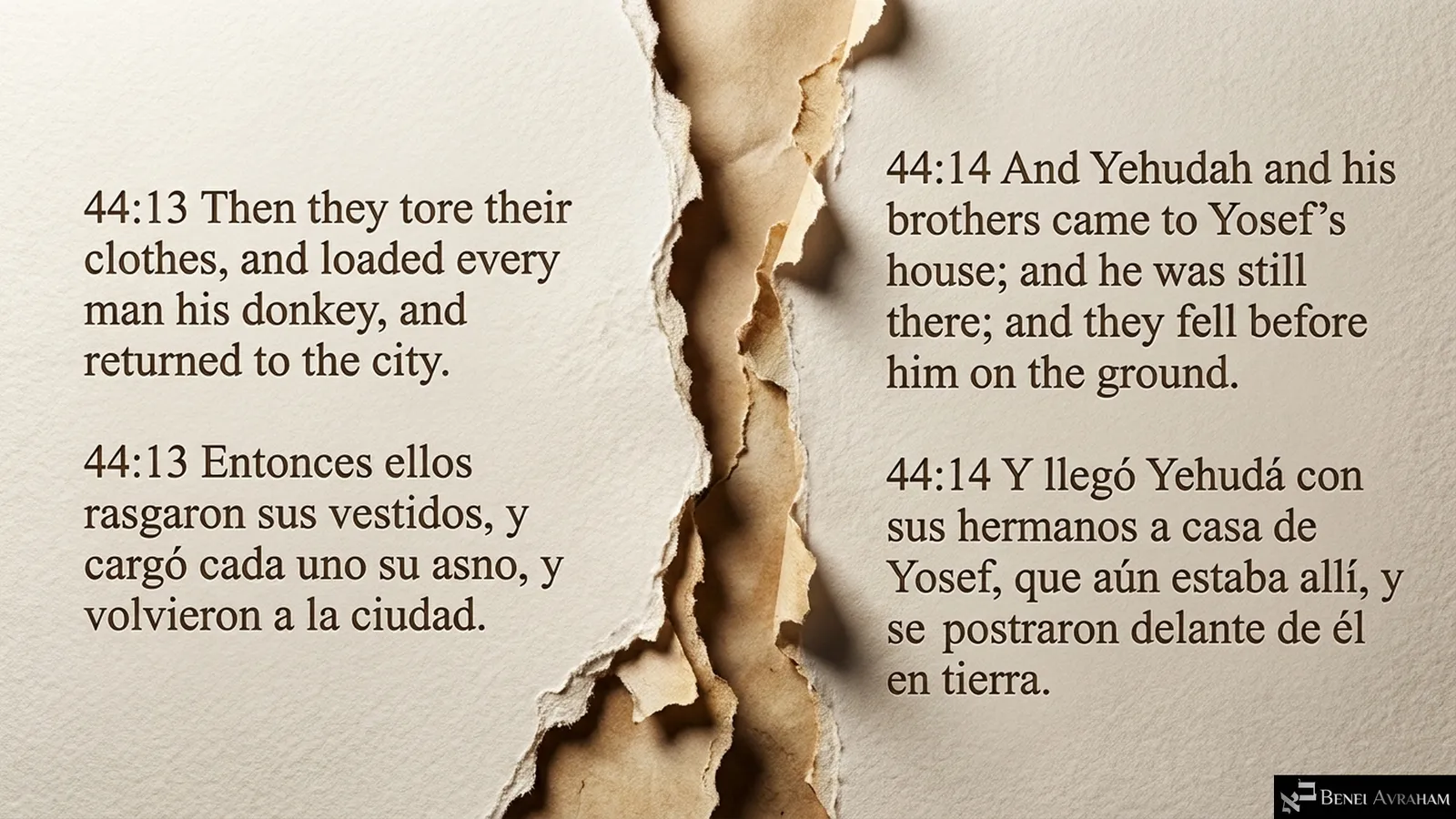
A long tear splits the page in two: they tore their clothes and returned to the city, and Yehudah and his brothers fell before Yosef on the ground (Genesis 44:13–14).
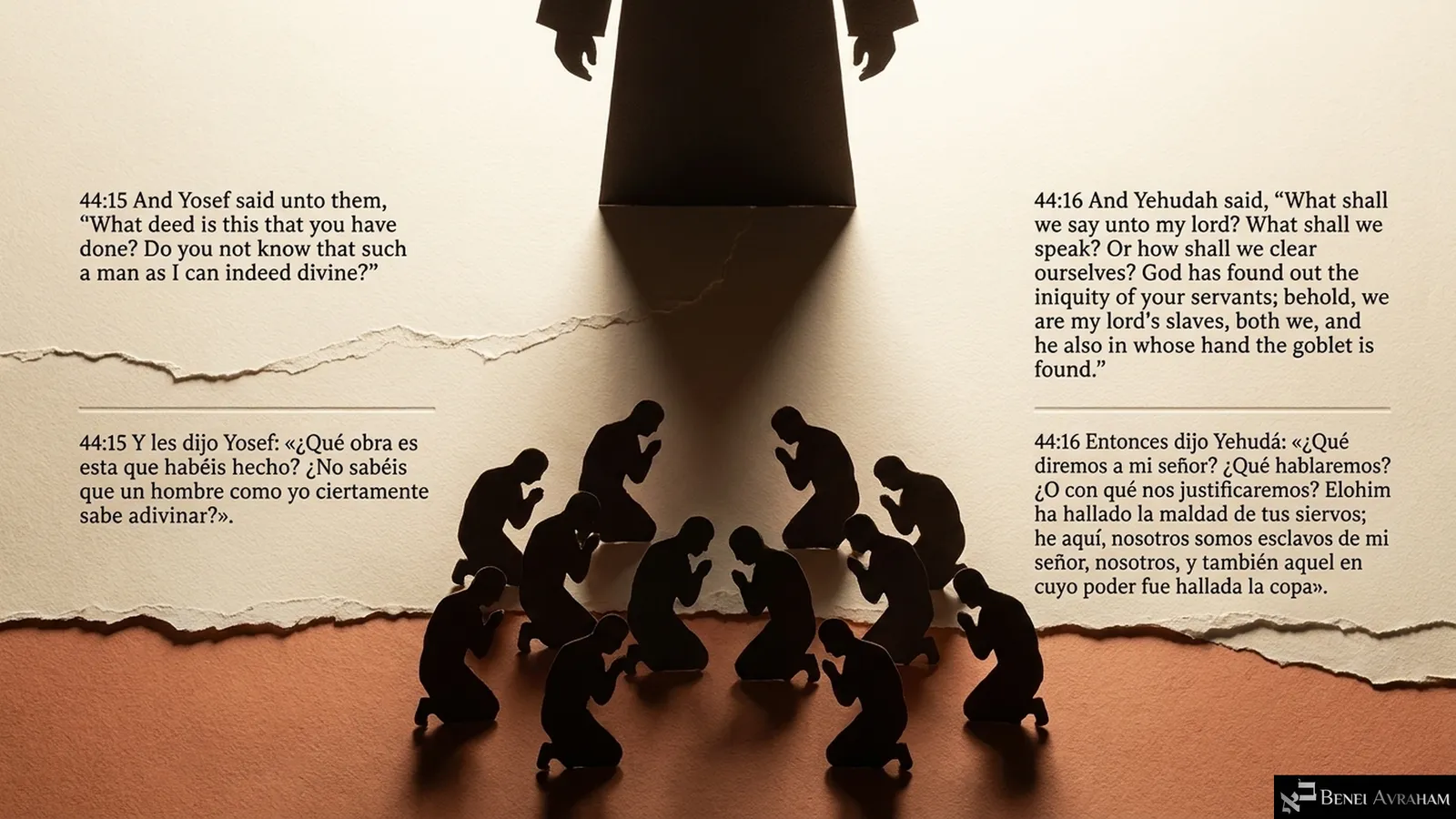
Eleven dark paper figures kneel in a circle beneath Yosef’s standing shadow: “What deed is this that you have done?”; “God has found out the iniquity of your servants; behold, we are my lord’s slaves” (Genesis 44:15–16).
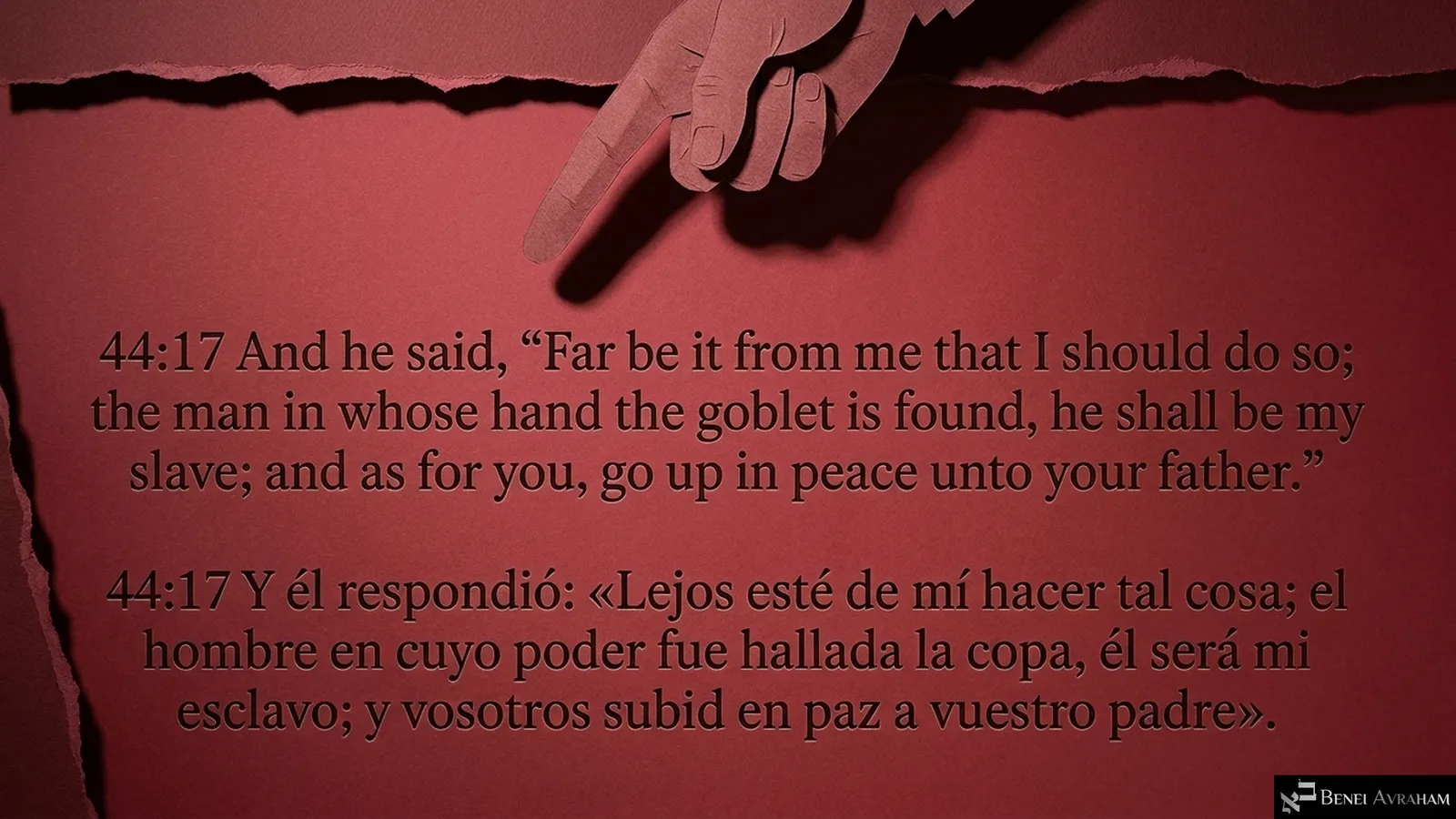
A paper hand points down from a torn red page: “The man in whose hand the goblet is found, he shall be my slave; and as for you, go up in peace unto your father” (Genesis 44:17).
Haftarah · 1 Kings 3:15–4:1

Haftarah: The Judgment of Shlomo
Title card for the haftarah inside layered paper arches with lions and menorahs: “Haftarah Parashat Miketz, 1 Kings 3:15–4:1”.
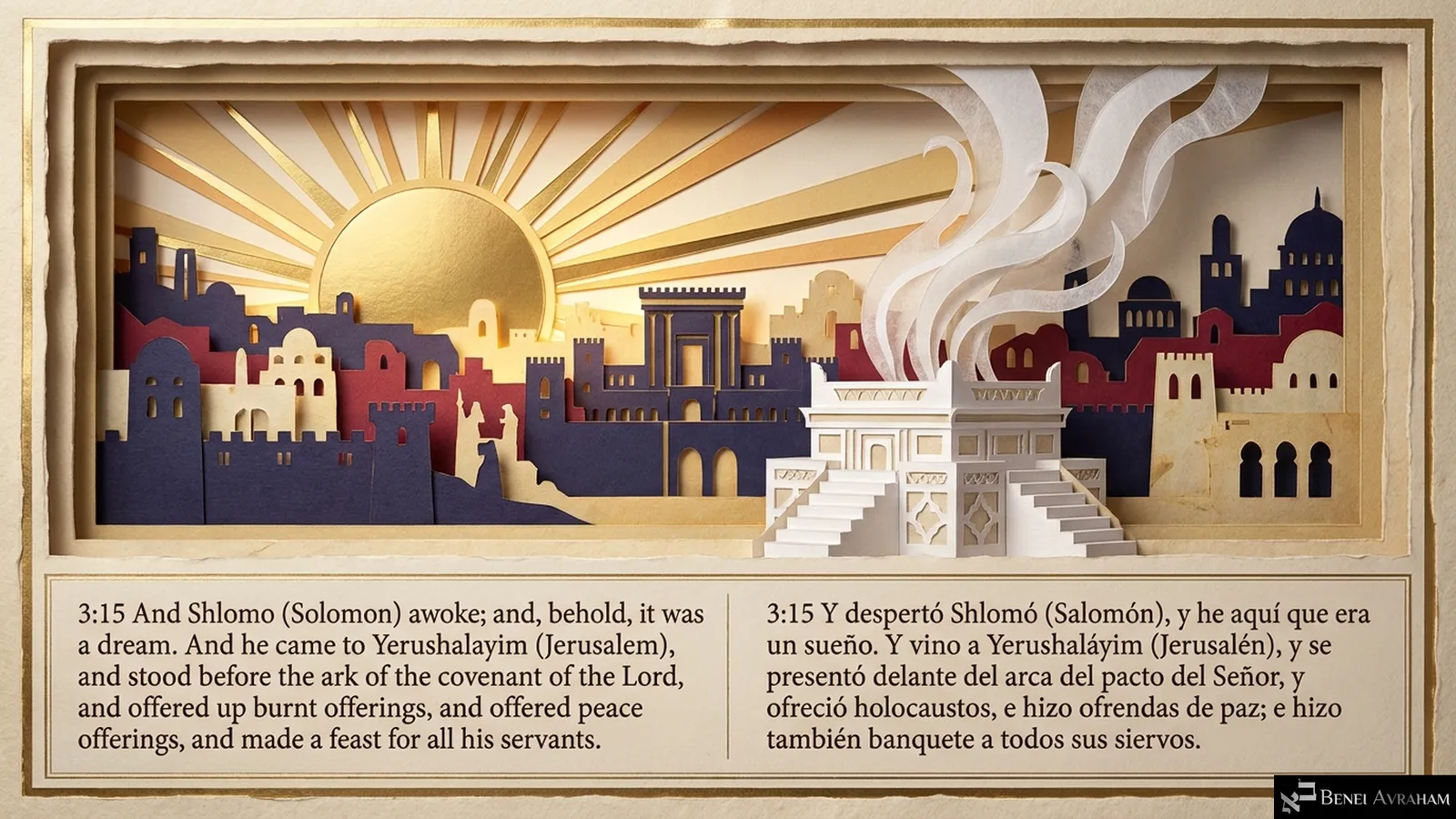
A paper Yerushalayim at sunrise, with smoke rising from a white altar: Shlomo awoke, and behold, it was a dream; he came to Yerushalayim, offered up burnt offerings and peace offerings, and made a feast (1 Kings 3:15).
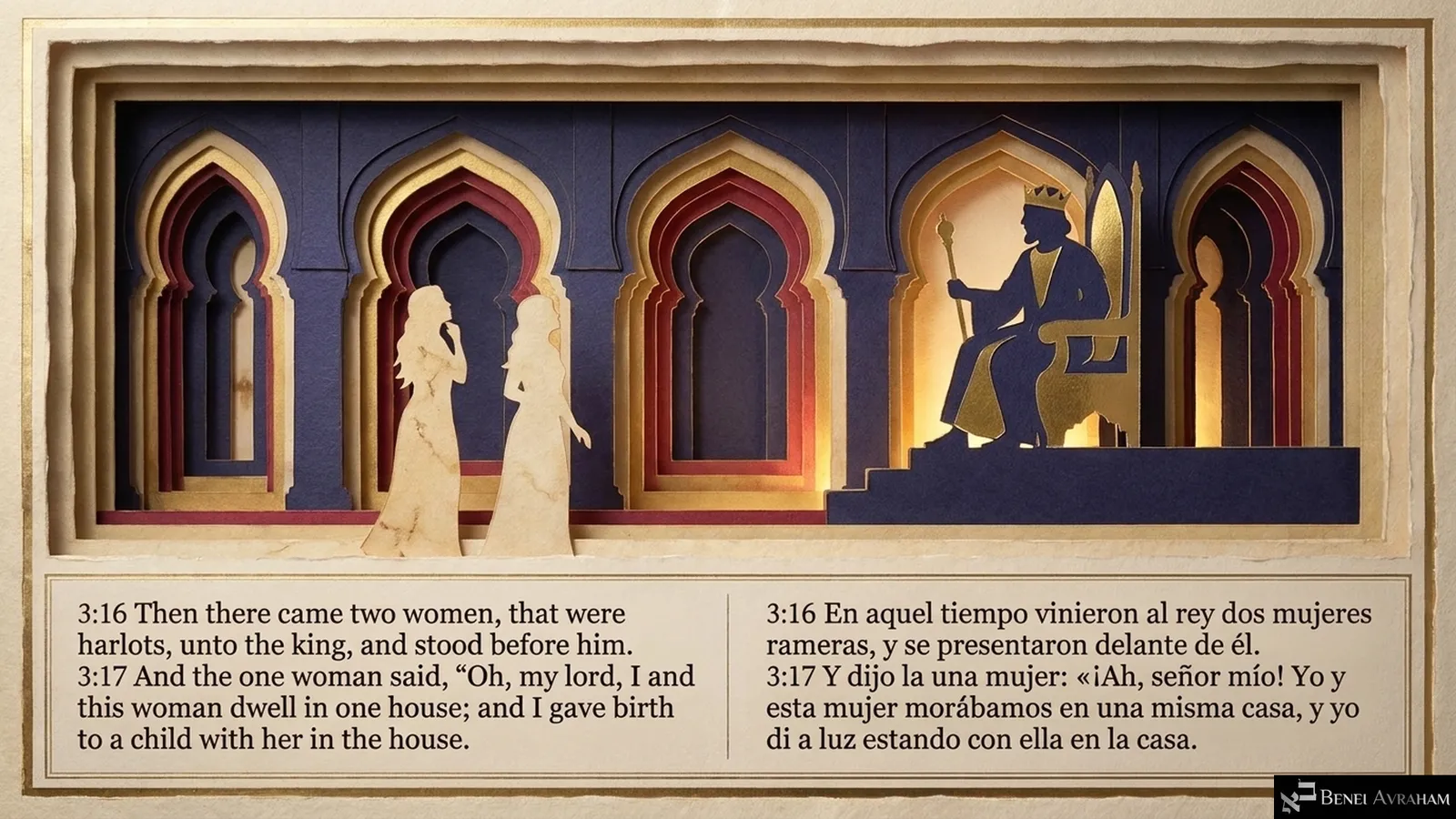
Two women stand before King Shlomo seated on his throne in an arched hall: “Oh, my lord, I and this woman dwell in one house; and I gave birth to a child with her in the house” (1 Kings 3:16–17).
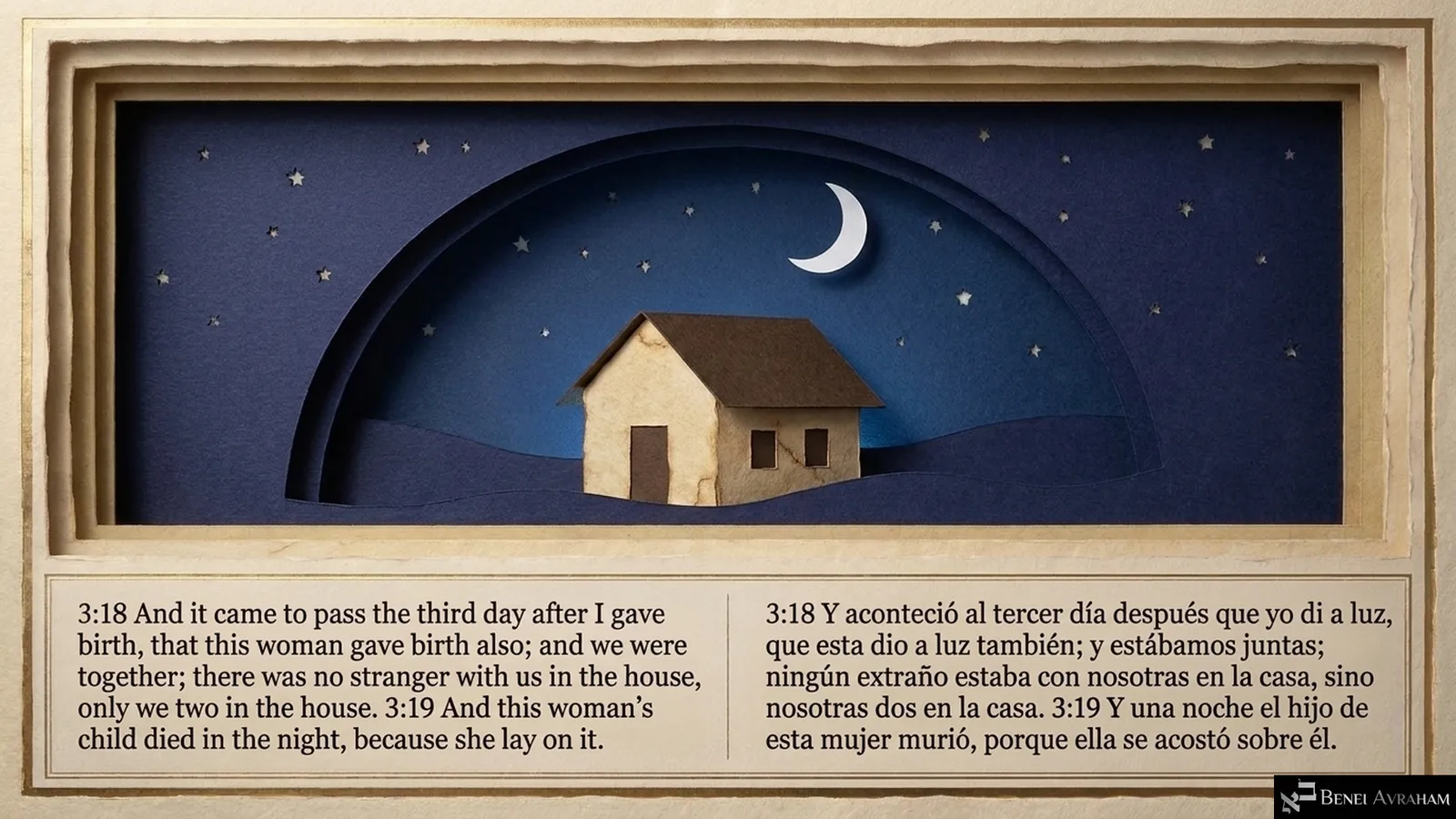
A small paper house alone under a crescent moon and stars: the other woman gave birth also, and this woman’s child died in the night, because she lay on it (1 Kings 3:18–19).
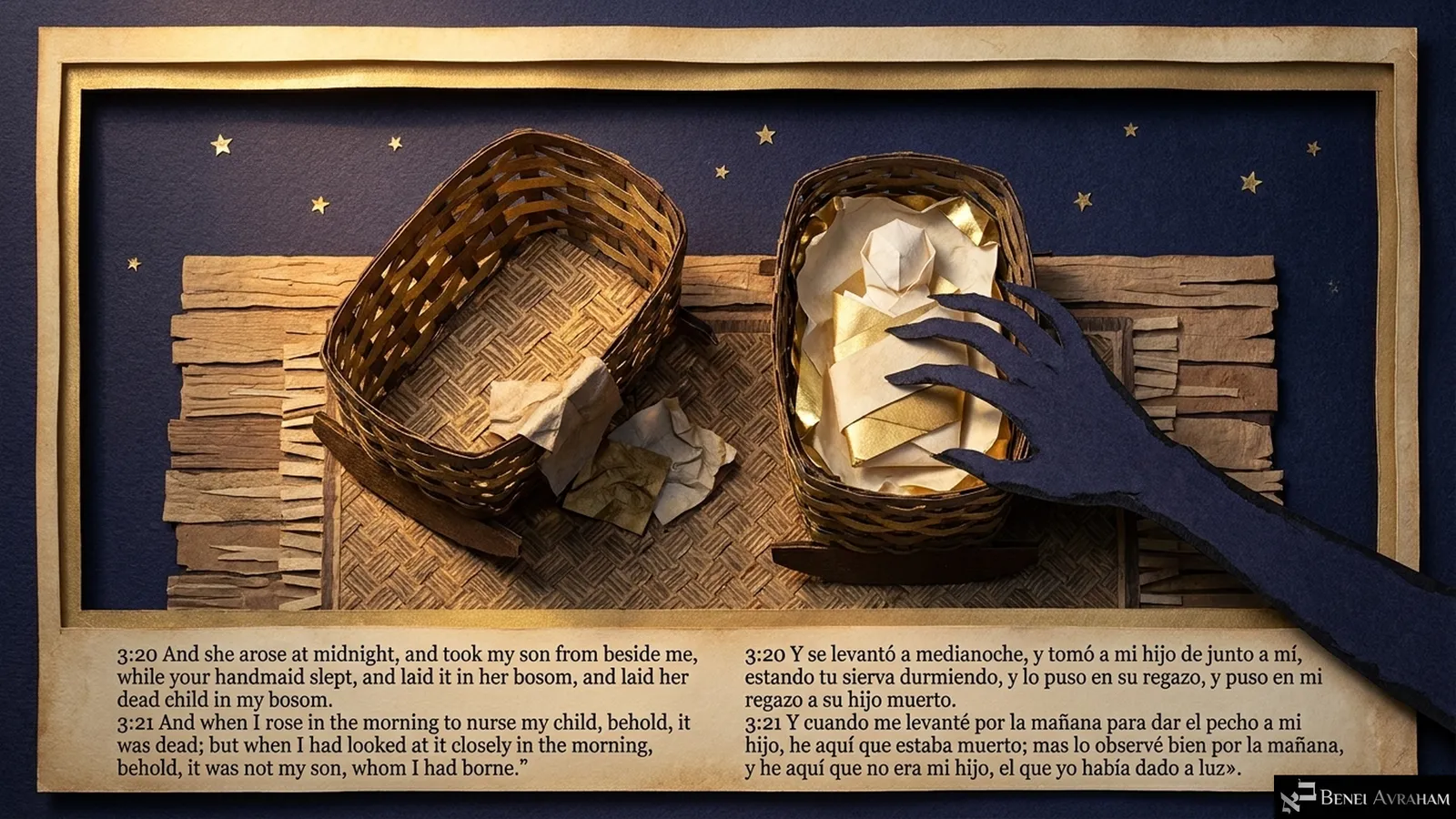
Two woven cradles under the stars, one empty, as a dark paper hand reaches into the other: she arose at midnight and took my son from beside me, and laid her dead child in my bosom (1 Kings 3:20–21).
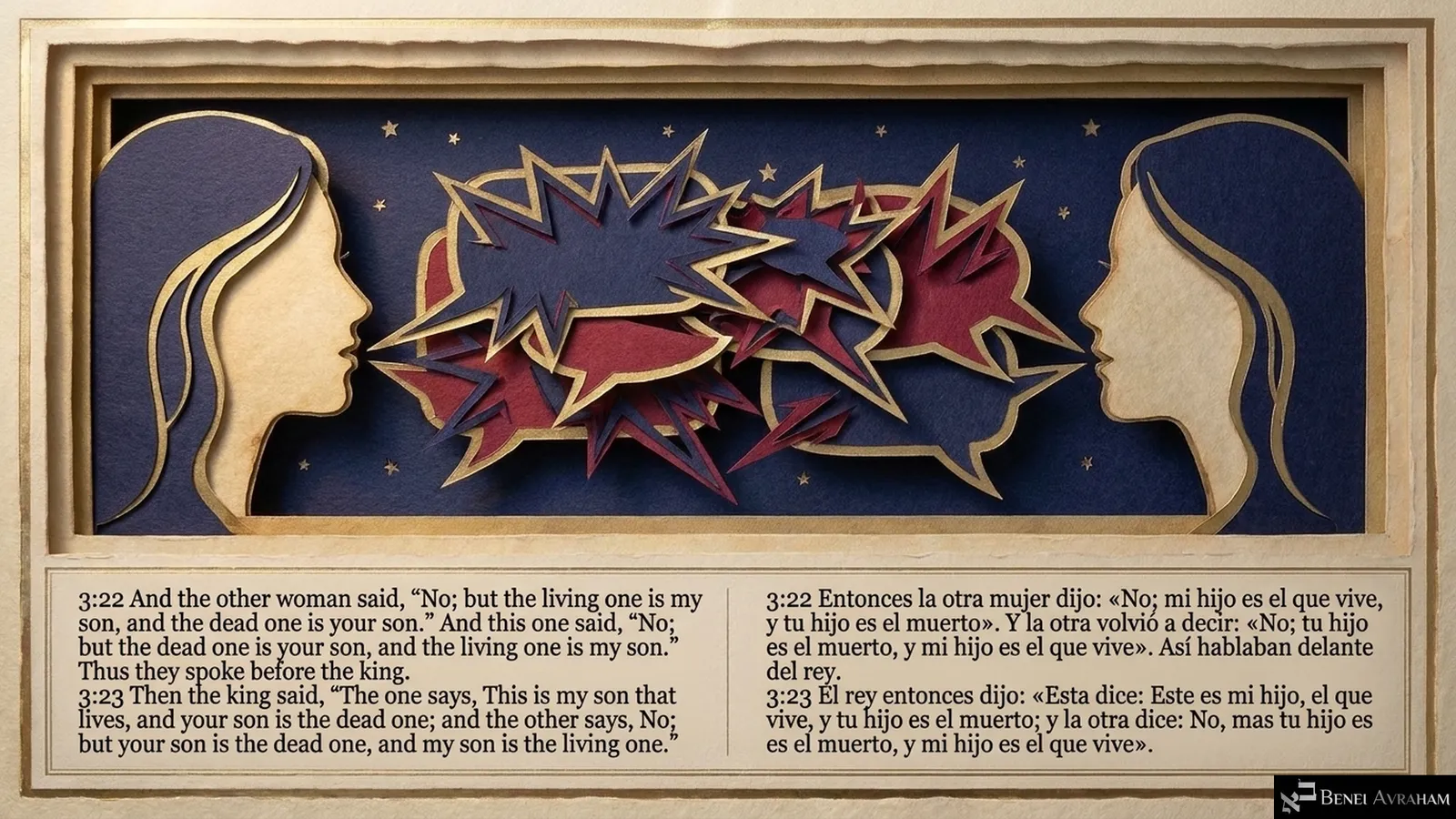
Two women face each other in profile as jagged speech bubbles clash between them: “No; but the living one is my son, and the dead one is your son” (1 Kings 3:22–23).
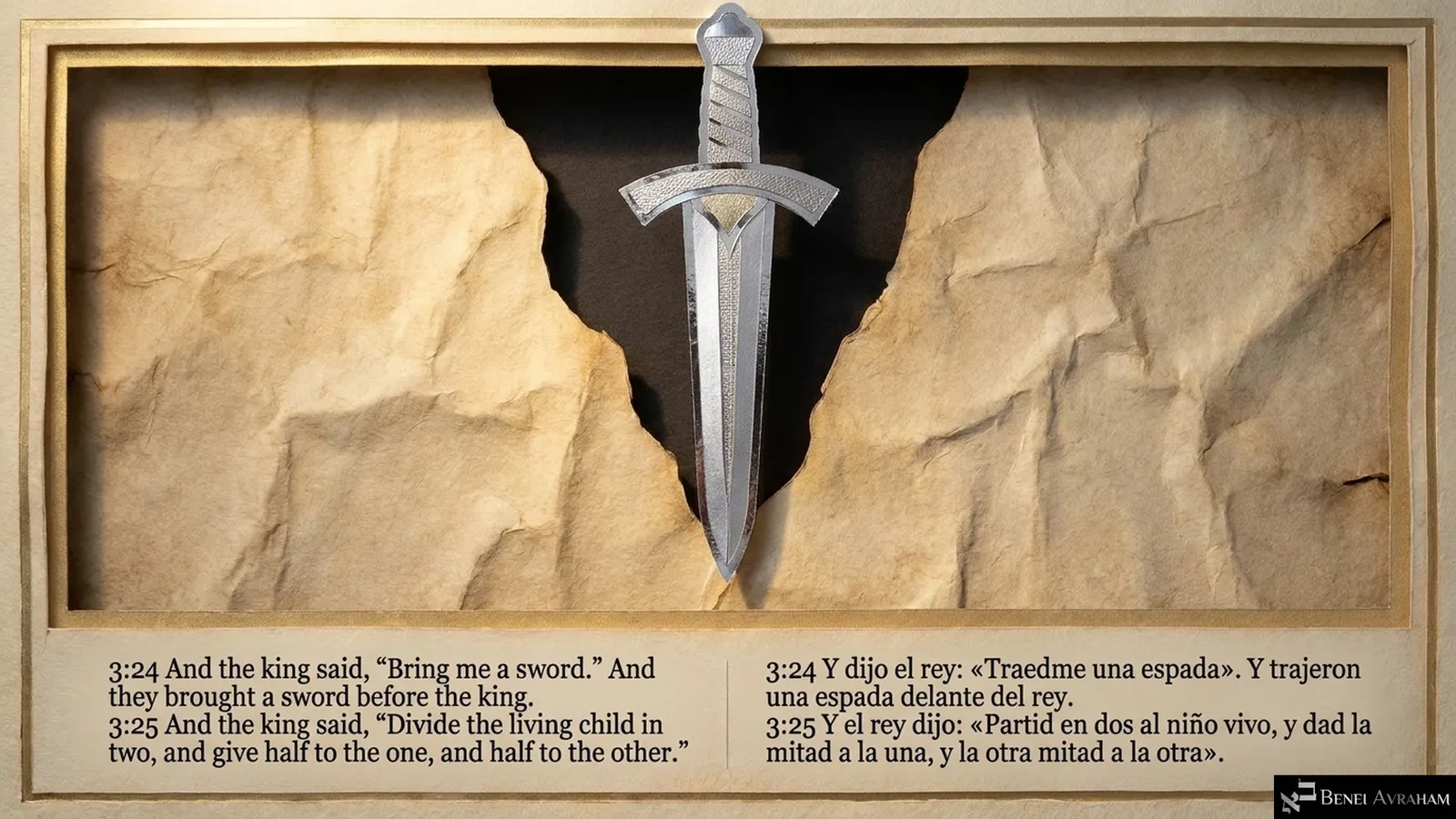
A silver sword hangs in a tear through crumpled paper: “Bring me a sword … Divide the living child in two, and give half to the one, and half to the other” (1 Kings 3:24–25).
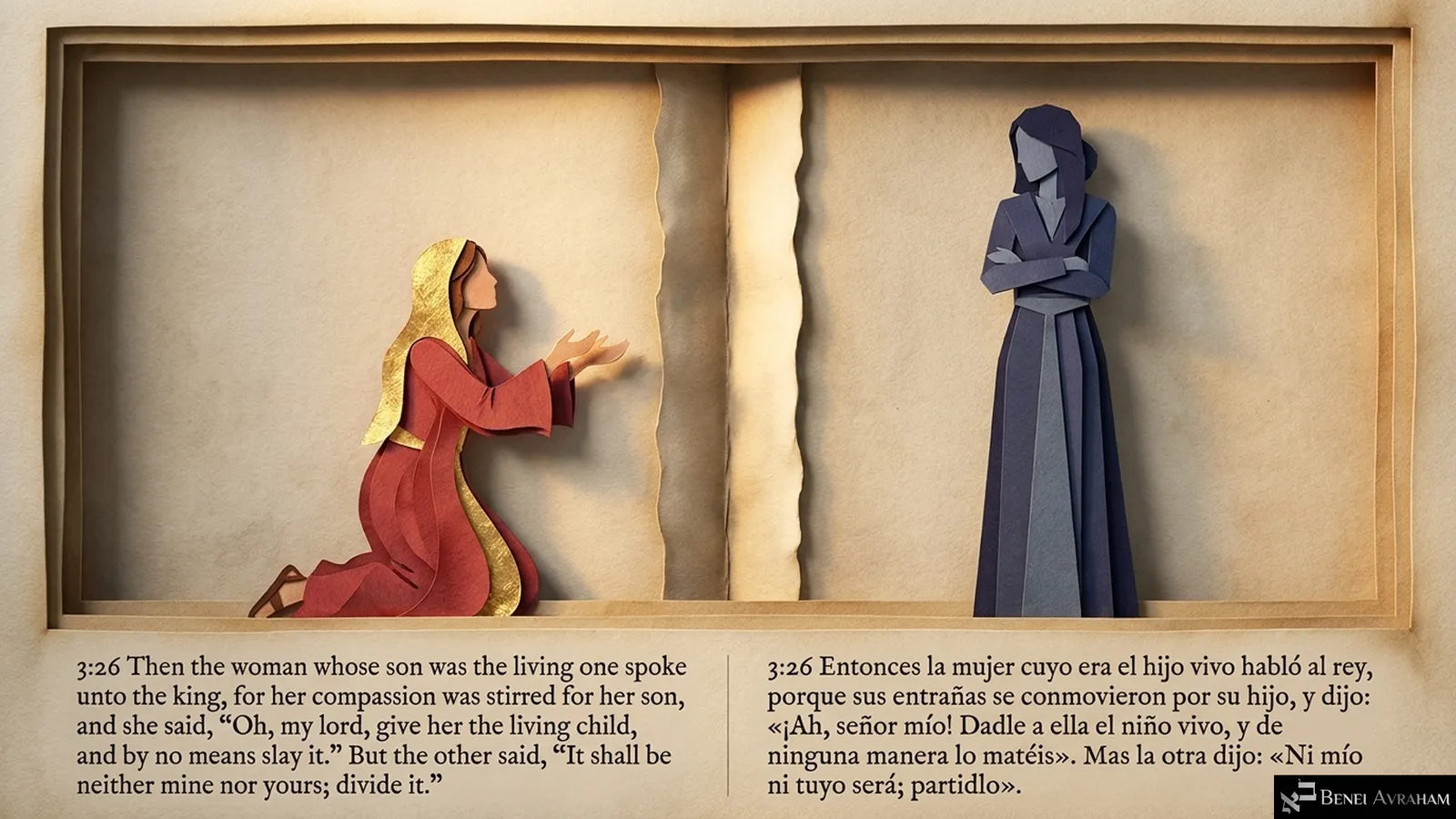
One woman kneels with open hands while the other stands with folded arms: “Oh, my lord, give her the living child, and by no means slay it.” But the other said, “It shall be neither mine nor yours; divide it” (1 Kings 3:26).
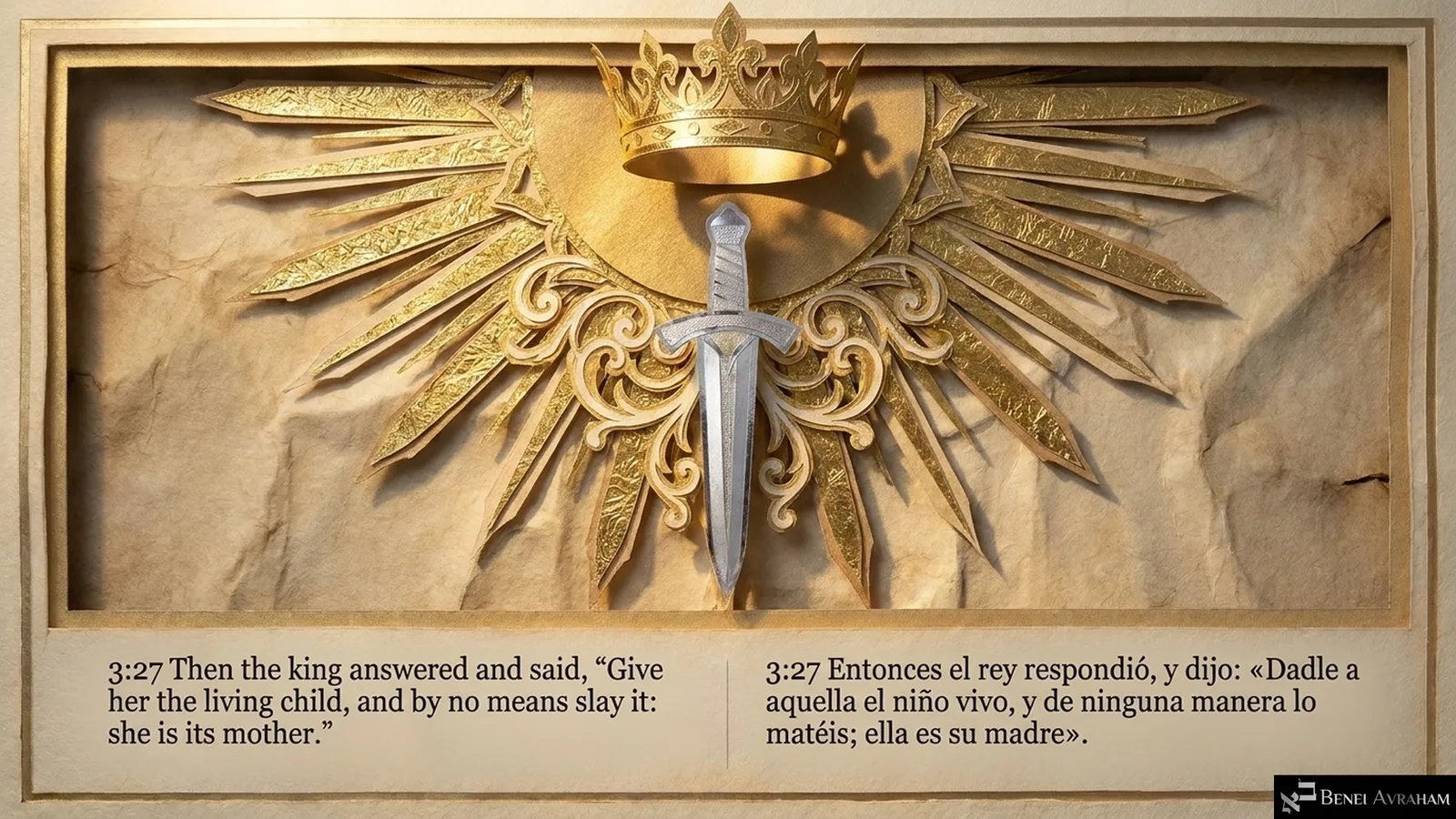
A golden crown and a silver sword over a burst of golden rays: “Give her the living child, and by no means slay it: she is its mother” (1 Kings 3:27).
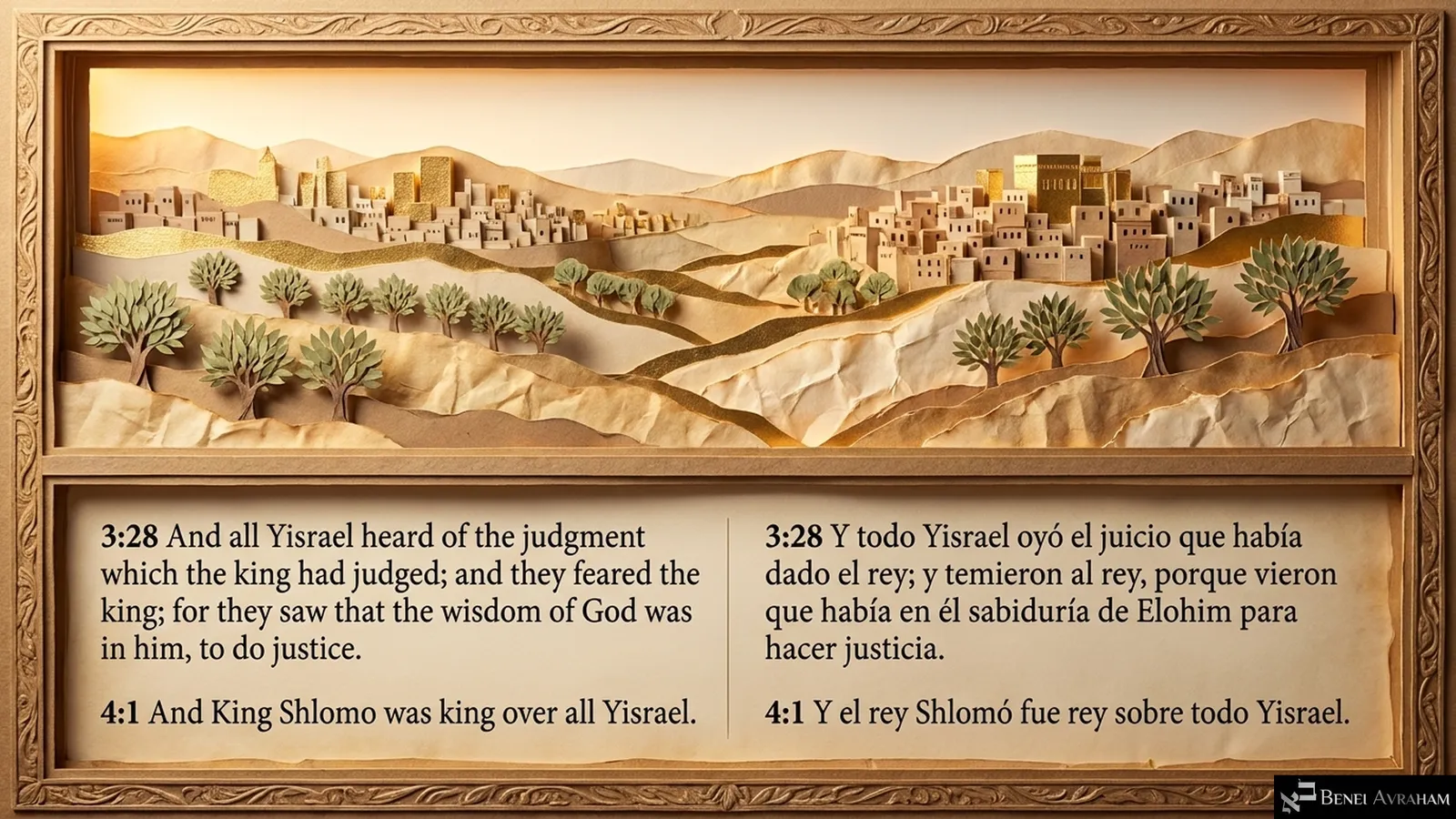
A paper landscape of olive trees and a golden city on the hills: all Yisrael heard of the judgment and saw that the wisdom of God was in him, and King Shlomo was king over all Yisrael (1 Kings 3:28–4:1).